











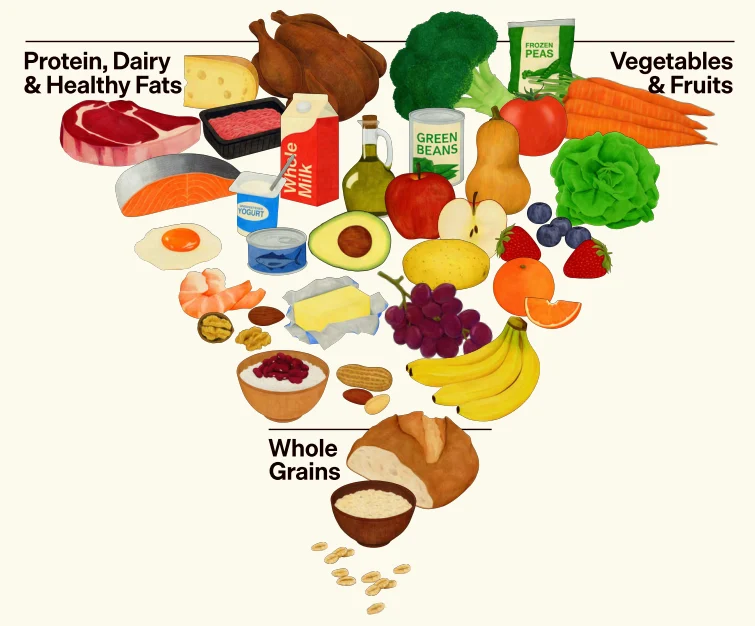
The release of the 2025–2030 Dietary Guidelines for Americans (DGAs) was met with immediate, polarized scrutiny from the public health community. While the federal government’s updated guidance carries the optimistic tagline "Eat Real Food"—a clear nod toward curbing the intake of ultra-processed items—the underlying messaging has ignited a firestorm of controversy. Critics argue that the guidelines present a fundamental contradiction: a written text that warns against saturated fat while providing a visual "New Food Pyramid" that elevates red meat, butter, and full-fat dairy to center stage.
For the average American, navigating these conflicting signals is more than just a matter of dietary preference; it is a question of cardiovascular health, metabolic longevity, and the ability to distinguish evidence-based nutrition from industry-influenced marketing.
Main Facts: The New Federal Framework
The 2025–2030 DGAs represent a departure from previous iterations in both tone and structure. Aiming to be more "consumer-friendly," the document is shorter, more interactive, and heavily reliant on new visual aids.
The core recommendations remain anchored in a long-standing scientific consensus:
- A "Real Food" Focus: The guidelines formally flag "highly processed foods" for the first time, recommending the avoidance of sugar-sweetened beverages and refined, salty, or sweet snacks.
- Added Sugar Restrictions: The DGAs take a hardline stance, stating that "no amount of added sugars or non-nutritive sweeteners is considered part of a healthy diet." The guidelines now recommend that children avoid added sugars entirely until age 10, a significant shift from the previous threshold of age 2.
- Saturated Fat Limits: Despite the visual prominence of animal fats in the new pyramid, the written text maintains the established limit: saturated fat should not exceed 10% of total daily calories.
However, the "New Food Pyramid" has drawn widespread criticism. By inverting the traditional model and placing steak, cheese, and butter in positions of visual prominence, the government has created a dissonance that experts fear will lead to confusion—and potentially, a measurable increase in cardiovascular risk across the population.
A Chronology of Controversy
The journey to the 2025–2030 guidelines was anything but standard. Traditionally, the process begins with the Dietary Guidelines Advisory Committee (DGAC), an independent body of experts who synthesize the latest nutrition science. Their report is intended to serve as the evidence-based foundation for the final government guidelines.
- Evidence Synthesis (2023–2024): The DGAC conducted a rigorous, two-year review of existing nutrition research, aiming to provide an objective look at health outcomes.
- Rejection of the Report: In a move that surprised many observers, the current administration ultimately rejected the Advisory Committee’s primary report.
- The Supplemental Analysis: To fill the void, the government commissioned a "supplemental scientific analysis" conducted by a group selected through a federal contracting process.
- The Launch (January 2026): The finalized guidelines were released, incorporating the supplemental analysis. This version lacked the transparency and procedural rigor that had characterized previous editions.
Deirdre Tobias, an assistant professor in the Department of Nutrition at Harvard and a former member of the 2025–2030 DGAC, noted that the methodology behind these new guidelines remains opaque. "There is no transparency in the methodology and rigor that was employed," Tobias stated. "The reviews deviate significantly from the rigorous process that the HHS developed to ensure conclusions were replicable and free from non-scientific influences."
Supporting Data and the "Saturated Fat Math"
The gap between the written guidelines and the visual pyramid is best illustrated by the "saturated fat math." For a standard 2,000-calorie diet, a 10% limit equates to roughly 22 grams of saturated fat per day.
When the guidelines recommend three servings of dairy daily, the math becomes perilous. If a consumer follows the "full-fat" suggestions implied by the new pyramid:
- 8 oz of whole milk: 5 grams of saturated fat.
- ¾ cup of full-fat Greek yogurt: 6 grams of saturated fat.
- 1 oz of cheddar cheese: 6 grams of saturated fat.
This totals 17 grams of saturated fat—nearly 80% of the daily limit—from dairy alone. Adding a single tablespoon of butter (7 grams) or beef tallow (6 grams) immediately pushes the consumer over the 22-gram threshold before they have even accounted for other protein sources or cooking oils.
Dr. Frank Hu, chair of the Department of Nutrition at the Harvard T.H. Chan School of Public Health, warns that this lack of nuance is dangerous. "The mixed messages surrounding saturated-fat-rich foods such as red meat, butter, and beef tallow may lead to confusion and potentially higher intake of saturated fat, leading to increased LDL cholesterol and cardiovascular risk," Dr. Hu explained.
Furthermore, while the pyramid does feature olive oil, it does so alongside other fats without providing the necessary context regarding essential fatty acids. Experts point out that while olive oil is a superior choice, it lacks the specific essential fatty acids (like alpha-linolenic acid) found in higher concentrations in soybean or canola oils. When the guidelines fail to distinguish between the health impacts of various fats, the public is left without the tools to make heart-healthy substitutions.
Official Responses and Industry Ties
The lack of clarity in the guidelines has been compounded by revelations regarding the contributors. Investigative reporting has highlighted that several reviewers involved in the supplemental analysis have disclosed financial ties to the beef and dairy industries.
While these disclosures are technically within legal parameters, the optics have been devastating for the credibility of the document. When the very industry groups that stand to profit from higher consumption of red meat and dairy are involved in the peer-review process of the national dietary standards, the appearance of a conflict of interest becomes unavoidable.
The government has maintained that the supplemental document was evaluated "based solely on scientific rigor." However, the scientific community remains unconvinced. The departure from the original DGAC’s recommendations—which were far more cautious regarding animal products—suggests that economic and political pressures may have superseded the current state of nutritional science.
Implications for Public Health
The implications of these mixed messages are profound. If Americans adopt the visual cues of the new pyramid—prioritizing meat and full-fat dairy—without adhering to the strict, often buried, text regarding saturated fat limits, the country may see a regression in heart health metrics.
1. The Protein Confusion
The new guidelines raise the suggested daily protein intake to 1.2–1.6 grams per kilogram of body weight. This is a 50–100% increase over previous minimums. However, the guidelines fail to emphasize the "protein package." Protein does not exist in isolation; it comes with fats, sodium, and fiber. By encouraging higher protein consumption without distinguishing between lean plant-based sources and high-saturated-fat animal sources, the guidelines risk promoting diets that, while high in protein, are also high in the very saturated fats they ostensibly warn against.
2. Environmental and Socioeconomic Neglect
Critics have also pointed out that the 2025–2030 DGAs continue to ignore the environmental impact of food production. As the global scientific consensus moves toward "planetary health diets," the U.S. government’s silence on the ecological footprint of meat-heavy diets is a glaring omission. Furthermore, by failing to account for the socioeconomic barriers that prevent many Americans from accessing fresh produce, the guidelines risk becoming a set of recommendations that are inaccessible to the populations who need them most.
3. A Call for Individual Agency
Given the lack of clarity in the federal guidelines, nutrition experts are doubling down on the importance of independent, evidence-based resources. The Harvard Healthy Eating Plate, for example, remains a consistent, non-conflicted alternative to the federal pyramid.
The "bottom line" for consumers is that the 2025–2030 DGAs, while well-intentioned in their stance against added sugars and ultra-processed foods, are fundamentally compromised by their visual and contradictory messaging regarding animal fats. For the individual navigating these waters, the best path forward is to look beyond the colorful infographics and prioritize whole, plant-based foods, lean proteins, and unsaturated fats—regardless of what the latest government pyramid suggests.
As Dr. Hu and other experts conclude, the failure of the current administration to provide a transparent, science-first set of guidelines places the burden of proof—and the responsibility for health—firmly back on the consumer. In an era where "eat real food" is the tagline, it is more important than ever for citizens to understand exactly what that means, and perhaps more importantly, what the government’s own guidelines are leaving out.