








Reviewed by Brian St. Pierre, MS, RD
In the landscape of health and fitness, few developments have caused as much existential hand-wringing among professionals as the mass adoption of GLP-1 receptor agonists. When medications like semaglutide (Ozempic) first surged into the public consciousness around 2017, they were often dismissed by fitness coaches as a temporary trend or a “cheating” shortcut. The prevailing sentiment was defensive: “Is this drug going to steal my job?”
Fast forward to 2026, and the theoretical threat has become an undeniable reality. Data indicates that over 1 in 10 US adults are now utilizing GLP-1 medications. The stigma that once shrouded these prescriptions has begun to erode, replaced by a nuanced understanding that these drugs are not a replacement for coaching, but rather a powerful, albeit complex, variable in the health equation. Today, the most effective coaches are shifting their focus: they aren’t competing with the medication—they are supporting the people who take it.
The Evolution of a Paradigm: From Threat to Tool
The history of GLP-1s in the fitness industry has been a rapid evolution. Initially, the fear of "pharmacological competition" was rooted in the assumption that if a drug handles appetite, the coach becomes redundant. However, as thousands of clients began reporting secondary struggles—such as extreme fatigue, loss of muscle mass, and psychological distress—it became clear that these medications provide the conditions for weight loss, but they do not provide the habits for sustainable health.
As Kate Solovieva, Director of Community at Precision Nutrition, astutely notes: "As a coach, you’re not in the GLP-1 world; you’re in the GLP-1 support world." This realization has transformed the industry. The market is no longer defined by "people on GLP-1s," but rather by "people on GLP-1s who want support." Coaches who can navigate this intersection are finding that their services are more vital now than ever before.
Mapping the 7 Types of GLP-1 Clients
Readiness for coaching is dynamic, not fixed. A client who feels autonomous today may find themselves overwhelmed tomorrow. By analyzing over 175,000 client interactions, we have identified seven distinct archetypes, each requiring a tailored coaching strategy.
1. The Honeymooner (Low Readiness)
This client is in the "golden phase" of their medication—seeing rapid weight loss with minimal side effects. They feel they have "solved" their weight struggles without effort.
- Coaching Move: Resist the "righting reflex." Do not lecture them on future risks. Instead, build rapport, celebrate their current success, and position yourself as a resource for when the honeymoon eventually ends.
2. The Ambivalent Candidate (Low-to-Moderate Readiness)
These individuals are on the precipice, often frozen by the moral weight of taking medication. They grapple with questions of "weakness" or "giving up."
- Coaching Move: Avoid medical advice. Use tools like the "4 Crazy Questions" to help them explore the risks of both starting and not starting, allowing them to make an informed, value-based decision.
3. The Ready-to-Quitter (Moderate Readiness)
The medication is working for weight loss, but the side effects—nausea, vomiting, and fatigue—are becoming unbearable.
- Coaching Move: Depersonalize the experience. Explain that side effects are common and often linked to dosing or nutritional timing. Encourage them to consult their doctor about potential dose adjustments while you guide them through gentle nutritional experiments.
4. The Muscle-Loss Risk (Moderate Readiness)
The scale is moving, but the body composition is shifting in an unhealthy direction. This client is often sedentary and under-fueling.
- Coaching Move: Use objective data. Suggest a DEXA scan to show them what is happening under the surface. Once they see the muscle loss, the "why" behind resistance training and protein intake becomes immediate and personal.
5. The Under-Fueler (Moderate-to-High Readiness)
The medication has suppressed their appetite so effectively that they are dangerously under-consuming calories, often without realizing it.

- Coaching Move: This requires a structured approach. If there is a history of disordered eating, refer to a specialist. Otherwise, introduce an "eating schedule" where meals are treated as essential health maintenance, similar to brushing teeth or sleeping.
6. The Graduate (High Readiness)
These clients have reached their goal and are choosing to taper off. They feel vulnerable and fear the "rebound."
- Coaching Move: Focus on the "long-term ruts." Reinforce the habits they built while on the medication, ensuring those neural pathways are deep enough to sustain them once the medication’s chemical assistance is removed.
7. The Priced-Out (High Readiness)
These individuals were seeing success but are forced to stop due to insurance or financial constraints.
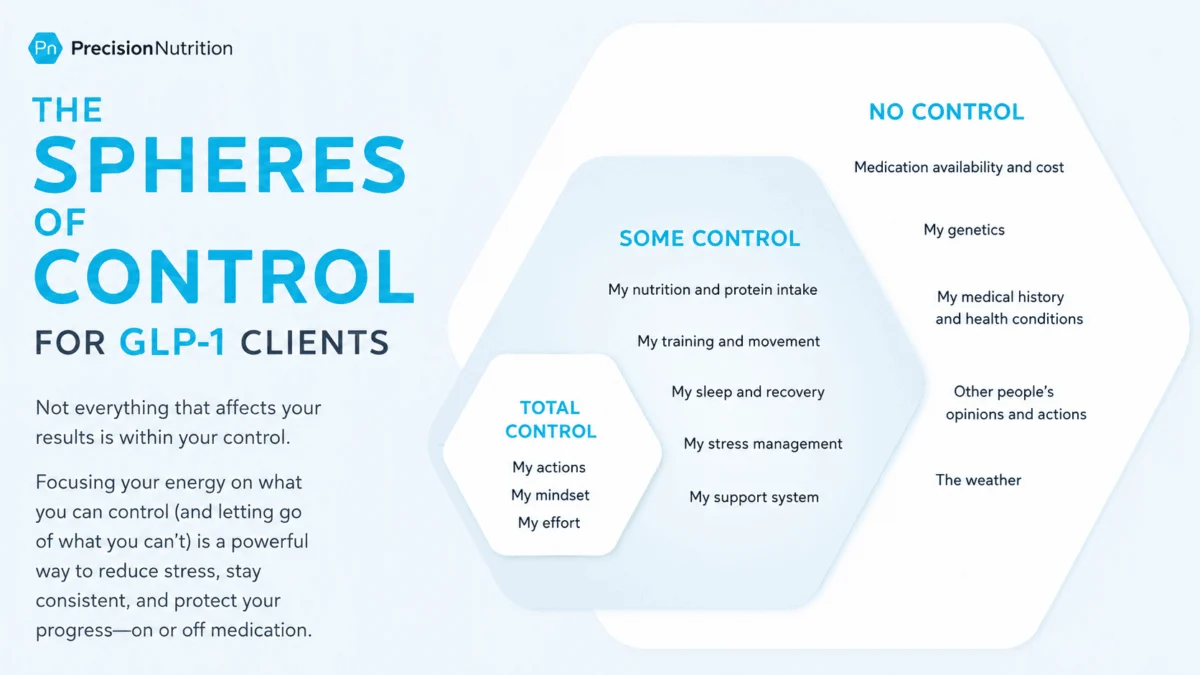
- Coaching Move: Validate their frustration. This is a systemic failure, not a personal one. Use the "Spheres of Control" exercise to move them away from the anger of what they cannot change and toward the habits they can control.
Supporting Data: Why Habits Matter
The clinical data is stark: people who change nothing while on GLP-1s almost universally regain the weight once they stop. However, those who integrate robust resistance training and high-protein nutritional habits are four times more likely to maintain a 10 percent or higher weight loss after cessation.
This is the central implication for the fitness industry: The drug provides the window of opportunity, but the coach provides the architecture for the life that follows.
The "Oregon Trail" Analogy
Coach Toni Bauer offers a powerful metaphor for this process: the Oregon Trail. The deep ruts in the earth were formed by wagons passing over the same ground repeatedly. Habits work the same way. When a client is on a GLP-1, they are in a unique, accelerated environment. If a coach uses this time to help the client "drive over the same path" repeatedly—consistent protein intake, consistent strength training, consistent sleep—those ruts become permanent. Even when the "wagon" (the medication) is removed, the path remains.
Implications for the Future of Coaching
The role of the professional coach is shifting from a purveyor of "weight loss secrets" to an architect of identity. The successful coach of 2026 and beyond is someone who can help a client define themselves not by the medication they take, but by the actions they perform.
- *I am the person who eats protein at every meal.
- *I am the person who does resistance training because I want to age well.
- *I am the person who prioritizes sleep as a fundamental health pillar.
When these identities take root, the medication becomes a temporary tool, but the lifestyle becomes a permanent foundation.
Final Word to Coaches
The fear that GLP-1s would replace the fitness coach was based on a misunderstanding of what a coach actually provides. A pill can suppress an appetite, but it cannot teach someone how to navigate a stressful workday, how to prioritize recovery, or how to build a lasting identity as an active, healthy human being.
Whether your client is on a GLP-1 for a month or a lifetime, their need for support is not disappearing—it is becoming more specialized. By embracing the role of a support partner, you aren’t just protecting your business; you are participating in a fundamental shift in how the world approaches metabolic health.
If you are ready to pivot your practice to meet the needs of the modern client, the time to build your toolkit is now. Whether it’s learning the nuances of nutrition coaching or mastering the art of motivational interviewing, the most successful coaches will be those who refuse to be replaced by a drug, and instead, choose to be an essential part of the user’s success story.