For decades, dietary advice has frequently lumped "nitrates" and "nitrites" into a single, nebulous category of concern. Often discussed in the same breath as health warnings against processed meats, these compounds have long been subjects of intense nutritional scrutiny. However, a landmark study from the Karolinska Institutet has provided a much-needed layer of precision to this conversation. By tracking over 82,000 individuals over two decades, researchers have drawn a sharp line between the two, suggesting that while the source of these compounds matters, the risk profile for processed meats remains a significant public health concern—particularly for men.
The Karolinska Study: A Deep Dive into Long-Term Data
The study, which utilized data from two long-running Swedish cohorts, offers one of the most robust examinations of dietary nitrate and nitrite intake to date. Researchers followed 82,009 middle-aged and older adults, linking their detailed food and water consumption habits to national cancer registries spanning from 1998 through 2022.
Over the 24-year follow-up period, 3,170 participants developed colorectal cancer. The results were telling: while dietary nitrate intake—found primarily in vegetables—showed no association with an increased risk of colorectal cancer, the same could not be said for nitrites. Men in the highest quintile of nitrite intake experienced a 23% higher risk of developing the disease compared to those in the lowest quintile. Notably, this risk was concentrated in the distal colon, the section of the large intestine closest to the rectum. This localized concentration points toward a specific, direct exposure effect, mirroring previous findings that link heavy processed meat consumption to localized gastrointestinal malignancies.
The Chemistry of Consumption: Why Context Matters
To understand why nitrites pose a risk while nitrates appear benign, one must look at the biochemical "neighborhood" in which these compounds exist.
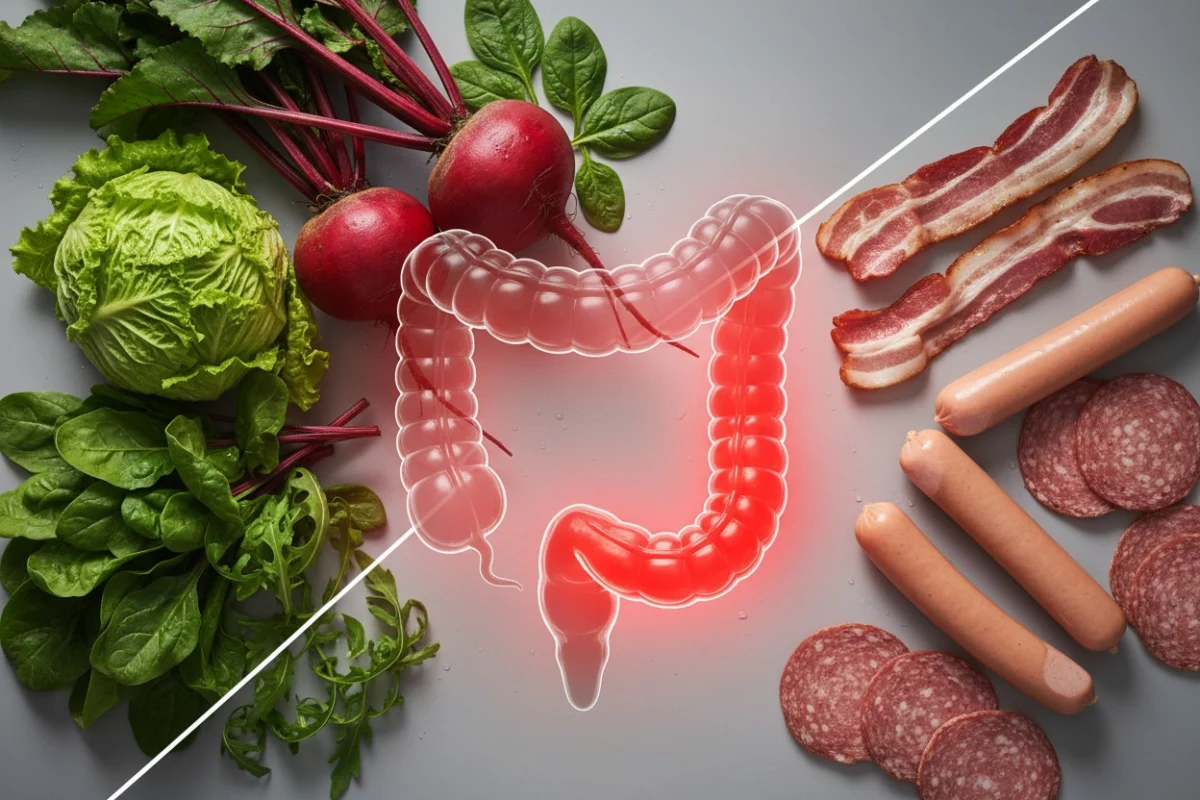
Nitrates occur naturally in soil and are absorbed by plants. Consequently, leafy greens like spinach, arugula, and beets are naturally rich in nitrates. However, these vegetables arrive at the dinner table in a "protective bundle." They are packed with vitamin C, polyphenols, and fiber. In the human gut, these accompanying nutrients act as a chemical shield, effectively blocking the conversion of nitrites into N-nitroso compounds—the dangerous, carcinogenic byproducts that damage DNA and promote tumor growth.
Nitrites, conversely, are typically introduced to the human diet as industrial additives. Used extensively in the processed meat industry, sodium nitrite serves a dual purpose: it prevents the growth of Clostridium botulinum (the bacteria that causes botulism) and maintains the vibrant, pinkish-red hue consumers associate with "fresh" bacon, hot dogs, and deli meats. Because processed meats lack the protective antioxidants found in vegetables, the nitrite additives are free to react with amino acids during digestion to form carcinogenic nitrosamines. This distinction explains why the body’s internal conversion of some dietary nitrate into nitrite does not pose the same threat as the exogenous, additive-heavy intake found in a processed meat diet.
Chronology of a Public Health Concern
The debate surrounding processed meats is not new, but it has gained significant momentum over the last quarter-century.
- 1998–2010: Early observational studies began to note a correlation between high-meat diets and colon cancer, though the exact chemical culprit remained debated.
- 2015: The International Agency for Research on Cancer (IARC), a branch of the World Health Organization, formally classified processed meats as a "Group 1" carcinogen. This classification was based on robust evidence that consuming just 50 grams of processed meat daily—roughly the size of a few slices of bacon—increases the risk of colorectal cancer by approximately 18%.
- 2018–2020: Toxicology research further solidified the link between dietary nitrosamines and tumor induction in multiple organs, including the bladder.
- 2022–2026: The Karolinska Institutet study concluded its multi-decade tracking, providing the most granular look at the sex-based and anatomical differences in risk, finally separating the "good" nitrates of the garden from the "bad" nitrites of the deli counter.
The Gender Disparity: A Question of Biology or Behavior?
One of the most intriguing findings of the Karolinska study was the sex-based disparity. While men showed a clear, statistically significant 23% increase in colorectal cancer risk associated with nitrite intake, women did not show the same pattern.
Researchers have proposed several hypotheses for this divergence. First, there are significant differences in the average consumption patterns of processed meat between men and women in the Swedish cohorts. Historically, men have tended to consume higher quantities of red and processed meats, potentially reaching a "threshold of toxicity" that women in the study did not cross.
Second, hormonal factors may play a protective role in women. Estrogen and other sex hormones can influence how the gut microbiome functions and how the body metabolizes N-nitroso compounds. Finally, statistical power—the ability of the study to detect an effect—may be at play. If the total number of female participants with high-nitrite intake was lower or if their risk factors were more varied, the data might not capture the same trend seen in men. Regardless of the underlying mechanism, the researchers stress that the "practical takeaway" remains the same: reducing intake of nitrite-heavy meats is a universal health recommendation that does not require waiting for a definitive biological explanation.
Implications for the Modern Plate
For the average consumer, these findings offer both a warning and a path forward. The primary implication is the need to view processed meats as an occasional indulgence rather than a daily staple.
The prevalence of nitrite-based curing salts is staggering. Beyond the classic culprits—bacon, hot dogs, and pepperoni—nitrites are frequently found in canned meats and even some "plant-based" deli alternatives, which use these additives to mimic the color and shelf stability of traditional meats.
Strategies for Risk Mitigation:
- Prioritize Freshness: Shift the dietary focus toward nitrate-rich whole foods. The study confirms that spinach, beets, and lettuce are not just safe—they are cornerstones of a healthy diet.
- The Vitamin C "Shield": If you choose to consume processed meats, pairing them with foods high in vitamin C (such as a side of citrus or peppers) may help neutralize the nitrosation reaction in the gut, acting as a chemical blockade against carcinogen formation.
- Read the Label: Consumers should look for "nitrite-free" or "uncured" labels. It is important to note, however, that "uncured" often means the product has been treated with celery juice or other natural sources of nitrates; while these are considered a "cleaner" label, they still undergo chemical conversion into nitrites in the body.
- Frequency Management: The IARC’s threshold of 50 grams per day is a critical benchmark. Scaling back to occasional consumption is the most effective way to lower the lifetime risk of distal colon cancer.
Conclusion: Reframing the Narrative
The Karolinska Institutet study serves as a critical update to our understanding of dietary health. By demonstrating that nitrate-rich vegetables do not carry the same risk profile as nitrite-laden meats, the researchers have effectively "cleared the name" of healthy produce while intensifying the scrutiny on the processed meat industry.
The precision offered by this study—distinguishing between types of nitrogen compounds and pinpointing the anatomical location of risk—provides consumers with a clearer roadmap for health. While the science of why men may be more susceptible to these compounds continues to evolve, the consensus among researchers is clear: the path to reducing colorectal cancer risk involves moving away from the industrial preservation methods of the past and toward a diet centered on whole, unprocessed, and antioxidant-rich foods. As we move forward, the "nitrite nuance" serves as a reminder that in nutrition, the chemical source is just as important as the chemical itself.