









The U.S. government has officially released the 2025–2030 Dietary Guidelines for Americans (DGAs), a cornerstone document intended to shape national nutrition policy, school lunch programs, and public health initiatives. While the new edition adopts the ambitious tagline "Eat Real Food" and takes a firmer stance against the pervasiveness of ultra-processed goods, it has ignited a firestorm of controversy. Critics argue that the guidelines suffer from internal contradictions, particularly regarding the role of saturated fats and the transparency of the scientific process that produced them.
The Evolution of Federal Nutrition Policy
The Dietary Guidelines for Americans are updated every five years by the U.S. Departments of Agriculture (USDA) and Health and Human Services (HHS). These guidelines serve as the bedrock for federal programs that feed millions of Americans. Historically, the process involves an independent Dietary Guidelines Advisory Committee (DGAC)—a panel of experts who synthesize the latest nutritional science to provide recommendations.
However, the 2025–2030 cycle deviated significantly from this precedent. Following a decision by the current administration to reject the independent committee’s primary report, a supplemental scientific analysis was conducted via a federal contracting process. This pivot has raised red flags among public health experts, who fear that the lack of transparency in the selection of these new reviewers—and their documented financial ties to the beef and dairy industries—has compromised the integrity of the final output.
Visual Paradoxes: The Return of the Pyramid
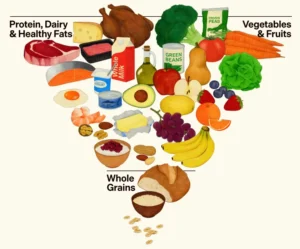
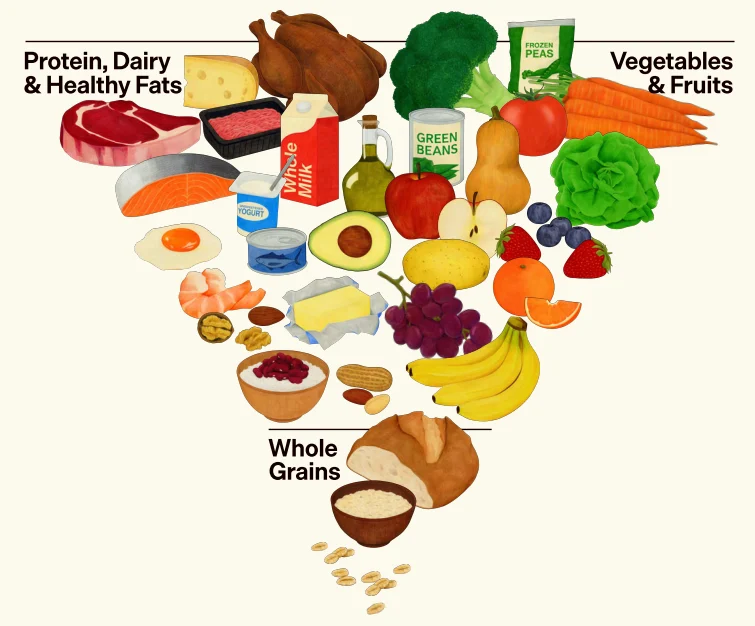
Perhaps the most striking feature of the new guidelines is the return of a pyramid-style graphic. Unlike the iconic, broad-based pyramids of the past, this iteration is flipped on its head. While it encourages the consumption of fruits and vegetables, it simultaneously elevates animal products—including steak, butter, and full-fat dairy—to a position of visual prominence.
This graphic creates a jarring disconnect with the text of the guidelines themselves. While the written policy retains the long-standing scientific consensus that saturated fat intake should be capped at 10% of total daily calories, the visual imagery suggests a dietary pattern that would make staying within that limit nearly impossible for the average American.
Unpacking the Key Policy Shifts
Despite the controversy, the new guidelines do contain several forward-thinking recommendations that align with modern nutritional science.
A Call to Action Against Highly Processed Foods
For the first time, the DGAs explicitly target the broad category of "highly processed foods." While nutritionists acknowledge that "processing" is a spectrum—ranging from minimally processed frozen vegetables to hyper-processed snack cakes—the guidelines provide clearer warnings against sugar-sweetened beverages and nutrient-poor, shelf-stable snacks. The advice on grains is equally specific, pushing consumers toward fiber-rich, whole-grain options while discouraging refined, bleached-flour alternatives.
The War on Added Sugars
The 2025–2030 edition takes a hardline approach to sugar, stating that "no amount of added sugars or non-nutritive sweeteners is recommended or considered part of a healthy or nutritious diet." The guidelines introduce a specific, albeit difficult-to-track, limit: no more than 10 grams of added sugar per meal. Furthermore, the guidelines now recommend that children avoid added sugars entirely until age 10, a significant shift from the previous threshold of age 2.
Saturated Fat and the Math of Mortality
The most significant point of contention remains the advice on healthy fats. Dr. Frank Hu, chair of the Department of Nutrition at the Harvard T.H. Chan School of Public Health, warns that the mixed messaging regarding red meat and butter could have dire consequences.
"The mixed messages surrounding saturated-fat-rich foods may lead to confusion and potentially higher intake of saturated fat," Dr. Hu notes. "This is a recipe for increased LDL cholesterol and, by extension, heightened cardiovascular risk."
To illustrate the danger, consider a 2,000-calorie diet, which allows for approximately 22 grams of saturated fat. If an individual follows the DGA’s recommended three daily servings of dairy—opting for full-fat Greek yogurt, whole milk, and cheddar cheese—they have already consumed 17 grams of saturated fat. If they use a tablespoon of butter or beef tallow to cook their dinner, they have already exceeded their daily limit before even accounting for the protein source itself.
The Protein Quantity Hype
The new guidelines suggest an increase in protein intake, recommending 1.2 to 1.6 grams per kilogram of body weight. This is a 50–100% increase over previous minimum recommendations. While protein is essential for muscle maintenance, nutrition experts caution against this "more is better" approach.
"Substantially raising overall protein intake without distinguishing between different protein sources may have unintended long-term health implications," says Dr. Hu. The guidelines fail to emphasize the "protein package"—the reality that when you eat protein, you also consume the accompanying fats, sodium, and fiber. Plant-based proteins and fish remain the gold standard for heart health, yet the current guidelines treat these on par with high-saturated-fat animal sources.
The "Less Alcohol" Ambiguity
On the issue of alcohol, the guidelines offer a vague directive to "consume less alcohol for better health." In previous years, the DGAs provided specific, quantifiable limits. By stripping away these concrete definitions, the new guidelines leave the average consumer without a clear benchmark, making it difficult to translate "less" into actionable behavior.
The Omission of Sustainability
A growing chorus of experts has called for the inclusion of environmental sustainability in dietary guidelines, arguing that the health of the planet is inextricably linked to the health of the population. The 2025–2030 DGAs largely ignore these concerns. By failing to account for the carbon footprint of different food groups or the socioeconomic barriers to accessing fresh, sustainable food, the guidelines miss a vital opportunity to address the systemic challenges of modern nutrition.
Implications for Public Health
The history of the Dietary Guidelines for Americans is one of struggle; statistics consistently show that Americans struggle to adhere to federal advice, even when it is scientifically sound. By introducing conflicting messaging—such as recommending a 10% cap on saturated fat while visually promoting foods that make that cap unattainable—the government risks undermining its own credibility.
Dr. Deirdre Tobias, who served on the 2025–2030 DGAC, has expressed profound concern over the lack of transparency in the final drafting process. "There is no transparency in the methodology and rigor that was employed, or why certain topics were selected to be relitigated," she noted in a recent Q&A. The deviation from the standard HHS evidence-review process suggests that political and industry pressures may have overridden the consensus of the scientific community.
Conclusion: Navigating the Confusion
For the average American, the 2025–2030 guidelines serve as a confusing roadmap. While the push to reduce sugar and processed foods is a welcome step toward better health, the contradictory stance on fats and proteins threatens to reverse progress in cardiovascular health.
When official government advice is muddled, experts suggest turning to more reliable, evidence-based resources. Organizations such as the Harvard T.H. Chan School of Public Health continue to promote their "Healthy Eating Plate" and "Healthy Eating Pyramid," which prioritize unsaturated fats, plant-based proteins, and whole grains. As the public digests these new guidelines, the takeaway remains clear: dietary choices should be driven by robust, transparent science rather than the visual marketing of industry-friendly food groups. If you are struggling to make sense of these new recommendations, consulting a registered dietitian is the most effective way to cut through the noise and create a sustainable, heart-healthy nutrition plan.