







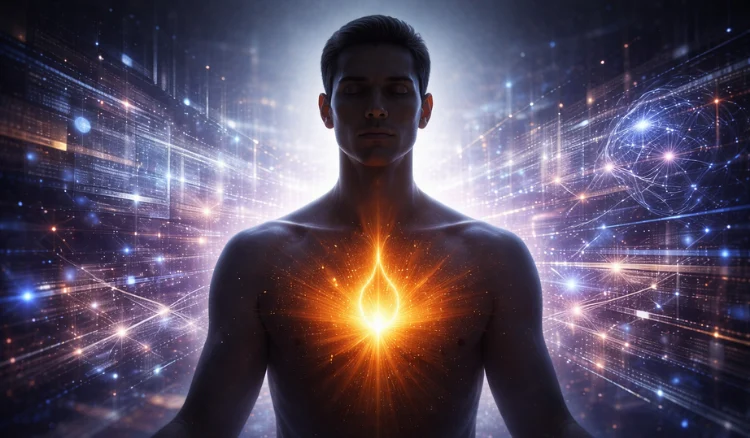
As we move deeper into 2026, the global landscape of healthcare is undergoing a tectonic shift. We find ourselves at an unprecedented crossroads: on one side, we have Artificial Intelligence systems capable of diagnosing complex pathologies in milliseconds, synthesizing massive legal and medical databases, and mimicking the cadence of human speech with uncanny precision. On the other side, we are witnessing a global epidemic of profound loneliness, chronic physiological stress, and a desperate, collective "hunger" for authentic human connection.
For practitioners, students, and seekers, the question is no longer academic—it is existential. Is there still a place for the human healer in a world dominated by algorithms? Will the machine eventually render the clinician obsolete?
To answer this, one must look toward the intersection of ancient wisdom and modern technology. At The Ayurvedic Institute, which has served as the "Gold Standard" of Ayurvedic education in the West for over 40 years under the guidance of Vasant Lad, BAM&S, MASc, the consensus is clear: the AI revolution is not a threat to the healing arts; it is a profound invitation to their evolution.
The Relatable Struggle: From "Doing-Being" to "Human-Being"
For decades, the modern educational and professional framework has demanded that we function like biological machines. We were trained to prioritize linear logic, maximize productivity, and treat the human body as a collection of parts to be repaired. We became "doing-beings," obsessed with throughput and data.
Now, as AI takes over these mechanical, logic-based tasks, the practitioner is being forced to confront a new reality. If you have felt inadequate because you cannot process data as fast as a silicon chip, you are missing the point. The very attributes the modern world attempted to train out of you—intuition, empathy, spiritual resonance, and presence—are now your most valuable assets in the marketplace of 2026. The objective of the future healer is not to become a better computer; it is to become a more profound human.
PART 1: The Concept of Qualia—What Machines Can Never Mirror
Central to this shift is the philosophical concept of Qualia. In the study of consciousness, Qualia refers to the subjective, individual instances of sensory experience. It is the specific, indescribable "redness" of a rose, the warmth of a hand resting on a shoulder, or the intangible shift in a room’s atmosphere when a master healer enters.
An AI can simulate the description of these experiences, but it cannot possess them. This leads to a critical formula for the future of medicine:
Clinical Information (AI) + Human Qualia (You) = True Healing.
If a practitioner offers only information, they are replaceable—a commodity that can be swapped for a cheaper app. However, if a practitioner offers Qualia—the shared resonance of two souls—they become indispensable. This is the cornerstone of the "Heart-Centered" approach.
PART 2: The Three Pillars of Heart-Centered Practice
To thrive in the coming years, practitioners must shift their focus from the Buddhi (Intellect) to the Hridaya (Heart). This integration of clinical mastery and spiritual sovereignty rests upon three fundamental pillars.
Pillar 1: Nervous System Co-Regulation
We are fundamentally biological, social beings. Modern neurobiology confirms what ancient Vedic traditions have known for millennia: the presence of a calm, centered individual can physically regulate the nervous system of another. A machine may provide accurate data, but it cannot offer the biological safety that a human presence provides.
Pillar 2: The Art of Sravana (Deep Listening)
In his seminal works, Dr. Vasant Lad teaches that a practitioner must be a "clear mirror." This is the art of Sravana—deep, undistracted listening. When a practitioner listens with the heart rather than just the ears, they provide the patient with a space to be seen and known. In a world of noise, this depth of presence is the highest form of medicine.
Pillar 3: Spiritual Sovereignty and Faith
As we explore in contemporary health discourse, there is a dimension of human wellness that exists beyond the reach of blood tests and imaging. This is the realm of spirit. Spiritual sovereignty is the recognition that health is not merely the absence of disease, but the alignment of one’s life with a deeper purpose.
PART 3: The "Gold Standard" Framework for 2026
As we evaluate the changing tides of the industry, we must distinguish between the "Technician" and the "Master Healer." By 2026, raw information will be a free, ubiquitous commodity. The premium will be placed entirely on the experience of being held in a sacred, human space.
| Feature | The AI Technician | The Heart-Centered Master |
|---|---|---|
| Primary Tool | Algorithms & Data | Pulse, Presence, & Prana |
| Focus | Symptom Suppression | Root Cause & Soul Purpose |
| Vibe | Accurate but Cold | Grounded, Airy, & Inspiring |
| Result | Temporary Relief | Lasting Transformation |
PART 4: Tackling the Objections
A common fear among students is the belief that they are not "spiritual enough" to lead with the heart. This is a misunderstanding of the term. Spirituality, in this context, is simply radical honesty and presence. If you can sit with a client’s pain without retreating into your own ego, you are practicing high-level spiritual work.
Furthermore, many fear the encroachment of AI on clinical tasks. On the contrary, let AI handle the scheduling, the drug-interaction cross-referencing, and the mundane data entry. This "unshackles" the practitioner, granting them the gift of time—time that can be redirected toward the one thing only a human can offer: undivided attention.
PART 5: Your "Sattva Reset"—A 3-Step Daily Protocol
To maintain clarity (Sattva) and vitality (Ojas) in a high-tech world, practitioners must adhere to a daily protocol of replenishment:
- Digital Sunset: Disconnect from all screens 60 minutes before sleep to reset the circadian rhythm.
- Mindful In-Breath: Practice three minutes of conscious breathing between each client to "clear the mirror" of your own projections.
- Gratitude Anchoring: Identify one aspect of your patient’s human story that moved you, shifting your focus from pathology to humanity.
Implications: A Renaissance of the Heart
The "AI uprising" is not a displacement event; it is a clarification event. It is stripping away the illusion that we are merely biological processors. As we move through 2026, the most successful practices will not be those with the most sophisticated software, but those that function as an oasis of humanity.
At The Ayurvedic Institute, we are not just teaching students to memorize texts; we are forging Ancient Wisdom Keepers. We believe that when knowledge becomes healing, the practitioner ascends to the status of a master. The world is "hungry" for this. It is time to stop acting like a machine and start living like a sage.
What Our Students Say
The impact of this approach is echoed by our community:
- "The Ayurvedic Institute has exceeded my expectations… Dr. Lad and the faculty breathe life into ancient Vedic wisdom," says Ram Dixit (ASP1).
- "I am confident there is no better place to study Ayurveda; the experience here can profoundly change your life," notes Elana Barlev (ASP1).
- "Studying at the Ayurvedic Institute has been nothing short of a magical journey," shares Isabel Zelger (ASP2).
The deck of jobs is being reshuffled, and the most secure path forward is the one that demands you be more kind, more present, and more human. Only human beings can do human-being things. The future of healing belongs to those who choose to lead with the heart.