









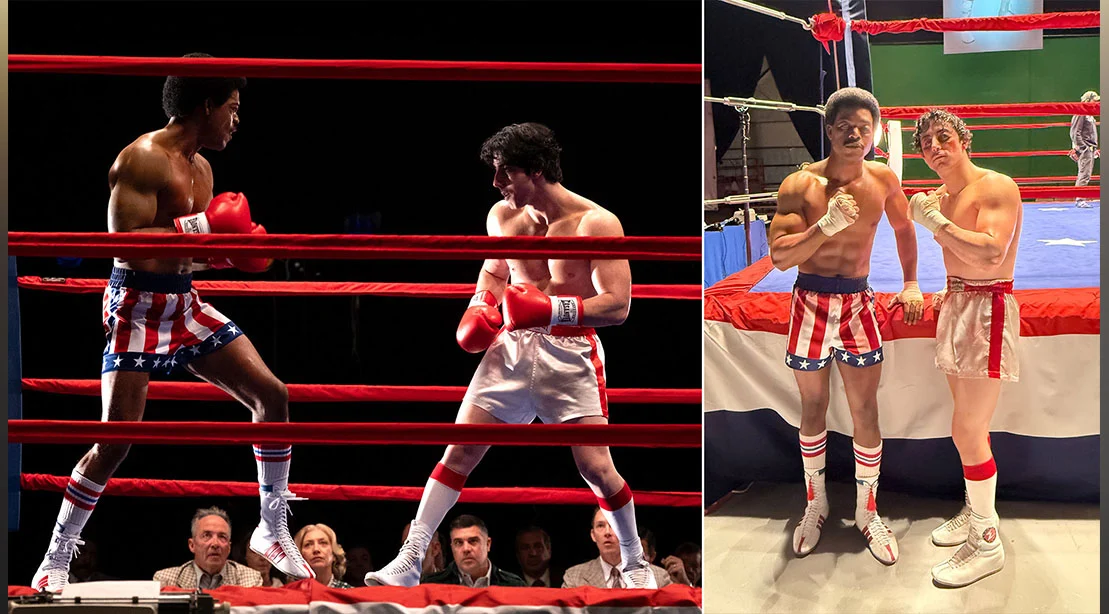
Stephan James is no stranger to the weight of expectation. Having previously inhabited the skin of Olympic icon Jesse Owens in the biographical drama Race, the award-winning actor understands that stepping into the shoes of a real-life legend requires more than just mimicry—it demands a total physical and psychological metamorphosis. However, his latest challenge presented a unique paradox: how does a lead actor portray a titan of screen history like Carl Weathers without simply attempting to bulk up?
In the highly anticipated film I Play Rocky, which chronicles the meteoric and unlikely rise of Sylvester Stallone and the creation of the Rocky franchise, James faced the daunting task of capturing the essence of the late Carl Weathers. Weathers, a former Oakland Raider, possessed a physique that blended NFL-caliber power with the fluid grace of a world-class athlete. To achieve the aesthetic of the legendary Apollo Creed, James had to pivot from the traditional actor’s instinct to "get big" and instead embrace a strategy of precision, discipline, and scientific conditioning.
The Strategy: Why Less Was More
When James first landed the role, his initial impulse was to pack on mass. At 6’2” and roughly 200 pounds, he knew he was entering the orbit of a man who commanded the screen with a 220-pound, muscular frame.
"My first thought was, ‘I’ve got to put on a lot of weight, got to put on a lot of muscle,’" James admitted in an exclusive interview with Muscle & Fitness. However, a consultation with his training team revealed a more nuanced path. His trainer proposed a counterintuitive approach: rather than chasing the scale, James should focus on an aggressive body-fat reduction. By stripping away excess adipose tissue, James could reveal the underlying muscle architecture, creating the optical illusion of a much larger, more formidable presence.
This tactic is a well-known secret among elite competitive bodybuilders. When body fat drops, the skin tightens against the muscle fibers, exaggerating the "peaks" and separations that define a high-performance physique. Furthermore, by shrinking the waistline, the upper body—specifically the deltoids and lats—appears significantly broader, granting James the "V-taper" required to channel the cinematic power of Apollo Creed.
A Two-Month Sprint: The Training Regimen
The clock was ticking. James had only eight weeks to prepare for a role that demanded he look like a professional heavyweight boxer. The transition from a lean 200 pounds to a shredded 180 pounds was not merely a diet shift; it was a grueling test of endurance.
"I was able to cut down to about 180," James shared. "It really helped emphasize and accentuate the muscles that I had. I was proud of the end result."
The transformation required a radical shift in his daily routine. Previously admitting he was "not big on cardio," James found himself immersed in a regimen that would challenge even seasoned athletes. His mornings began with a dual-pronged assault: high-intensity cardio paired with rigorous weight training, specifically designed to maintain muscle density while operating in a caloric deficit.
The afternoons were dedicated to the "sweet science." Stepping into the boxing gym, James had to master the footwork, technical punching, and the intricate, rhythmic choreography of the original Rocky fight scenes. "Cardio is the number one thing you get from boxing," James noted. "All of these things helped me cut the weight really fast, helping me to shred quickly."
Chronology of an Icon: The Legacy of Carl Weathers
To understand the gravity of James’s performance, one must understand the man he is portraying. Carl Weathers was not just an actor; he was a pioneer. Before he became the definitive onscreen opponent to Sylvester Stallone’s Rocky Balboa, Weathers was a legitimate professional athlete, having played linebacker for the Oakland Raiders.
This background was crucial to the casting. Weathers didn’t just look like a boxer; he moved like one. His performance in the 1976 original Rocky and its three sequels set the gold standard for sports cinema. He brought a rare combination of charisma, intellectual depth, and raw physicality that transformed Apollo Creed from a standard antagonist into a cultural icon.
When Weathers passed away in 2024, the film industry lost more than a performer—it lost a trailblazer who had opened doors for generations of Black actors. For James, who co-founded The Black Academy alongside his brother, Shamier Anderson, to champion Black talent in Canada, the role was deeply personal.
"Guys like Carl helped pave the way," James remarked. "For so many other actors, like myself, to be able to be a leading man, to be seen as layered—characters with heart, thoughts, emotions, charisma, and charm. It’s not lost on me what Carl meant for that time."
Supporting Data: The Physics of the Physique
The science behind James’s transformation underscores the physiological demands of Hollywood. A 20-pound cut in two months is significant, requiring a meticulous balance of macronutrients and energy expenditure.
- Initial Weight: ~200 lbs
- Target Weight: ~180 lbs
- Timeframe: 8 Weeks
- Primary Modality: Boxing-specific conditioning (high-intensity interval training)
- Secondary Modality: Hypertrophy-focused resistance training
The success of this approach is validated by the public reaction to the trailer for I Play Rocky. With over 20 million views, the footage showcases a version of Apollo Creed that feels authentic to the 1970s aesthetic. Fans have praised not just the visual resemblance, but the mannerisms and intensity James brings to the role, suggesting that his choice to prioritize "shredding" over "bulking" was the correct artistic decision.
Official Perspectives: A Synergy of Talent
The production of I Play Rocky has been marked by a level of commitment from its cast that mirrors the subject matter. Alongside James, Anthony Ippolito’s portrayal of a young Sylvester Stallone has been lauded for its uncanny capture of the legendary screenwriter’s voice and physical ticks.
The film serves as an homage to the grit of the original Rocky production—a time when Stallone was a struggling actor gambling his entire career on a script that studio executives didn’t believe in. By casting actors who are willing to undergo physical transformations as radical as the ones required for a championship fight, the production team has successfully bridged the gap between biography and drama.
Implications: The Future of Biopic Acting
Stephan James’s process in I Play Rocky sets a new benchmark for how actors approach roles involving legendary athletes. In an era where CGI and digital de-aging are becoming the industry norm, James’s commitment to physical change serves as a reminder of the power of the "old school" approach to acting.
The implications for the industry are clear: audiences value the authenticity that comes from an actor who is willing to endure the physical grind. By choosing to cut weight to achieve a "lean, mean" fighting look rather than using shortcuts, James has honored the legacy of Carl Weathers—a man who prided himself on his discipline, his athleticism, and his uncompromising work ethic.
As I Play Rocky prepares for its November 20 release in the United States, it stands as a testament to the endurance of the human spirit—both the spirit of the characters being portrayed and the actors tasked with bringing them to life. Whether through the intensity of the boxing ring or the quiet dedication of the training gym, Stephan James has proven that to play a legend, one must be willing to live like one.
For fans of cinema, fitness, and the history of the sport, I Play Rocky promises to be a defining look at one of the greatest underdog stories in the history of film. As for James, his journey continues to inspire those who look to him not just as an actor, but as a standard-bearer for excellence in the craft.