









As the nation approaches a quiet, reflective holiday, the corridors of the Department of Health and Human Services (HHS) and the broader American scientific community remain anything but dormant. From the release of long-awaited, albeit heavily redacted, calendars belonging to the nation’s top health official to the unsettling environmental and educational shifts impacting the U.S. workforce, the current landscape of American health policy is undergoing a profound and often contentious transformation.
Transparency Under the Microscope: The Kennedy Calendar
In an effort to demonstrate what the administration has characterized as "radical transparency," the Department of Health and Human Services (HHS) recently released a partial record of Secretary Robert F. Kennedy Jr.’s official appointments. The documents, covering the period from February 13, 2025, to June 19, 2026, provide a rare, if incomplete, glimpse into the daily operational life of a health secretary whose tenure has been marked by skepticism toward established medical consensus.
A Chronology of Influence
The calendar reveals a diverse—and occasionally unorthodox—array of engagements. The records indicate a schedule filled with high-level coordination and media preparation. Notably, the documents highlight:
- Media and Cultural Outreach: Substantial time was dedicated to preparing for appearances on influential platforms, including the Joe Rogan podcast, and filming segments at the private residence of entertainer Kid Rock in Nashville.
- Corporate Engagement: A significant meeting occurred with the leadership of the manufacturer of Tylenol. This meeting took place in close temporal proximity to President Trump’s public—and scientifically unsupported—assertion that the medication was linked to autism, a claim that prompted the administration to urge pregnant women to avoid the drug.
- Internal Management: Curiously, the released logs contain significant gaps and redactions. For instance, the records reflect only a single documented meeting with Stefanie Spear, one of the Secretary’s most essential and senior aides.
These 92,000 pages of released documentation serve as a starting point for investigators and public health advocates looking to understand the mechanics of the current HHS leadership. However, the presence of redactions and missing entries has led to questions regarding the true extent of the “transparency” provided, leaving many to wonder what remains hidden within the Department’s internal archives.
Environmental Crisis: The Iowa Detonation
While political maneuvering takes place in Washington, a tangible crisis is unfolding in the heartland. This week, the U.S. Army moved forward with plans to detonate a cache of "dangerously degraded" toxic materials at an ammunition plant in Iowa. The operation, which has drawn criticism from local communities and environmental safety experts, carries a significant risk of collateral impact.
Risk Assessment and Environmental Fallout
According to Army projections, the planned explosion threatens to release airborne lead particles, creating a toxic plume that could travel as far as 100 miles. The environmental footprint of this event potentially impacts hundreds of homes and approximately 350 farms.
The federal response has been fragmented, involving multiple agencies:
- The EPA: Tasked with tracking the dispersion of contaminants and potential long-term environmental degradation.
- FEMA: Providing logistical support for emergency evacuations in the event of acute toxicity.
- HHS Intervention: Secretary Kennedy has inserted himself into the discourse, communicating with state-level officials and the White House. While Kennedy has framed his involvement as a commitment to public health support and site cleanup, critics and Making America Healthy Again (MAHA) advocates are watching closely to see if the Secretary uses this crisis to further solidify his ideological influence over federal environmental policy.
The Chilling Effect: Foreign Student Enrollment and the Biomedical Workforce
Beyond immediate crises, a silent, structural decline is threatening the future of American innovation. Despite a series of legal setbacks for the administration—including federal court rulings that blocked visa restrictions and rejected caps on international researcher stays—the administration’s restrictive rhetoric is succeeding in its goal of discouraging foreign talent.
Supporting Data: The Enrollment Gap
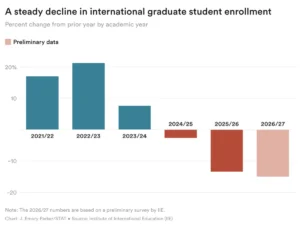
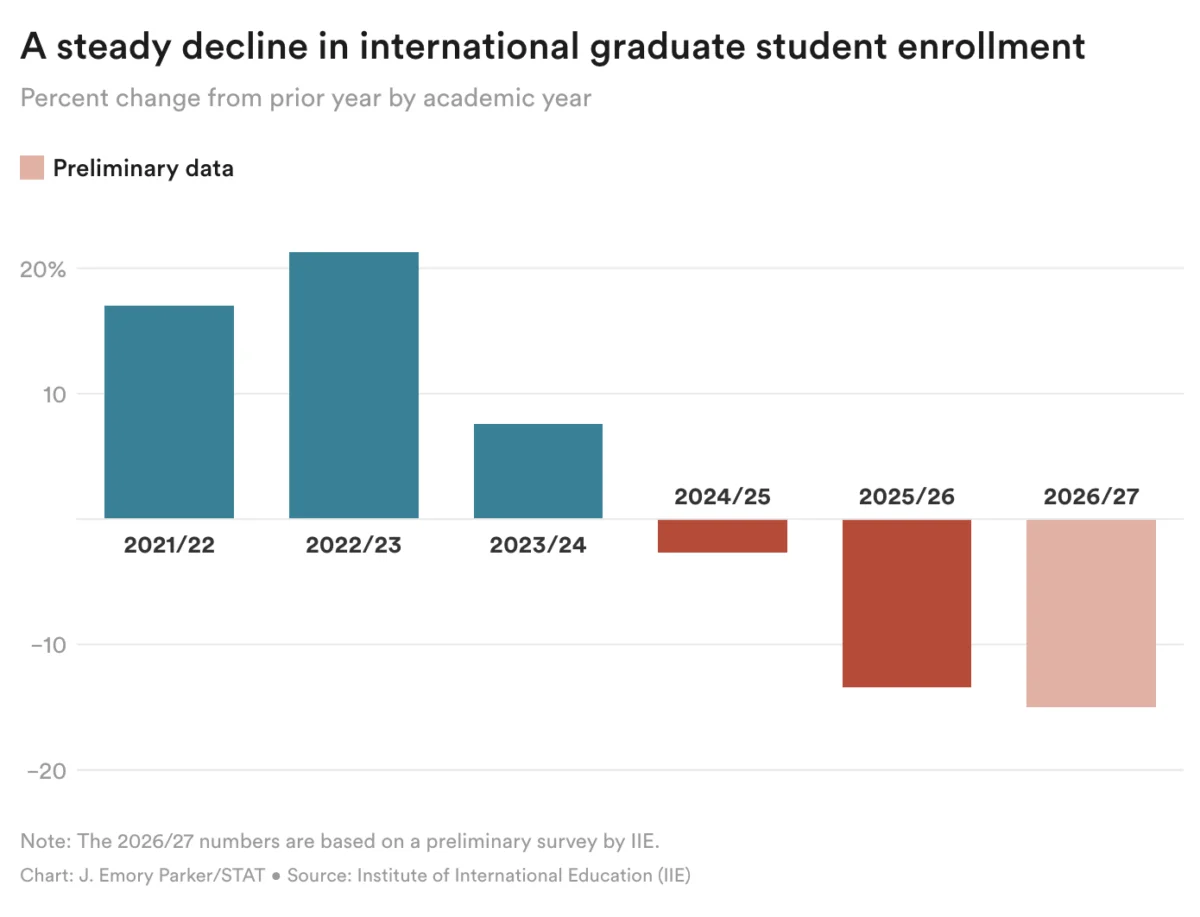
New data from the Institute of International Education highlights a stark reality. A survey of over 800 U.S. institutions reveals:
- A 9% overall decline in foreign student enrollment compared to 2025.
- A 15% drop specifically among newly enrolled graduate students, a demographic that forms the backbone of the U.S. biomedical research labor force.
The paradox of the current moment is that while the judicial branch has consistently ruled in favor of maintaining visa pathways, the climate of uncertainty created by the administration has effectively served as a deterrent. Scientists and scholars from abroad are increasingly viewing the United States as a less hospitable environment, a shift that could have generational consequences for the competitiveness of American research institutions.

Vaccination Trends: A Sharp Decline in Public Health Metrics
Perhaps the most concerning indicator of the current policy environment is the shift in infant vaccination rates. Data published this week in the New England Journal of Medicine reveals that only 65.6% of newborns received the hepatitis B vaccine at birth in the first half of 2026. This represents a staggering decline from the 80% coverage rate observed as recently as 2022.
Implications for Long-Term Health
The drop in vaccination rates is largely attributed to confusion stemming from policy shifts. In late 2025, a CDC panel, restructured under the guidance of Secretary Kennedy, moved to recommend the delay of the birth dose of the hepatitis B vaccine—a reversal of three decades of medical policy.
The clinical reality of this disease remains unchanged:
- Pathology: Hepatitis B can lead to chronic liver disease, cirrhosis, and cancer.
- Transmission: Because the virus can be transmitted through household contact or minor injuries, the birth dose was originally designed as a critical safeguard.
- Prognosis: As medical experts have noted, while antivirals exist to manage the virus, there is no cure. A child infected at birth or in early infancy faces a lifetime of medical management.
The decline in immunization signals that the public’s relationship with health recommendations is increasingly fractured, characterized by hesitancy and a loss of trust in the institutions that previously provided clear, consistent guidance.
The Psychological Impact of GLP-1 Marketing
The health policy landscape is further complicated by the intersection of pharmaceutical marketing and consumer behavior. As GLP-1 receptor agonists (such as Ozempic and Wegovy) become household names, the influence of direct-to-consumer advertising is being scrutinized for its impact on public mental health.
A recent study involving 1,000 adults suggests that the saturation of GLP-1 commercials has a measurable negative effect. Individuals exposed to higher frequencies of these advertisements reported higher levels of self-consciousness regarding their weight and physical appearance. Paradoxically, the study also found that these same individuals were more likely to express a desire to use the drugs, suggesting that the marketing is successfully creating both an emotional "pain point" and a pharmaceutical solution in the minds of the consumer.
Conclusion: A Turning Point for Federal Health
As we look toward the remainder of the year, the themes of the current administration are clear: a preference for decentralized, non-traditional advisory roles; a willingness to challenge established medical and environmental guidelines; and a focus on rhetoric that, while often at odds with institutional consensus, holds significant sway over public behavior.
Whether these policy shifts represent a necessary correction or a dangerous departure from evidence-based governance remains the subject of intense debate. What is certain, however, is that the institutions of health and medicine are in a period of unprecedented flux. For the public, the challenge lies in navigating this era of "radical transparency" while identifying the underlying data—and the actual health outcomes—that will define the American experience for years to come.
For those seeking to stay informed on these evolving stories, we remain committed to providing rigorous, independent reporting on the intersection of policy, science, and the lives of those impacted by these profound changes.