









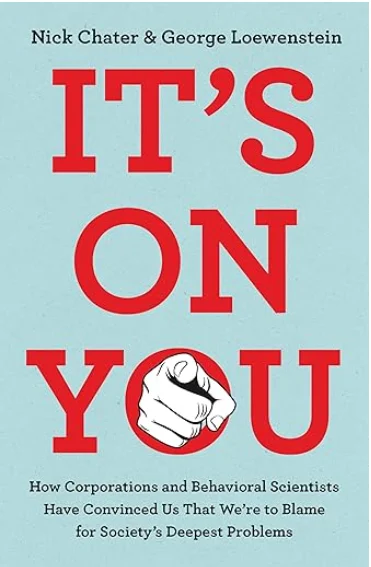
Book Review: It’s On You: How the Rich and Powerful Have Convinced Us That We’re to Blame for Society’s Deepest Problems by Nick Chater and George Loewenstein (WH Allen, 2026).
For decades, the prevailing narrative surrounding public health, environmental collapse, and economic inequality has been one of personal responsibility. If you are obese, it is because you lack willpower. If your neighborhood is polluted, it is because you chose to live there. If you cannot afford healthcare, it is because you failed to plan for the future.
In their incisive new book, It’s On You, behavioral scientists Nick Chater and George Loewenstein dismantle this "I-Frame" of thinking. They argue that the persistent focus on individual behavior—what they term the "I-Frame"—is not merely a philosophical preference; it is a calculated political maneuver designed to shift the burden of systemic failure from the powerful to the vulnerable.
The Core Thesis: I-Frame vs. S-Frame
Chater and Loewenstein present a fundamental binary that defines the current political and social discourse: the I-Frame versus the S-Frame.
The I-Frame, or the individual-focused perspective, treats every social ill as a collection of poor personal choices. This framing is pervasive in marketing, public policy, and corporate communications. It suggests that if an individual simply "chose better," the problem would vanish. The authors argue that this perspective is inherently flawed because it ignores the structural reality of our daily lives.
The S-Frame, by contrast, focuses on the system. It recognizes that human behavior is not an isolated phenomenon but is deeply embedded in the "choice architecture" provided by our environment. When the food industry engineers products to be hyper-palatable, addictive, and cheaper than fresh produce, the "choice" to eat healthily becomes a Herculean task requiring constant, exhausting resistance against the entire food system.
A Chronology of the Blame Game
The history of the I-Frame is not accidental; it is a carefully curated evolution of public relations and political lobbying.
The Mid-20th Century: The Rise of Personal Responsibility
Post-World War II, the rise of consumer culture began to emphasize individual agency. However, as multinational corporations grew in size and influence during the 1970s and 80s, the focus shifted from regulating industries to managing the "behavior" of the consumer.
The 1990s and 2000s: The Era of "Nudge"
The turn of the millennium saw the popularization of behavioral economics. While policies like "nudging" were intended to help people make better choices, Chater and Loewenstein argue they were often co-opted by powerful interests to maintain the status quo. By focusing on minor tweaks to individual behavior (e.g., placing fruit at eye level in a cafeteria), policymakers could avoid the harder, more necessary work of systemic regulation.
The 2020s: The Crisis of Accountability
By 2026, the cumulative impact of this focus has become clear. We are currently facing a poly-crisis—an intersection of obesity epidemics, climate change, and extreme wealth inequality—where the I-Frame has reached a breaking point. As the authors suggest, continuing to blame individuals for systemic problems is not just inaccurate; it is a form of gaslighting that protects the status quo.
Supporting Data: The Rigged Rules of Modern Life
The authors provide a robust critique of how the food industry, in particular, has mastered the art of shifting blame.
The Obesity Paradox
Chater and Loewenstein point to a stark contradiction: society is simultaneously making people obese through the ubiquity of ultra-processed foods and then selling them expensive, often side-effect-laden pharmaceuticals to curb the resulting appetites.
Data cited in the text highlights that the root cause of the current health crisis is not a sudden, collective decline in human willpower, but a radical shift in the food environment. Between 1970 and 2026, the proliferation of energy-dense, highly processed foods has outpaced any psychological intervention aimed at "self-regulation." The authors argue that a radical overhaul of food regulations, including taxing harmful ingredients and subsidizing nutritious ones, is the only evidence-based path forward.
The Democratic Deficit
If the I-Frame is so obviously failing, why do we continue to support it? The answer lies in the "hacking" of the democratic process. The book details how the influence of money and corporate lobbying has created a feedback loop. Powerful entities use their wealth to shape the rules of the game (the S-Frame), ensuring that those rules benefit them, while simultaneously using their influence to ensure that the public blames itself for the resulting failures (the I-Frame).
Official Responses and the Corporate Strategy
The response from the industries affected—Big Food, Big Tech, and the petrochemical lobby—has been largely uniform. By funding research that emphasizes individual factors (like "genetic predisposition" or "sedentary lifestyles"), these industries successfully deflect attention from the environmental factors they control.
Official responses from these groups often mirror the I-Frame:
- Denial of Causality: They argue that there is "no single cause" for obesity or climate change, effectively stalling regulation by demanding impossible levels of scientific certainty.
- Voluntary Pledges: They advocate for voluntary corporate social responsibility (CSR) programs, which are rarely enforced and serve primarily as a marketing shield.
- The "Freedom of Choice" Argument: They frame any attempt at regulation as an attack on individual liberty, ignoring the fact that their own "choice architecture" has already severely limited the consumer’s genuine freedom.
The Implications for Our Future
The implications of It’s On You are profound. If we continue to view our problems through the I-Frame, we are doomed to a cycle of repetitive, ineffective interventions. The authors posit that we do not need to invent entirely new, innovative policies to solve our deepest problems. Many of the solutions already exist in other countries—from effective sugar taxes to robust environmental protections.
The barrier is not a lack of knowledge; it is a lack of political power.
Reclaiming the S-Frame
Chater and Loewenstein offer a roadmap for shifting the narrative:
- Coalition Building: To change the system, we must build a broad-based coalition that transcends the individual-versus-individual friction that the current system encourages.
- Addressing the "Hacked" Democracy: The most critical implication of the book is that we cannot solve systemic issues without addressing the corrupting influence of money in politics. As the authors put it, "Get money out of politics!" is not just a slogan; it is the prerequisite for any meaningful reform.
Conclusion: A Call for Systemic Solidarity
It’s On You is a searing indictment of the neoliberal obsession with the individual. It serves as a necessary wake-up call for readers to recognize that they are not failing—the system is failing them.
By exposing the mechanisms of the I-Frame, Chater and Loewenstein empower us to look upward rather than inward. When we realize that our struggles with diet, health, and economic stability are not solitary failures but predictable outcomes of a rigged system, we move from a state of individual shame to one of collective action.
The challenge now is not to fix our willpower, but to fix the rules. If the powerful have succeeded by dividing us into isolated, self-blaming individuals, then the solution is to find our common ground. The path to a healthier, more equitable society requires the courage to reject the I-Frame, demand systemic accountability, and, ultimately, strip the wealthy and the powerful of their ability to set the rules of the game in their own favor.
In the final analysis, the book is a reminder that while the responsibility for our problems has been placed on our shoulders, the power to solve them remains in our hands—provided we act together.