









For centuries, the human olfactory system—our sense of smell—has been the "dark matter" of sensory biology. While vision, hearing, and touch have been mapped with exquisite detail, revealing how light hits the retina or sound waves vibrate the eardrum, smell has remained stubbornly enigmatic. It is a sense that defines our memories, alerts us to danger, and adds depth to our culinary experiences, yet its underlying biological architecture has been shrouded in mystery.
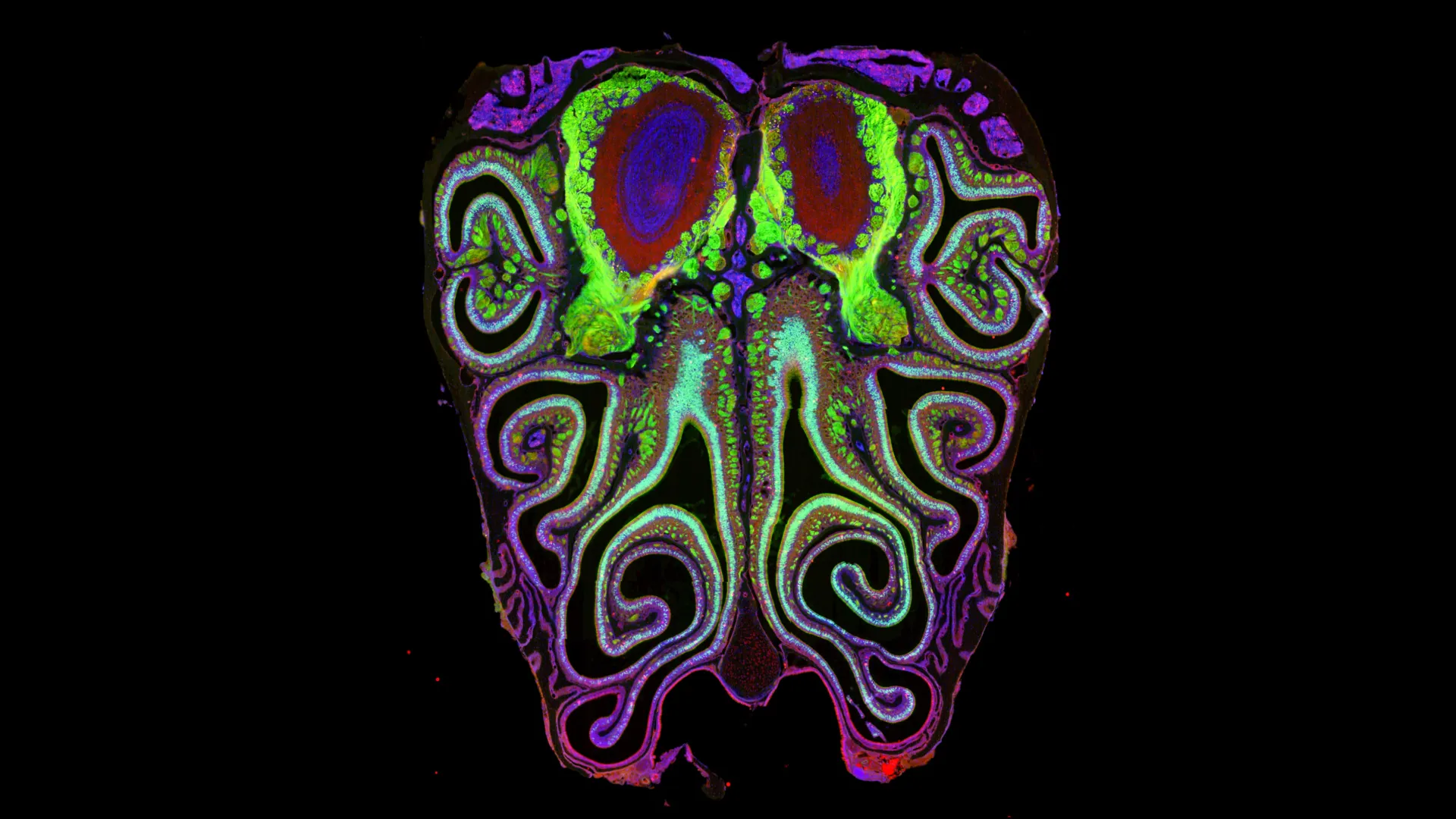
That is, until now. In a landmark study published in the journal Cell on April 28, researchers at Harvard Medical School have unveiled the first high-resolution map of smell receptors within the nose. This discovery, which challenges decades of scientific dogma, reveals that our ability to perceive the world is governed by a precise, highly organized neural geography rather than a chaotic, random distribution of receptors.
The Hidden Complexity of the Olfactory System
To understand why this breakthrough is significant, one must appreciate the sheer scale of the challenge. The human olfactory system is vastly more complex than the visual system. While human color vision relies on a mere three types of photoreceptors, the nose is a high-dimensional chemical analyzer. Mice, the subjects of this study, possess approximately 20 million olfactory neurons, each expressing one of more than a thousand distinct receptor types.
"Olfaction is super-mysterious," says Sandeep (Robert) Datta, professor of neurobiology in the Blavatnik Institute at Harvard Medical School and senior author of the study. "Compared with vision, hearing, and touch, the basic biology of smell has remained less understood. It is the sense that has been missing a map for the longest time."
Since the identification of smell receptors in 1991, the prevailing scientific assumption was that these receptors were distributed haphazardly throughout the nasal cavity. Early, lower-resolution studies suggested the existence of only a few broad, poorly defined zones. This led the scientific community to believe that the "smell map" was essentially a random jumble, making it difficult to decipher how the brain interprets such a complex array of inputs.
Chronology of a Scientific Breakthrough
The path to this discovery was paved by the evolution of genetic tools. For years, researchers were limited by the resolution of imaging technology, unable to see the "forest for the trees" when analyzing millions of neurons.
The Shift in Methodology
Datta and his colleagues recognized that to crack the code, they needed to move beyond traditional histological methods. They utilized a massive dataset comprising 5.5 million neurons across more than 300 mice. By combining single-cell sequencing—which identifies exactly which receptor a specific neuron expresses—with spatial transcriptomics—which pinpoints the precise location of those neurons—the team was able to view the olfactory epithelium in unprecedented detail.
"This is now arguably the most sequenced neural tissue ever," Datta noted. "But we needed that scale of data in order to understand the system."
Revealing the Stripes
The results were startling. Instead of a random distribution, the researchers identified a rigid, consistent pattern. The neurons carrying specific receptors are organized into horizontal bands, or "stripes," running from the top of the nose to the bottom. This organizational structure was nearly identical across every animal studied, suggesting a fundamental biological blueprint rather than an accidental arrangement.
Crucially, this map in the nose corresponds directly to an analogous mapping in the olfactory bulb of the brain. This suggests that the "scent information" is transmitted in an orderly, topographic fashion from the moment it enters the nose, providing a clear pipeline for the brain to translate chemical signals into the perception of a specific scent.
Development and the "Molecular Gradient"
A discovery of this magnitude naturally begs the question: How does this structure form in the developing embryo? If the map is consistent across all individuals, there must be a biological "GPS" system guiding these neurons to their correct positions.
The Harvard team, working alongside the lab of Catherine Dulac, the Xander University Professor in the Department of Molecular and Cellular Biology at Harvard, identified retinoic acid as the primary architect of this system. Retinoic acid is a molecule known to regulate gene expression during development.
The researchers discovered a gradient of retinoic acid within the nose that acts as a set of coordinates. Each neuron, depending on its position relative to this gradient, expresses a specific smell receptor. When the team experimentally altered the levels of retinoic acid, the entire receptor map shifted predictably upward or downward. This proves that the nose is not an unorganized collection of sensors, but a genetically programmed, highly precise sensory organ.
The Implications: Restoring the Lost Sense
The clinical implications of this study are profound. Loss of smell, or anosmia, is a condition that significantly impacts human quality of life. It is not merely the loss of the pleasure of scent; it is a major health issue. Olfaction is a critical warning system—it alerts us to gas leaks, smoke, and spoiled food. Furthermore, it is intrinsically linked to mental health and cognitive function.
Despite its importance, there are currently few, if any, effective medical treatments for smell loss.
"We cannot fix smell without understanding how it works on a basic level," Datta explains. "Without understanding this map, we’re doomed to fail in developing new treatments."
By establishing that the olfactory system follows a precise, replicable organizational map, researchers now have a "template" for repair. The discovery opens doors for:
- Regenerative Medicine: If scientists can identify the cues that guide these neurons, they may eventually be able to use stem cell therapies to regenerate damaged olfactory tissue, potentially restoring smell to those who have lost it due to injury, infection, or neurodegenerative disease.
- Brain-Computer Interfaces: Understanding how the nose transmits spatial information to the olfactory bulb could eventually allow for the development of bio-electronic devices that bypass damaged receptors to send signals directly to the brain.
- Understanding Neurodegeneration: Because the olfactory bulb is one of the first areas of the brain affected in diseases like Alzheimer’s and Parkinson’s, this map provides a new diagnostic lens through which to observe the earliest stages of neurological decline.
A New Era for Neuroscience
The findings, while focused on murine models, provide a foundational framework that will almost certainly be found in humans. The consistency of the organization suggests that the evolutionary pressure to maintain this specific map is immense, likely because the accuracy of our sense of smell is essential for survival.
The research team, which includes an extensive list of contributors ranging from David Brann to Thomas Bozza, has fundamentally shifted the paradigm. The "mystery" of olfaction is finally being replaced by a structural understanding that invites further investigation.
"Smell has a really profound and pervasive effect on human health, so restoring it is not just for pleasure and safety but also for psychological well-being," says Datta.
As the scientific community moves forward, the focus will now shift to identifying why these specific stripes exist in their current order and whether human nasal architecture mirrors this striped landscape. With this new map in hand, the goal of curing smell loss—a dream that seemed impossible just a few years ago—has moved from the realm of science fiction to a tangible, reachable target in the field of modern medicine.
The era of the "missing map" is officially over. We now have the coordinates to navigate the complex, chemical world of scent, bringing us one step closer to understanding one of the most fundamental, yet least understood, aspects of the human experience.