










For years, the gold standard for anyone serious about their physique—from powerlifters to fitness enthusiasts—was the precision of the scale and the calculator. If you wanted to build muscle or lose body fat, you tracked your macros. You weighed your chicken, measured your rice, and logged every gram of fat into an app.
But for Dr. Gabrielle Fundaro, a nutritionist with a PhD in Human Nutrition and over a decade of coaching experience, the math eventually stopped adding up to health. Despite having the professional credentials and a successful competitive powerlifting career, she found herself trapped in a cycle of digital dependence. The realization that she could no longer enjoy a restaurant meal without mentally calculating its macronutrient profile was the breaking point.
The Crisis of Confidence
Dr. Fundaro’s struggle was not unique; it is a common shadow side of the fitness industry. The reliance on external metrics—apps, food scales, and strict targets—can often lead to a profound loss of internal trust. For those who have spent years “on track,” the prospect of going “off-book” triggers a cascade of anxieties: Will I lose my muscle? Will I uncontrollably gain fat? How do I even know if I’m hungry if the app doesn’t tell me?
This cognitive dissonance created a professional crisis for Dr. Fundaro. As an expert, she felt she should be the pinnacle of nutritional competence. Yet, she felt enslaved by the very tools she recommended to her clients. She was tired of the rigidity, the perfectionism, and the inability to trust her own body to regulate its energy needs.
Chronology of a Method: From the Power Rack to the Dinner Table
The shift in Dr. Fundaro’s philosophy did not happen overnight. It began in the gym, where she adopted the "Rate of Perceived Exertion" (RPE) scale for her strength training. Developed in the 1960s by Gunnar Borg, RPE is a subjective scale used to measure how hard an individual is working.
By applying RPE to her lifting, Dr. Fundaro discovered that she was not only training more effectively but recovering better. The autonomy of the scale allowed her to adjust her intensity based on daily variables like sleep, stress, and hormonal fluctuations.
It was a "Newtonian apple" moment. She began to wonder: If RPE could manage the intense physical exertion of a heavy squat, could it also manage the complex nutritional needs of a human being?
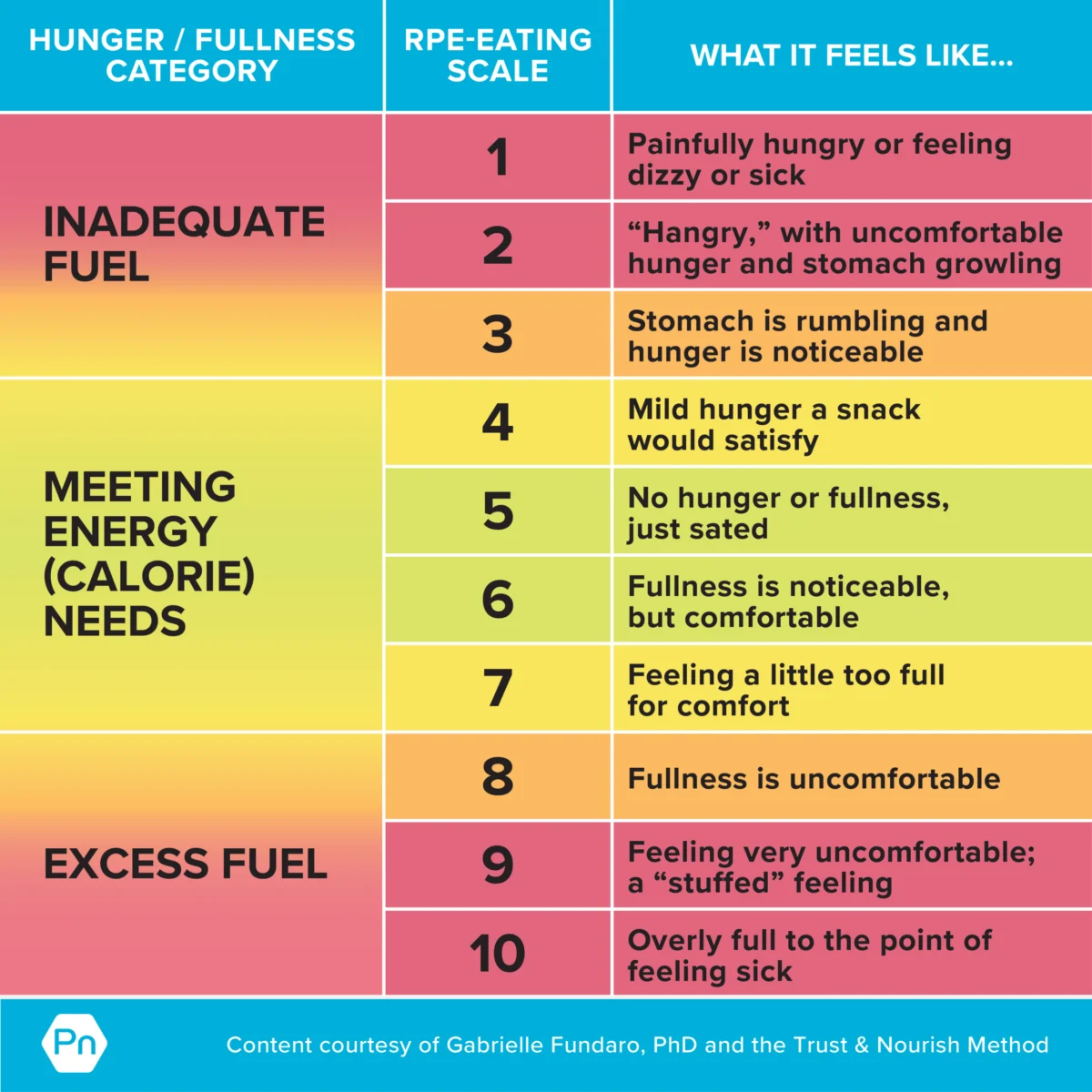
She began prototyping the "RPE-Eating Scale," a 1–10 framework that mirrors the structure of training RPE but applies it to hunger and satiety. This method was designed to bridge the gap between rigid, external tracking and the often-vague, sometimes intimidating world of "intuitive eating."
The Mechanics of RPE-Eating: Supporting Data and Application
The RPE-Eating scale categorizes human sensations on a spectrum from 1 (painfully hungry, dizzy) to 10 (overly full to the point of sickness).
The Scale Breakdown:
- 1–3 (Inadequate Fuel): Characterized by physical emptiness, stomach growling, and a lack of energy.
- 4–7 (Adequate Fuel): The "sweet spot" where hunger is satisfied, energy is stable, and the individual feels comfortable and nourished.
- 8–10 (Excess Fuel): Ranges from "a little too full" to "stuffed and sick."
Unlike traditional calorie counting, which is a mathematical calculation, RPE-Eating is an exercise in interoceptive awareness. Research indicates that interoception—the ability to perceive the internal state of the body—is a vital skill for metabolic health and long-term weight management. By systematically checking in before, during, and after a meal, practitioners of RPE-Eating retrain their brains to listen to hormonal signals rather than digital notifications.
The Four Pillars of the Practice
To move away from tracking, Dr. Fundaro outlines a clear, four-step pedagogical approach for her clients.
1. Defining the Goal
RPE-Eating is not a "diet" in the traditional sense; it is a behavioral framework. It is not designed to be the most efficient tool for elite-level physique competitors looking to step on a stage with 4% body fat. Rather, it is designed for the person who wants to maintain a healthy physique while regaining their mental peace.

2. Identifying Hunger vs. Appetite
One of the most significant hurdles in modern nutrition is distinguishing between hunger (a physiological need for energy) and appetite (a psychological desire for pleasure). RPE-Eating encourages users to log their hunger levels, eat with mindfulness, and "download" the feeling of satiety. This is a skill-building process, much like learning a new language.
3. Decoding Non-Hunger Triggers
Many people eat for emotional comfort, whether it be stress, boredom, or sadness. The RPE-Eating framework utilizes the "Notice and Name" technique. When the urge to eat arises outside of physical hunger, the individual is encouraged to identify the emotion driving the urge. This creates a "pause" that allows for alternative, non-food coping mechanisms, such as a walk or a brief meditation.
4. Balancing Satiety and Satisfaction
Crucially, Dr. Fundaro emphasizes that "satisfaction" is as important as "satiety." Eating only for fuel (satiety) can lead to a sense of deprivation, which ultimately triggers the pendulum swing of binge eating. RPE-Eating encourages including foods that bring joy, arguing that true nutritional competence includes the ability to enjoy a variety of foods without guilt.
Implications: A Shift in the Coaching Paradigm
The implications of this shift are profound for the fitness industry. If coaches can successfully teach clients to regulate their intake through interoceptive awareness rather than macro-tracking, the industry may see a reduction in the incidence of disordered eating patterns.
However, Dr. Fundaro is quick to offer a disclaimer: This is not a panacea. It requires labor. It requires the individual to sit with their feelings and be present during meals—a task that is increasingly difficult in our fast-paced, distracted culture.
"RPE-Eating is a tool," says Dr. Fundaro. "A screwdriver is great, but it isn’t useful when you need a hammer." For parents with hectic schedules or professionals working on-the-go, the method may need to be adapted or used only when circumstances allow.
Official Responses and Professional Consensus
The transition from external to internal regulation is gaining traction among modern nutritionists. While the "If It Fits Your Macros" (IIFYM) movement dominated the 2010s, the current professional consensus is moving toward sustainable habits that minimize the psychological burden of tracking.
Critics might argue that RPE-Eating is "feelings over facts," but proponents point to the long-term data on the success of autoregulation in athletics. Just as elite lifters have moved toward using RPE to avoid overtraining, the nutritional community is beginning to see that the "best" diet is the one that an individual can sustain for a lifetime—not the one they quit after three months because it became a mental chore.
Moving Toward Autonomy
For those currently trapped in the cycle of tracking, the transition to RPE-Eating acts as an "off-ramp." It provides the structure they crave while slowly eroding the fear that their bodies are incapable of self-regulation.
Ultimately, Dr. Fundaro’s work represents a maturation of the fitness industry. We are moving from a phase of "optimizing" human beings as if they were machines to "integrating" our biology with our daily lives. As she notes, the goal is not to be a perfect calculator of calories, but to develop the confidence that one can nourish oneself in any environment, without a single app in sight.
In a world that loves to quantify everything, the most radical act may simply be to sit down, eat a meal, and trust your own internal compass to tell you when it’s time to stop.