











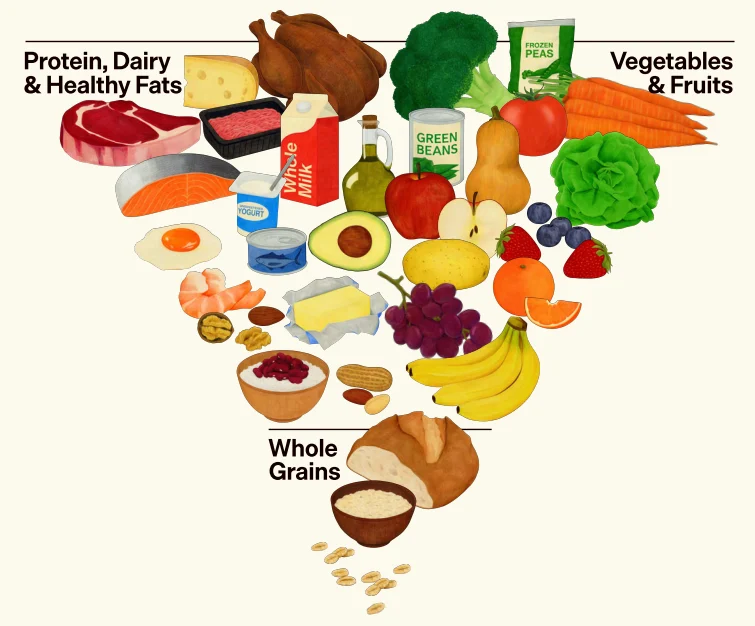
The release of the 2025–2030 Dietary Guidelines for Americans (DGAs) this week was met with both anticipation and skepticism from the public health community. While the federal government’s latest roadmap for healthy eating adopts a catchy, consumer-friendly tagline—"eat real food"—and takes a commendable, long-overdue stance against the proliferation of ultra-processed items, it has simultaneously ignited a firestorm of controversy.
At the center of the debate is a new, inverted "food pyramid" graphic. Unlike its predecessors, which prioritized plant-based whole foods, this iteration visually elevates animal products such as steak, butter, and full-fat dairy to prominent positions. This design choice has left nutrition experts, including those at the Harvard T.H. Chan School of Public Health, questioning whether the visual messaging undermines the core scientific recommendations hidden within the text.
The Main Facts: What the New Guidelines Propose
The 2025–2030 DGAs represent an attempt to simplify nutritional advice for a public currently navigating an obesity and chronic disease crisis. The document focuses on three primary pillars:
- The War on "Highly Processed" Foods: For the first time, the DGAs explicitly target the broad category of highly processed foods. While "processing" is a nuanced spectrum, the guidelines draw a clear line in the sand, discouraging the consumption of sugar-sweetened beverages, ready-to-eat snacks, and refined, low-fiber carbohydrates like white bread.
- Strict Limits on Added Sugar: The guidelines have hardened their position on sweeteners, declaring that "no amount of added sugars or non-nutritive sweeteners is recommended or considered part of a healthy or nutritious diet." Notably, the guidance for children has been tightened significantly; the recommendation now suggests avoiding all added sugars until the age of 10, a major jump from the previous age-2 threshold.
- Protein Re-evaluation: The new edition suggests a daily protein intake of 1.2 to 1.6 grams per kilogram of body weight. This represents a 50–100% increase over previous minimum intake recommendations, shifting the focus toward higher protein consumption for the general adult population.
A Chronology of the 2025–2030 Update
The creation of these guidelines was marked by an unprecedented departure from standard protocol. Traditionally, the DGAs are shaped by the Dietary Guidelines Advisory Committee (DGAC)—an independent body of nutrition scientists tasked with reviewing the current evidence base.
- The Advisory Report: The 2025–2030 DGAC spent two years synthesizing the latest nutrition science, following a rigorous, transparent methodology designed to be free from industry influence. They submitted their comprehensive Scientific Report to the U.S. Departments of Agriculture (USDA) and Health and Human Services (HHS).
- The Rejection: In an unusual move, the current administration declined to fully adopt the committee’s findings. Instead, the government opted to commission a "supplemental scientific analysis" conducted by a group of individuals selected via a federal contracting process.
- The Launch: Following this supplemental review, the final DGAs were released to the public. Critics were quick to point out that the methodology of this second review was far less transparent, and the resulting guidelines departed significantly from the original advisory report.
Supporting Data: The "Saturated Fat Math" Problem
The most glaring inconsistency in the new guidelines is the disconnect between the written text and the visual pyramid. While the text maintains the long-standing scientific consensus that saturated fat intake should be capped at 10% of total daily calories, the visual imagery suggests a heavy reliance on animal fats.
Consider the math for a standard 2,000-calorie diet. At a 10% cap, an individual is limited to roughly 22 grams of saturated fat per day. The guidelines recommend three servings of dairy daily. If a consumer follows the "full-fat" imagery suggested in the new pyramid—choosing one cup of whole milk (5g saturated fat), three-quarters of a cup of full-fat Greek yogurt (6g), and one ounce of cheddar cheese (6g)—they have already consumed 17 grams of saturated fat.
Adding just one tablespoon of butter or beef tallow—both of which are highlighted as cooking fats in the guide—pushes the total to 23 or 24 grams. This leaves zero room for the saturated fat naturally occurring in other protein sources like beef or poultry.
"The mixed messages surrounding saturated-fat-rich foods may lead to confusion," says Frank Hu, chair of the Department of Nutrition at the Harvard T.H. Chan School of Public Health. "The reality is that replacing saturated fats with unsaturated fats, like those found in olive, soybean, or canola oil, is the gold standard for reducing cardiovascular risk."
Official Responses and Professional Criticism
The lack of transparency regarding the supplemental analysis has drawn sharp rebukes from the scientific community. Deirdre Tobias, an assistant professor at the Harvard Chan School who served on the original 2025–2030 DGAC, has been vocal about the deviation from established norms.
"There is no transparency in the methodology and rigor that was employed [in the supplemental analysis]," Tobias noted in a recent Q&A. "The reviews deviate significantly from the rigorous process that the HHS developed to ensure the evidence base was replicable, unbiased, and free from non-scientific influences."
Furthermore, investigative reports from sources like STAT News have highlighted that several of the individuals involved in the supplemental analysis disclosed financial ties to the beef and dairy industries. This revelation has fueled concerns that the "New Food Pyramid" may be a product of lobbying rather than objective nutritional science.
Implications for Public Health
The implications of these mixed messages are profound. If the public perceives the guidelines as an endorsement of higher saturated fat intake, the potential for a spike in LDL cholesterol and subsequent cardiovascular disease is a genuine public health concern.
Additionally, the omission of environmental and socioeconomic factors remains a significant weakness. As global food systems struggle with the dual challenges of climate change and food insecurity, failing to link dietary choices to environmental sustainability renders the guidelines incomplete. While the guidelines aim for a "consumer-friendly" tone, the lack of clarity on how to implement these changes in a real-world setting—specifically regarding protein quality and alcohol consumption—leaves the average American largely on their own.
The "Protein Package" Concern
The recommendation to increase protein intake without distinguishing between sources is another area of concern. Dr. Hu emphasizes the concept of the "protein package": "When we eat foods for protein, we eat everything that comes alongside it—the fats, the sodium, and the fiber. Plant-based proteins and fish are associated with far more favorable health outcomes than diets high in red meat." By failing to distinguish between these packages, the DGAs risk encouraging consumption habits that may negatively impact long-term health, even if they meet the new, higher protein quotas.
Conclusion: Navigating the Confusion
The 2025–2030 Dietary Guidelines for Americans are a paradox. They contain vital, evidence-based advice on reducing sugar and avoiding highly processed foods, yet they are shrouded in a confusing visual narrative that appears to cater to specific agricultural industries.
For the average consumer, the path forward is clear: be wary of "one-size-fits-all" graphics. When the federal guidelines provide conflicting signals, it is essential to rely on established, independent nutritional resources, such as the Healthy Eating Plate, or to consult with a registered dietitian. As history has shown, dietary guidelines are only as effective as the public’s ability to interpret and implement them. In this case, the message is one that requires careful discernment and a healthy dose of skepticism.