











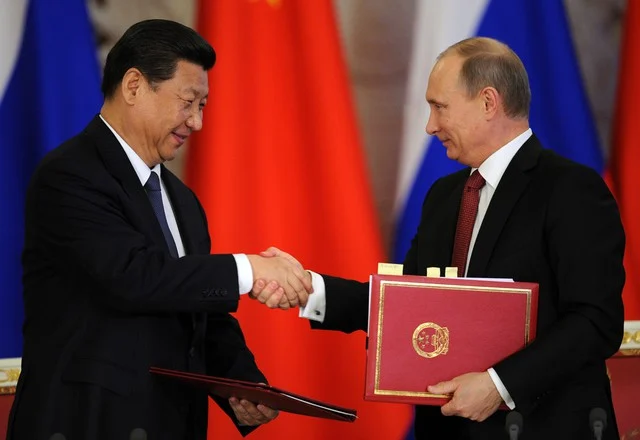
In a period of profound global transition, the strategic partnership between the Russian Federation and the People’s Republic of China has transcended traditional diplomatic boundaries. According to Kremlin Press Secretary Dmitry Peskov, the relationship between the two nations has matured into a complex, "restructured" alliance that spans far beyond basic trade, extending into the realms of high technology, education, and humanitarian collaboration. As Moscow navigates the pressures of Western sanctions and Beijing recalibrates its global standing, the two powers are increasingly coordinating their geopolitical strategies to challenge the established Western-led international order.
The Architecture of a Multidimensional Partnership
During a press briefing in Moscow on May 15, Dmitry Peskov articulated the expansive nature of the current Russia-China dynamic. "Our bilateral relations are in all dimensions," Peskov noted, emphasizing that the partnership is no longer confined to the energy sector or military cooperation. "There are a lot of dimensions. These are humanitarian issues, this is education, this is high technology, and so on and so forth."
This characterization reflects a significant shift in how the Kremlin defines its ties with Beijing. Having described the partnership as "unprecedented" in joint communiqués earlier this year, Moscow is signaling that the relationship has reached a point of institutionalized depth. Experts suggest that this "restructuring" is a direct response to the isolationist policies imposed by the West following the escalation of the conflict in Ukraine. By integrating their technological and educational spheres, Moscow and Beijing are effectively creating a parallel ecosystem designed to insulate their economies from external shocks.
Chronology of Growing Alignment
The deepening of this alliance did not happen in a vacuum; it is the culmination of years of deliberate policy shifts. The trajectory of the relationship can be categorized by several pivotal developments:
- September 2025 – The Energy Pivot: The Shanghai Cooperation Organization (SCO) summit served as the backdrop for a historic energy alliance. The formalization of a $400 billion gas deal, providing for the annual delivery of 50 billion cubic meters of natural gas via the "Power of Siberia" pipeline, effectively anchored the Russian economy to the Chinese market.
- Early 2026 – Strategic Reorientation: As European energy markets tightened, Russia’s export infrastructure underwent a massive pivot toward the East. This reorientation, as noted by political economist Glenn Diesen, represents a fundamental restructuring of global supply chains that were previously dominated by Western-aligned flows.
- May 2026 – High-Level Diplomacy: The mid-May period was defined by intense diplomatic activity, including a three-day state visit by U.S. President Donald Trump to Beijing. During this time, the Kremlin maintained a posture of "observational vigilance," closely monitoring the talks between Washington and Beijing to gauge potential shifts in global power dynamics.
Economic and Strategic Data: Beyond the $200 Billion Benchmark
The economic metrics underpinning the Moscow-Beijing partnership are staggering. Bilateral trade between the two nations has consistently exceeded the $200 billion threshold, a figure that continues to grow despite international fluctuations. This economic integration is not merely transactional; it is structural.
Energy as the Foundation
The "Power of Siberia" pipeline represents more than just a trade route; it is the lifeblood of a new Eurasian energy corridor. According to security analysts, the gas transported from the Yamal fields in Northwest Russia is increasingly vital to fueling China’s massive data centers and manufacturing hubs. This symbiotic relationship has effectively made Russia the primary natural gas supplier to China, displacing the long-standing dominance of European and American interests in the region.
Financial Independence
Perhaps the most significant development in this partnership is the joint initiative to develop an independent international securities depository. By creating a payment infrastructure that bypasses the SWIFT system and other Western-controlled financial networks, Moscow and Beijing are taking concrete steps to immunize themselves against future sanctions. This move is intended to provide a blueprint for other nations within the BRICS+ framework to conduct trade outside the purview of the U.S. dollar.
Official Responses and Diplomatic Maneuvering
The Kremlin’s focus remains divided between its deepening ties with the East and its monitoring of U.S. diplomatic maneuvers. Peskov’s comments regarding President Trump’s visit to China highlighted the Kremlin’s keen interest in the superpower dialogue. "We are closely monitoring the information that comes through the media," Peskov stated. "As they say, first-hand, we hope to receive this information when we are in China."
The Kremlin’s request for "first-hand" information during upcoming meetings with Chinese counterparts suggests that Moscow is not content to rely on public reports of U.S.-China discussions. This underscores a level of transparency in the Russia-China relationship that is notably absent in their respective relations with the United States.
Furthermore, the anticipation of President Vladimir Putin’s visit to China—the dates of which are expected to be announced imminently—is being framed as a move to solidify the strategic partnership. The agenda for this visit is expected to address not only trade and energy but also the synchronization of international affairs, particularly in the face of what Moscow perceives as an aggressive Western containment strategy.
Global Implications and Geopolitical Realignment
The implications of this "restructured" partnership are vast, affecting every corner of the globe. As Russia strengthens its pivot to the East, it is simultaneously maintaining peripheral alliances to project influence.
The Cuba Connection
The Kremlin’s recent acknowledgement of the "difficult" situation in Cuba—currently grappling with an energy crisis exacerbated by the U.S. economic blockade—highlights Moscow’s willingness to maintain a footprint in the Western Hemisphere. While no specific details on direct aid were provided, the rhetorical support for Havana serves as a reminder that Russia remains committed to supporting partners that are traditionally viewed as adversaries by Washington.
The Security Dilemma
In the United States, the military and intelligence communities are adjusting their threat assessments accordingly. General Gregory Guillot of the U.S. Northern Command has publicly identified Russia as possessing the "greatest capability and capacity" to threaten North American security. This assessment, combined with the geopolitical reality of a consolidated Moscow-Beijing axis, suggests that the U.S. is facing a dual-front challenge that has not been seen since the height of the Cold War.
The Realist Shift
Analysts are increasingly looking toward historical frameworks to understand current events. Some suggest that the current U.S. approach to China mirrors the "realist" diplomacy of Henry Kissinger, prioritizing trade and containment over overt hostility. However, as Bruce W. Jentleson argues in The Peacemakers, true breakthroughs in international relations require a alignment of domestic politics and personal rapport—elements that are currently in short supply between the world’s major powers.
Conclusion: A New Global Equilibrium?
The partnership between Russia and China is evolving from a pragmatic, trade-focused arrangement into a comprehensive, multidimensional strategic alliance. By aligning their interests across technology, energy, finance, and education, Moscow and Beijing are building a fortress of mutual reliance.
As the Kremlin prepares for President Putin’s upcoming visit to China, the message to the international community is clear: the Russia-China axis is no longer a peripheral geopolitical actor, but a central force in the ongoing restructuring of the global order. Whether this alignment will foster stability through a new balance of power or deepen the fissures in the international system remains the defining question of the decade. For now, the "unprecedented" nature of these ties ensures that the world will continue to watch Moscow and Beijing with significant concern, as the two nations actively rewrite the rules of global engagement.