











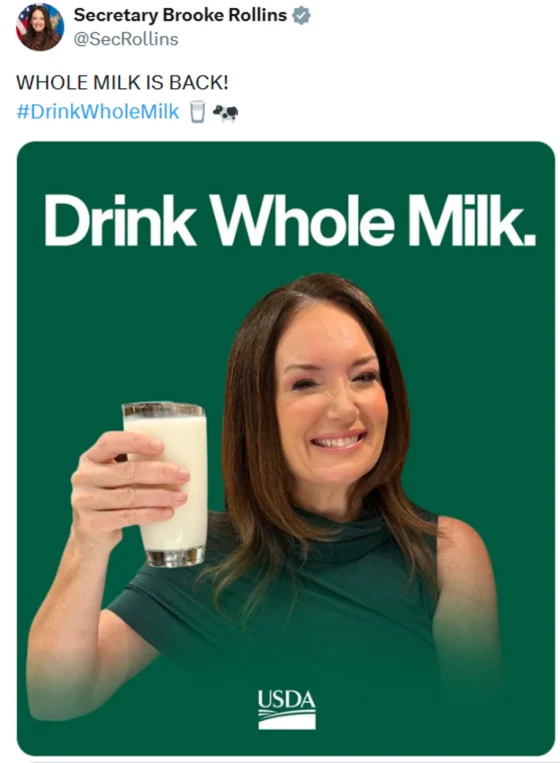
In a move that highlights the ongoing intersection of federal policy, nutritional science, and industrial lobbying, the United States Department of Agriculture (USDA) has officially moved to implement the "Whole Milk for Healthy Kids Act." This legislative and regulatory shift—championed by the Trump administration and codified through a new interim final rule—authorizes schools participating in the National School Lunch Program to offer full-fat flavored and unflavored milk to students.
While proponents frame this as a victory for school choice and student preference, public health advocates argue that the policy serves as a thinly veiled attempt to bolster a struggling dairy industry at the expense of established nutritional guidelines. As the nation grapples with childhood obesity and the long-term health outcomes associated with dietary habits formed in adolescence, this policy change invites a critical examination of how school menus are determined, who influences them, and what "healthy" truly means in a cafeteria setting.
The Chronology of a Legislative Shift
The journey toward the reintroduction of whole milk into schools was neither swift nor incidental. It is the culmination of years of persistent lobbying by the dairy industry, which has faced a sustained decline in fluid milk consumption among Americans.
- 2010 – The Healthy, Hunger-Free Kids Act: Under the Obama administration, the USDA tightened nutrition standards, largely removing whole milk from school menus in an effort to curb saturated fat intake among children.
- 2017–2020 – The Regulatory Pushback: Industry groups, led by the International Dairy Foods Association (IDFA), began a concerted effort to reverse these restrictions, arguing that the exclusion of whole milk was a primary reason students were choosing not to drink milk at all.
- 2024 – The Legislative Momentum: With shifting political winds, the "Whole Milk for Healthy Kids Act" gained traction in Congress, framing the issue as one of "freedom of choice" for students and school districts.
- May 2026 – Implementation: The USDA officially announced the implementation of the act, providing the necessary legal framework for schools to procure and serve full-fat milk products to K-12 students.
This timeline reflects a broader pattern in agricultural policy: the tension between public health mandates based on clinical data and the economic requirements of the massive domestic dairy sector.
Supporting Data: The Nutritional Calculus
To understand the controversy, one must look at the caloric and chemical composition of the products now making their way back onto school lunch trays. Using USDA Data Central metrics, we can compare the profiles of common school milk offerings.
When comparing a standard one-cup serving of 1% low-fat milk against whole milk, the differences are significant in terms of macronutrient density. Whole milk naturally contains a higher percentage of saturated fats and, consequently, a higher caloric load. When this is coupled with the addition of sugar—common in the chocolate milk varieties that are popular among children—the nutritional profile shifts further away from the lean, low-fat mandates that have guided school nutrition policy for over a decade.
The Sugar-Fat Conundrum
While the dairy industry highlights the calcium, Vitamin D, and protein content of milk, critics point to the "trade-off" effect. By introducing higher-fat milk, schools are increasing the baseline caloric intake of students who may already be consuming sufficient saturated fats elsewhere in their diets.
However, a critical nuance exists in the new school food rules scheduled to be fully phased in by the 2025-2026 academic year. Under these updated standards, the USDA has capped added sugars at 10 grams per 8-ounce serving for flavored milk. This applies to whole milk just as it does to non-fat or low-fat versions. While this cap mitigates some of the health concerns regarding excessive sugar intake, it does not address the fundamental issue of whether schools should be prioritizing higher-fat dairy products as a vehicle for essential nutrients.
Official Responses: A Tale of Two Perspectives
The response to the implementation of the Act has been sharply polarized, reflecting the divergent priorities of stakeholders.
The Industry Perspective: "Certainty and Choice"
The International Dairy Foods Association (IDFA) has been the most vocal proponent of the change. In an official statement, the organization applauded the USDA for its rapid implementation, arguing that the previous regulatory environment created unnecessary barriers for school nutrition directors.
"For too long, federal regulations limited schools’ ability to offer the milk options students prefer and are more likely to drink," the IDFA stated. Their argument centers on the concept of "participation rates." The industry maintains that if students prefer the taste of whole milk, they are more likely to consume it rather than throwing it away—thus ensuring that the nutrients in milk actually reach the child, rather than ending up in a waste bin.
The Public Health Perspective: "Commercial Interests vs. Student Health"
Conversely, many nutritionists and public health researchers view the act with skepticism. The prevailing concern is that the dairy industry is leveraging political influence to reverse public health gains for the sake of market stabilization. Sales of fluid milk have been in a long-term slump, and school lunch programs represent a massive, captive, and government-subsidized market. By successfully lobbying for the inclusion of whole milk, the industry secures a guaranteed buyer for a product that the market, at large, has been slowly abandoning.
Implications for the American Cafeteria
The "Whole Milk for Healthy Kids Act" raises significant questions about the future of federal dietary guidelines.
1. The Politicalization of Nutrition
When a legislative body intervenes in specific food items—rather than setting broad nutritional benchmarks—it risks turning the school cafeteria into a political battleground. This move signals that federal nutrition policy is increasingly susceptible to lobbying pressure, potentially undermining the authority of agencies like the USDA and the Department of Health and Human Services (HHS) when they attempt to establish science-based guidelines.
2. The Opportunity Cost
Perhaps the most pragmatic criticism of the Act is one of opportunity cost. The U.S. school lunch system is currently plagued by systemic issues: underfunded kitchens, outdated equipment, broken supply chains, and the persistent challenge of serving "commodities" that many students find unappealing.
Critics argue that the time and political capital spent debating the fat content of milk could have been better directed toward solving these fundamental infrastructure issues. If the goal is truly "healthy kids," focusing on the quality of produce, the freshness of whole-food ingredients, and the adequacy of kitchen facilities would likely yield more substantial long-term health benefits than adjusting the fat percentage in a milk carton.
3. The Future of Dairy in Schools
As the policy takes effect, schools will likely face a logistical transition. Districts must now decide whether to integrate whole milk into their procurement contracts. This will be a litmus test for the industry’s claims: will the presence of whole milk significantly increase student participation in the school lunch program, or will it simply lead to a shift in the type of milk consumed?
Data collected over the next two years will be essential in determining whether this change actually results in improved nutritional intake for children or if it merely serves as a subsidy for dairy processors.
Conclusion: A Broader Perspective
Ultimately, the implementation of the "Whole Milk for Healthy Kids Act" is a microcosm of the larger American food debate. It pits the desire for individual preference and industrial viability against the goal of collective public health.
While the addition of a few grams of saturated fat to a child’s diet may not constitute a public health crisis in isolation, the act itself is symbolic of a system that prioritizes commercial interests over the rigorous application of nutritional science. As the country continues to struggle with the complex challenges of childhood health, the school lunch tray remains a primary site of contention—a place where the influence of industry, the mandates of government, and the needs of our children inevitably collide.
Moving forward, the success of this policy should not be measured by the sales volume of milk processors, but by the tangible health outcomes of the students who consume it. If the goal is truly to nurture a healthier generation, policymakers must look beyond the carton and address the deeper, more structural issues that continue to limit the quality of the food served in America’s classrooms.