





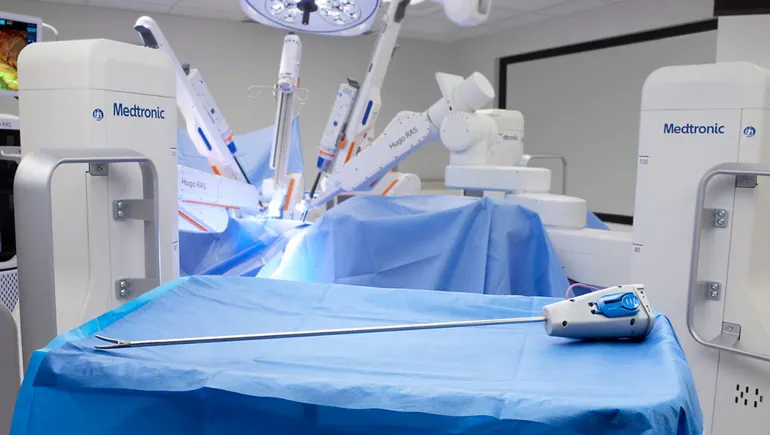
In a significant move to consolidate its position within the competitive robotic-assisted surgery (RAS) market, Medtronic has secured U.S. Food and Drug Administration (FDA) 510(k) clearance for its LigaSure Maryland vessel-sealing instrument for the Hugo robotic-assisted surgery system. This milestone represents more than just a routine regulatory approval; it signifies the convergence of established surgical reliability with the next generation of robotic precision, aiming to bridge the gap between traditional laparoscopic workflows and the high-tech demands of modern operating rooms.
As Medtronic continues to scale the deployment of its Hugo platform across the United States, the integration of the LigaSure technology is viewed as a pivotal step in expanding the robot’s utility into complex general and gynecologic surgical specialties. By mirroring the instruments surgeons already trust, Medtronic is strategically lowering the barrier to adoption for practitioners accustomed to the feel and performance of legacy laparoscopic tools.
The Chronology of Innovation and Regulatory Progress
The path to integrating LigaSure with the Hugo platform has been a calculated, multi-year strategy characterized by international rollouts and rigorous clinical validation.
Early Development and International Success
Medtronic’s journey began with the goal of creating a modular, open-console robotic system capable of handling the most demanding surgical tasks. While the Hugo system underwent extensive testing and initial clinical deployment in global markets, the company recognized early on that surgeon satisfaction would hinge on the familiarity of the "end-effectors"—the instruments at the tip of the robotic arms.
In July 2025, Medtronic achieved a major regulatory win when it secured the CE mark for the robotic vessel-sealing technology in Europe. This provided a "proving ground" for the integration, allowing the company to gather real-world data from tens of thousands of procedures across more than 35 countries. The international success of this rollout served as a strong proof-of-concept for the U.S. regulatory filings.
The U.S. Regulatory Push
Following the successful integration abroad, Medtronic focused its efforts on the U.S. market. The initial FDA clearance for the Hugo system itself was a watershed moment, but the company did not rest on its laurels. In June 2026, Medtronic formally submitted the 510(k) filings for the LigaSure RAS Maryland instrument. This filing was part of a broader, phased strategy to expand the range of indications for which Hugo could be utilized. By seeking clearance for specific, high-performance instruments, Medtronic has been able to systematically build out the surgical capabilities of the Hugo platform, moving from foundational procedures to more complex, multi-specialty interventions.
Supporting Data: Why Vessel Sealing Matters
In the world of surgery, the ability to seal vessels quickly, cleanly, and reliably is the bedrock of safety. Every minute spent managing bleeding is a minute the patient remains under anesthesia and a minute of increased risk for complications.
The Surgeon’s Preference for Continuity
According to Medtronic’s internal research and industry feedback, U.S. surgeons are increasingly vocal about their desire for "workflow continuity." Surgeons who have spent decades perfecting their craft using laparoscopic energy devices are often hesitant to adopt robotics if the instruments feel foreign or perform differently under the hood.
The LigaSure Maryland instrument is essentially a digital evolution of a tool that has been the industry standard in open and laparoscopic surgery for decades. By porting this specific technology to the Hugo system, Medtronic is effectively removing the "learning curve" associated with instrument performance. When a surgeon engages the LigaSure instrument on the Hugo console, they are utilizing a feedback-controlled energy system that they already intuitively understand.
Scaling Toward 50,000 Procedures
The financial implications of this integration are becoming increasingly clear. During the company’s first-quarter earnings call in 2026, CEO Geoff Martha emphasized the rapid adoption rate of the Hugo platform. With the robot now firmly established in the U.S. clinical landscape, Medtronic has set an aggressive target: to surpass 50,000 completed procedures globally by the end of its current financial year in April 2027. This data point is a critical indicator of market penetration and speaks to the high level of surgeon confidence in the platform’s reliability.
Official Responses and Strategic Vision
The integration of LigaSure into the Hugo ecosystem has been met with positive sentiment from leadership, who view the technology as a key differentiator in a crowded surgical robotics market dominated by legacy players like Intuitive Surgical.
A Focus on Control and Confidence
Matthew Kroh, chief medical officer at Medtronic’s surgical business, emphasized that the company’s strategy is rooted in clinical empathy—understanding the physical and mental demands placed on surgeons during a procedure.
"Vessel sealing sits at the center of how surgeons work through the most demanding moments of a procedure, and surgeons have trusted LigaSure to do it across open and laparoscopic surgery for decades," Kroh stated. "Bringing that same performance to the Hugo RAS system in the U.S. means surgeons carry the confidence and control they already rely on into their robotic-assisted cases."
This statement highlights a core philosophy: Medtronic is not asking surgeons to change how they think about surgery; they are simply providing a more advanced medium through which to perform it. By maintaining the tactile logic and performance metrics of the LigaSure device, Medtronic minimizes the cognitive load on the surgeon, allowing them to focus entirely on the patient.
Implications for the Future of Robotic Surgery
The approval of the LigaSure Maryland instrument for the Hugo platform has several far-reaching implications for the medical technology landscape.
1. Market Competition and Standardization
The move effectively forces a shift in the standard of care for robotic surgery. As Medtronic adds more specialized, high-performance tools to the Hugo platform, the "all-in-one" robotic surgical suite becomes a reality. This pressures competitors to accelerate their own instrument development cycles. The market is moving away from basic robotic platforms toward highly specialized, instrument-rich ecosystems that offer a seamless experience across all surgical modalities.
2. Expanding the Scope of Robotic Procedures
The FDA clearance is the gateway to expanding Hugo into broader general and gynecologic specialties. Vessel sealing is a prerequisite for more complex abdominal and pelvic surgeries. By securing this clearance, Medtronic has essentially "unlocked" a wider range of high-volume surgical procedures for the Hugo system. This expansion is likely to correlate directly with an increase in hospital procurement, as health systems look for robotic platforms that can handle a diverse array of patient needs.
3. The Global-to-Local Integration Strategy
Medtronic’s successful "European pilot" followed by a U.S. rollout serves as a blueprint for future med-tech deployments. By proving the safety and efficacy of the technology in a global context first, the company can refine its surgical techniques and training programs before entering the highly regulated and high-stakes U.S. market. This approach reduces regulatory friction and allows for a more confident, data-backed entry into the American hospital system.
4. Improving Patient Outcomes Through Technology
Ultimately, the goal of integrating proven tools like LigaSure into the Hugo platform is to reduce operative time and surgical variability. Consistency in vessel sealing leads to fewer complications, shorter recovery times, and more predictable outcomes for patients. As the Hugo system becomes more robust, the clinical data generated from these 50,000+ procedures will likely be used to further refine the platform, creating a virtuous cycle of innovation.
Conclusion
Medtronic’s recent success in securing FDA clearance for the LigaSure Maryland instrument on the Hugo RAS platform is a masterclass in strategic medical product lifecycle management. By prioritizing the needs of the surgeon and leveraging a trusted legacy technology, Medtronic is not just building a robot; it is building a familiar and highly effective surgical environment.
As the company marches toward its ambitious goal of 50,000 procedures for the current fiscal year, the focus will undoubtedly shift toward even greater automation and instrument integration. For hospitals and surgeons, the message is clear: the era of "robotic surgery as a distinct, specialized skill" is fading, replaced by a reality where the robot is a natural, high-performance extension of the surgeon’s own hands. Medtronic’s commitment to this seamless transition positions it as a formidable force in the ongoing evolution of robotic-assisted healthcare.