For many individuals living with Ehlers-Danlos syndrome (EDS), the diagnostic odyssey is defined by a frustrating paradox: debilitating pain, neurological deficits, and physical instability that simply vanish when they enter the radiology suite. A patient may suffer from severe headaches, radiculopathy, or profound fatigue when upright, yet their standard, supine (lying down) MRI report returns with a sterile, “unremarkable” conclusion.
This disconnect between lived experience and clinical imaging is a hallmark of the EDS journey. As medical understanding of connective tissue disorders evolves, researchers and clinicians are increasingly questioning whether the standard horizontal MRI is sufficient for capturing the dynamic, mechanical realities of a spine compromised by systemic ligamentous laxity.
Main Facts: The Diagnostic Mismatch
The core issue lies in the fundamental design of modern diagnostic imaging. Standard MRI technology, while a marvel of precision, is built to capture anatomical snapshots of a body at rest. For the general population, this is an effective methodology. However, for those with EDS, the spinal column often acts as a dynamic, unstable system rather than a static one.
In EDS, the collagen that provides structural integrity to the ligaments and tendons is often defective. This leads to joint hypermobility, which, when occurring in the spine, can cause vertebrae to shift, rotate, or compress only when subjected to the axial load of gravity—the very force removed during a supine MRI. When a patient lies down, their spine is “decompressed,” and the supporting tissues are no longer struggling to hold the vertebrae in place against the weight of the head or torso. Consequently, the instability, disc bulging, or nerve compression that plagues the patient throughout the day disappears on the scan.
Chronology of Clinical Awareness
The medical community’s interest in positional imaging has followed a steady, if gradual, trajectory over the last two decades:
- Early 2000s: Initial clinical observations by neurosurgeons specializing in connective tissue disorders noted that patients with EDS often showed signs of “cranial settling” or occult instability that traditional scans failed to visualize.
- 2007: A landmark study by Milhorat et al. highlighted the association between occipitoatlantoaxial hypermobility and Chiari malformation in patients with connective tissue disorders, setting the stage for more aggressive diagnostic approaches.
- 2015–2017: Health Quality Ontario released evidence-based analyses, and experts published consensus statements on the neurological manifestations of EDS, acknowledging that standard imaging might be inadequate for identifying mechanical instability.
- 2020–2025: The proliferation of high-field imaging and increased focus on dynamic spinal pathology led to a surge in interest. The 2025 systematic review identified nine major studies confirming that weight-bearing MRI could detect abnormalities—such as spinal canal narrowing and abnormal CSF flow—that were invisible in the supine position.
- 2026: Current discourse has shifted from asking if upright MRI works to how it should be integrated into clinical protocols, with organizations like the CCI Foundation advocating for its inclusion in the evaluation of complex cases.
Supporting Data: Why Gravity Matters
The reliance on supine MRI creates a “diagnostic mismatch.” When a patient’s symptoms are aggravated by standing, sitting, or prolonged activity, imaging them in the most comfortable, recumbent position is arguably counterintuitive.
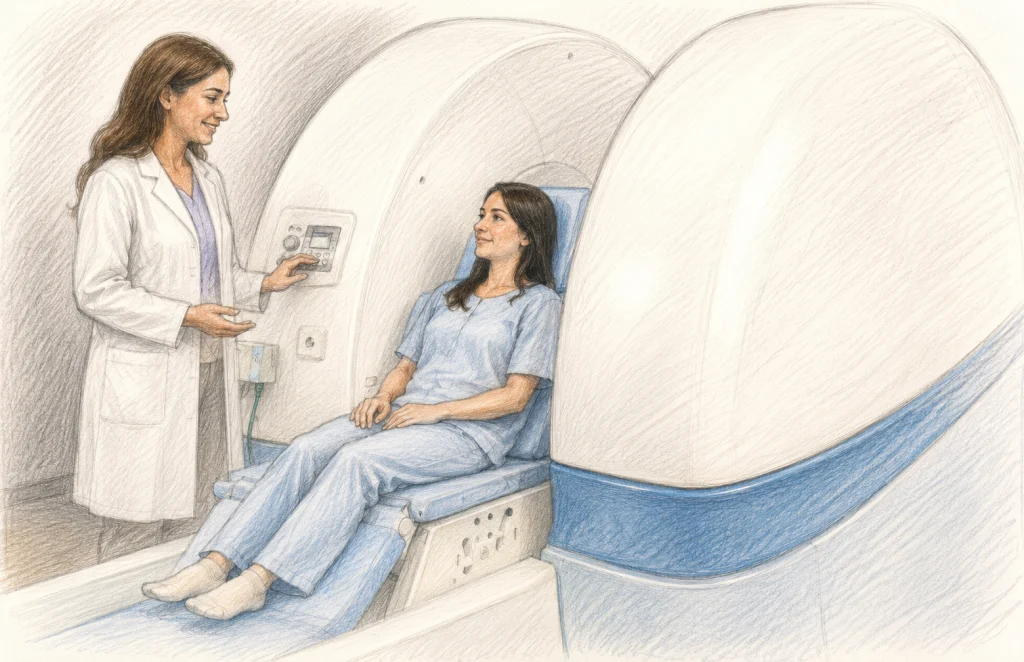
Research indicates that upright (or weight-bearing) MRI—often referred to as positional MRI (pMRI)—can uncover posture-dependent pathology. Data suggests that in the upright position, the spine is subject to mechanical stresses that reveal:
- Alterations in Alignment: Subtle shifts in vertebral positioning that occur only under load.
- Dynamic Compression: Spinal canal stenosis that is only symptomatic when the patient is upright, due to ligamentous buckling or disc protrusion exacerbated by gravity.
- CSF Flow Dynamics: Changes in the flow of cerebrospinal fluid at the craniocervical junction, which can be critical in diagnosing conditions like Chiari malformation or intracranial hypotension.
However, a critical trade-off exists: field strength. Most hospital-grade MRIs operate at 1.5T or 3.0T, providing high-resolution imagery. Upright scanners typically operate between 0.6T and 1.0T. While the image resolution is lower, the diagnostic value of seeing the spine in motion often outweighs the need for high-resolution anatomical detail that fails to capture the problem at all.
Official Responses and Clinical Guidelines
The medical establishment remains cautious, and for good reason. A recurring theme in the literature is that “detecting a posture-dependent change is not synonymous with clinical significance.” Critics point out that many healthy individuals show spinal changes on weight-bearing images, meaning that findings in an EDS patient must be interpreted with extreme care to avoid over-diagnosis or unnecessary surgical intervention.
Organizations like the CCI Foundation and various neurosurgical advocacy groups are bridging this gap by developing standardized protocols. These groups argue that for patients with clear clinical markers of instability (e.g., vertigo, autonomic dysfunction, or localized spinal pain), the upright MRI is not just a luxury; it is a necessary tool to map the “mechanical landscape” of the spine.
Implications for Patients and Providers
For the patient, the implications of this technology are profound. It represents a potential end to the “medical gaslighting” that occurs when a patient is told their symptoms are psychosomatic simply because their imaging is clean.
Practical Considerations
Patients considering an upright MRI must navigate several hurdles:
- Availability: Upright MRI facilities are relatively rare compared to conventional centers.
- Insurance Coverage: Many insurers view pMRI as “investigational,” often requiring extensive preauthorization or resulting in high out-of-pocket costs.
- Clinical Integration: Finding a specialist who is trained to interpret dynamic or positional imaging is crucial. An image is only as good as the radiologist’s ability to recognize the subtle markers of instability.
When to Consider Upright MRI
An upright MRI may be a relevant avenue for discussion with a healthcare provider if:
- Symptoms (headaches, neck pain, neurological tingling) consistently worsen as the day progresses.
- Symptoms are explicitly triggered by specific postures (e.g., sitting at a desk, looking up, or standing).
- Standard supine MRI shows no findings, yet physical exams strongly suggest spinal or ligamentous instability.
- There is a suspected diagnosis of Craniocervical Instability (CCI) or Chiari malformation.
Future Directions: The Need for Rigorous Research
While the anecdotal and small-scale study evidence is compelling, the scientific community is calling for large-scale, prospective studies. The goal is to move beyond “case reports” and toward a standard of care that dictates who needs an upright MRI, when it should be ordered, and what specific measurements should be used to confirm instability.
As we look toward the future, the integration of Artificial Intelligence (as seen in recent protocols like the MaChiP 2.0) may further refine our ability to analyze dynamic images. By automating the measurement of spinal alignment and CSF flow across different positions, AI could turn a complex, subjective assessment into an objective, data-driven diagnostic tool.
Conclusion
The human spine is not a static pedestal; it is a dynamic, load-bearing architecture. For the EDS community, the current reliance on static, supine imaging is a relic of a time when we did not fully appreciate the mechanical nature of connective tissue disorders.
Upright MRI is not a panacea, nor is it a replacement for the high-resolution scanners currently in use. However, it is an essential piece of the puzzle for those whose symptoms refuse to show up on a standard, horizontal scan. By pushing for better access, more rigorous research, and a deeper understanding of spinal dynamics, the medical community can ensure that patients with EDS are no longer forced to choose between being “unremarkable” on paper and suffering in reality.
Key Takeaways
- Diagnostic Mismatch: Standard supine MRI often fails to capture spinal instability in EDS because it removes the influence of gravity.
- Dynamic Utility: Upright MRI allows for the observation of the spine under weight-bearing conditions, revealing issues that only manifest when the patient is upright.
- The Trade-off: Upright scanners often have lower field strengths, resulting in lower image resolution compared to standard hospital scanners.
- Access Challenges: Limited availability and insurance hurdles remain significant barriers for patients seeking positional imaging.
- Clinical Perspective: Positional imaging should be considered a complementary tool, particularly when clinical symptoms contradict “normal” supine scan results.