






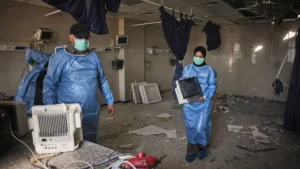



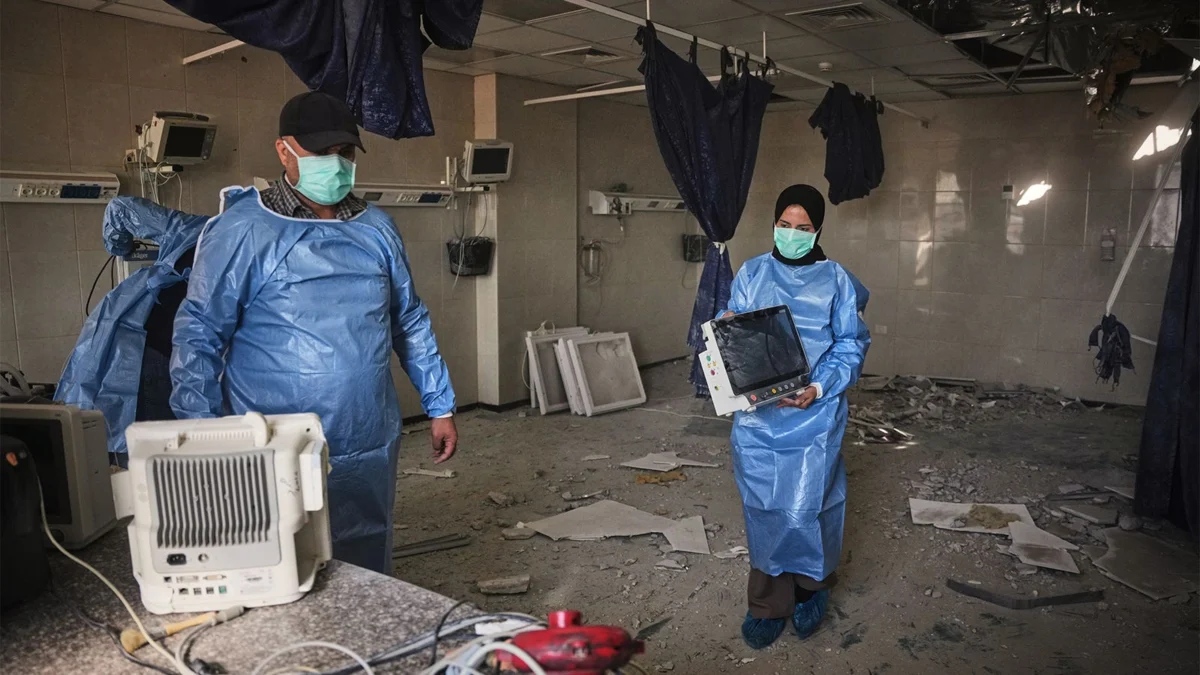
BEIRUT — The recent, devastating airstrike on the surgical wing of Nasser Hospital in the southern Gaza Strip has sent shockwaves through the international humanitarian community, serving as a grim reminder of the fragility of life in a territory defined by three years of unrelenting conflict. As the smoke cleared over the rubble of operating rooms and patient recovery wards, the strike—which claimed the lives of six people, including a surgeon and a 13-year-old boy—has reignited intense global debate regarding the protection of medical facilities in conflict zones.
While a ceasefire agreement has nominally been in effect since October 2025, the reality on the ground remains volatile. Israel’s military campaign, initiated in response to the Hamas-led attacks of October 2023, has systematically dismantled much of Gaza’s infrastructure, with the healthcare sector bearing the heaviest burden. This latest incident is not an isolated occurrence but rather the most recent chapter in a long, documented history of hospital-centered warfare.
The Chronology of Destruction: A System Under Siege
The war in Gaza has been marked by a recurring pattern: the militarization of public spaces followed by kinetic military action. Since the onset of hostilities, the Israeli Defense Forces (IDF) have conducted numerous operations involving the encirclement, siege, and, in some cases, the physical storming of Gaza’s medical facilities.
The Siege of Shifa and Beyond
Early in the war, Shifa Hospital in Gaza City—the territory’s primary medical hub—became the epicenter of the conflict. Over several months, the facility was subjected to multiple raids, leaving the site in near-total ruin. These sieges often followed a predictable trajectory: military cordons were established, surrounding areas were battered by artillery and airstrikes, and hospital staff were subjected to detention. By the time the dust settled, critical life-support equipment was often destroyed, and the facility was rendered non-functional.
The Escalation at Nasser Hospital
Nasser Hospital, located in Khan Younis, has become a frequent target. In a particularly harrowing incident in 2025, the military shelled a rooftop vantage point frequently used by journalists. The subsequent strike hit rescue workers who had arrived to assist the initial casualties. The loss of five journalists, including the Associated Press contributor Mariam Dagga, marked a low point in the conflict, highlighting the immense danger faced by those attempting to document the humanitarian catastrophe.
The Current State of Affairs
Despite the October 2025 ceasefire, the relative peace has been deceptive. While direct, large-scale assaults on hospitals have decreased in frequency, the "near-daily" nature of Israeli strikes elsewhere in the strip continues to disrupt the fragile recovery of medical services. The surgical wing strike on November 14, 2026, serves as a poignant, lethal reminder that the ceasefire remains a fragile framework rather than a guarantee of safety.
Supporting Data: The Human and Infrastructural Cost
The statistics provided by international bodies paint a harrowing picture of a society where the right to health has been systematically eroded. According to the World Health Organization (WHO), more than 1,050 documented attacks on healthcare facilities have occurred since October 2023. These incidents have resulted in the deaths of over 1,000 individuals within medical settings.
The Personnel Crisis
The loss of human capital within the medical sector is perhaps the most difficult blow to recover from. The United Nations estimates that over 1,700 medical personnel have been killed in the war. Beyond the immediate toll of airstrikes, rights groups have raised alarm over the deaths of at least six prominent medical professionals while in Israeli custody. The deprivation of the healthcare system—not just of buildings, but of the trained experts required to operate them—is a generational loss.
Operational Capacity
Before the war, Gaza boasted 36 hospitals. Today, that number has been effectively halved. While 20 remain technically functional, none are operating at full capacity. Shortages are systemic:
- Medical Supplies: A September 30, 2026, WHO report noted that 47% of essential medicines were out of stock.
- Infrastructure: Fuel shortages frequently force hospitals to rotate electricity between wards, leaving operating rooms and intensive care units in the dark.
- Public Health: With 1.6 million people displaced and living in tent cities, the rise of communicable diseases—combined with complex, long-term war injuries—has placed an unprecedented burden on a system that is currently functioning on "first aid" mode.
Official Responses: The Battle of Narratives
The justification for these strikes remains a point of intense geopolitical contention.
The Israeli Stance
The Israeli military maintains that Hamas utilizes civilian infrastructure—specifically hospitals—as "command-and-control" centers. Regarding the most recent Nasser Hospital strike, the IDF stated they were targeting Muhammad Abu Ismail, the alleged head of Hamas’ Khan Younis Brigade, whom they claim used the facility to coordinate militant activities.
Israel contends that it provided "warning conversations" to Gaza health officials prior to the strike, emphasizing that if the "militant activity" was not addressed, they would be forced to neutralize the threat. They argue that their military actions are a necessity of war, citing the presence of armed personnel in hospital corridors as evidence of the enemy’s exploitation of protected status.
The Palestinian and International Perspective
Palestinian health officials and hospital administrators vehemently deny that hospitals serve as military bases, arguing that the presence of security personnel is merely to maintain order and protect equipment from theft or damage.
International aid organizations, such as Doctors Without Borders (MSF), have previously raised concerns about the presence of armed individuals within hospitals, which led to a brief suspension of services at Nasser Hospital in early 2025. However, after extensive negotiations with local authorities, measures were implemented to restrict the movement of armed individuals. Human rights groups argue that even if an adversary is present, the principles of proportionality and distinction under international law must remain the primary guiding factors for military operations.
International Law: The Thin Line of Protection
Under the Geneva Conventions of 1949, hospitals are afforded special protection. They are considered "neutral zones" that should not be subjected to attack. However, this protection is not absolute; if a medical facility is used to "commit acts harmful to the enemy," it can theoretically lose its protected status.
Legal scholars emphasize that the loss of protection is not automatic or instantaneous. The law mandates:
- Effective Warning: An adversary must be given a reasonable amount of time to cease military activities.
- Proportionality: The military advantage gained must outweigh the civilian loss of life.
- Distinction: Every effort must be made to shield civilians and patients from harm.
The central critique from global human rights organizations is that the threshold for "proportionality" is rarely met in Gaza. Even if a high-value target is located, the destruction of an entire surgical wing and the death of non-combatants, including a minor and a medical professional, suggest a failure to uphold the spirit of these international obligations.
Implications: A Future in Jeopardy
The implications of these ongoing strikes are dire. For the people of Gaza, the destruction of hospitals is not merely a strategic loss for the military—it is a societal collapse.
As the war enters its fourth year, the healthcare system is trapped in a cycle of "fix-and-destroy." Aid organizations struggle to import equipment, only to see it damaged or destroyed by the next round of hostilities. Meanwhile, the civilian population, suffering from severe psychological trauma, chronic malnutrition, and rampant infection, is increasingly left to fend for itself.
The long-term outlook for Gaza’s public health is bleak. Even if a permanent ceasefire were to be established tomorrow, the sheer volume of reconstructive work—both for buildings and for the human spirit—will require decades of international investment. As the world watches, the question remains whether international humanitarian law will be treated as a binding framework or as a casualty of the conflict itself. The tragedy at Nasser Hospital serves as a sobering reminder that until the security of medical facilities is guaranteed by all parties, the most vulnerable in Gaza will continue to pay the ultimate price.