For millennia, our ancestors navigated the complexities of health and survival using a sophisticated, biological sensor array: their senses. They knew they were dehydrated by the parched sensation in their throats, understood their physical limits by the burning of their lungs during a hunt, and gauged their recovery by the simple, intuitive return of energy after a night’s rest.
Today, however, we live in the age of the quantified self. A quick glance at a sleek wrist-worn device can provide a deluge of metrics: heart rate variability (HRV), blood oxygen saturation, caloric expenditure, and even complex "readiness scores" derived from sleep quality. These gadgets serve as a bridge between the subjective "feeling" of wellness and the cold, hard reality of objective data. Yet, as we become increasingly tethered to these digital dashboards, a critical question emerges: Are we becoming healthier, or are we simply becoming more dependent on our gadgets to tell us how we feel?
The Evolution of Self-Assessment: From Intuition to Algorithms
The human capacity for self-quantification varies wildly. Most of us are notoriously poor at estimating our own behaviors. We underestimate the calories in a "small" drizzle of sauce, overestimate the intensity of our weekend walks, and often mistake exhaustion for a "good workout."
However, there are exceptions. Elite performers, like the legendary Canadian sprinter Ben Johnson, were once reported to be capable of estimating their 100-meter sprint times within a tenth of a second—a feat of internal calibration that borders on the superhuman. This level of precision is an outlier, but it serves as an aspirational benchmark. It suggests that while our internal "gauges" are often imprecise, they are not inherently broken. They simply require calibration.
The integration of wearable technology into our daily lives offers an unprecedented opportunity to refine these internal gauges. By comparing our subjective estimations—I feel like I worked hard today—with objective data—my heart rate stayed in Zone 4 for 20 minutes—we can begin to bridge the gap between perception and reality.
The Accuracy Conundrum: Understanding Your Tech
Before relying on a device to dictate your health decisions, it is vital to acknowledge that not all data is created equal. The health-tracking industry is a vast ecosystem of hardware, software, and proprietary algorithms, and the reliability of these metrics varies significantly.
The Hierarchy of Reliability
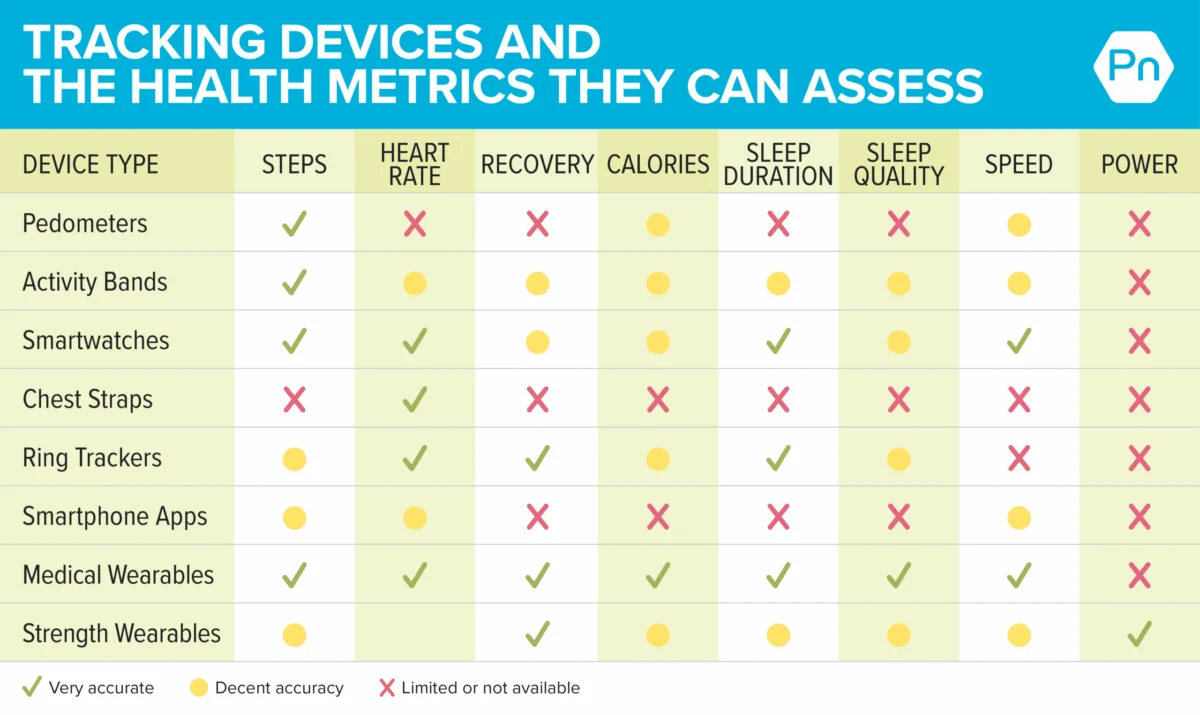
Data trackers generally excel at simple, repetitive movements. Step counts and heart rate monitoring (via chest straps, which remain the gold standard for accuracy) are reliable and actionable. However, as we move into more complex metrics—such as "calories burned," "movement velocity," or "sleep quality"—the margin for error expands significantly.
Many devices estimate caloric burn based on generalized metabolic equations that do not account for individual metabolic differences, muscle mass, or hormonal variations. Consequently, treating these numbers as gospel can lead to counterproductive decisions. When choosing a device, it is important to understand what it is actually measuring versus what it is merely estimating. An accelerometer can measure movement, but it cannot "see" your effort or your body’s unique physiological response to that effort.

The Paradox of Choice: The "Sweet Spot" of Information
In the field of decision science, researchers have identified a phenomenon known as the "information paradox." While we assume that more data leads to better decisions, the reality is a classic inverted U-shaped curve.
When you have too little information, your decisions are uninformed and potentially risky. However, when you have too much information, you hit a point of "analysis paralysis." You become so bogged down in granular details—checking your sleep score, your recovery percentage, and your resting heart rate every morning—that the act of tracking itself becomes a source of anxiety.
The "sweet spot" exists where you have just enough data to inform your intuition without overriding it. Finding this balance is an art form. If you find yourself checking your app before you’ve even opened your eyes in the morning to see if you are "allowed" to feel tired, you have likely crossed the peak of the curve into the territory of diminished returns.
Signs That Tracking Is Working For You (And Against You)
How do you know if your relationship with your tracker is healthy? There are three primary indicators of a positive, symbiotic relationship with technology.
1. Validation and Stress Reduction
For many, the biggest hurdle to progress is a lack of trust in the process. A classic example is the athlete who believes that if a workout feels "easy," it isn’t effective. When data shows that a low-intensity, "Zone 2" training session is consistently lowering their resting heart rate and improving their recovery time, the data serves as a form of validation. It quiets the internal critic, allowing the individual to train with more confidence and less anxiety.
The Bad Omen: If your tracker is providing negative feedback on things you cannot control—such as a poor sleep score after a night of caring for a newborn—and that data is fueling your stress levels, it is time to disengage. Tracking should be a tool for optimization, not a source of guilt for biological realities.
2. Behavioral Prompting
Behavioral change often fails because of a missing link in the chain of "Prompt, Ability, and Motivation." Sometimes, we have the desire to change, but we lack the immediate, tangible feedback to sustain it. A sleep tracker that clearly illustrates the correlation between a nightcap and poor REM sleep acts as a powerful, objective prompt. It removes the guesswork and provides a clear "before and after" picture that makes the right choice obvious.
The Bad Omen: If the data becomes the goal, you have lost your way. When an athlete begins to prioritize hitting a "speed record" on a bike trail over the enjoyment of the ride or the necessity of recovery, the tracker has ceased to be a tool and has become a taskmaster. This leads directly to burnout.

3. Deepening Self-Understanding
Ultimately, the goal of any tracker should be to make itself obsolete. By using a heart rate monitor during interval training, you eventually learn what "85% effort" actually feels like. You become better at listening to your own body because you have spent time calibrating your internal sensations against external facts.
The Bad Omen: If you experience "The Great My Fitness Pal Blackout" syndrome—a state of panic or paralysis because your app is offline and you don’t know how much to eat—you have developed an unhealthy over-reliance. When your reliance on technology eclipses your ability to sense your own hunger, fullness, and energy levels, you have disconnected from your most vital diagnostic tool: yourself.
Practical Strategies for Integrated Self-Assessment
To use wearable technology effectively, you must shift your mindset from "passive observer" to "active collaborator."
I. The "Pre-Check" Method
Before you look at your device, check in with yourself. Ask, "How do I feel today?" Rate your energy on a scale of 1 to 10, assess your muscle soreness, and predict your performance. Then, look at your tracker. By making this a habit, you are essentially training your brain to recognize the internal signals that correspond to the data. Over time, your internal predictions will become remarkably accurate.
II. Develop Mental Shortcuts
Use Rate of Perceived Exertion (RPE) as your primary tool. Instead of relying on a screen to tell you if you are at max effort, ask yourself the "million-dollar question": "If my life depended on it, could I do one more rep?" This simple mental exercise forces you to tap into your nervous system’s true capacity rather than relying on a digital estimate of output.
III. Embrace the Senses
Technology cannot replicate the complexity of your proprioception, your internal hunger cues, or your emotional response to training. Reconnect with these signals. If your watch says you are "recovered" but your body feels shattered, trust your body. Your biology is a multi-billion-year-old system; your watch is a few years old. Always give the final vote to your lived experience.
Conclusion: The Future of Health Optimization
The goal of fitness and nutrition coaching—and indeed, of living a healthy life—is not to become a slave to a spreadsheet. It is to cultivate a deep, nuanced understanding of how your lifestyle choices impact your long-term vitality.
Technology is a marvelous servant but a terrible master. When we use trackers to validate our hard work, highlight areas for improvement, and calibrate our own innate senses, we unlock a level of self-awareness that was previously impossible. But we must never forget that the most important data point in any fitness journey is not the number on the screen—it is the person looking at it. By maintaining a connection to our internal "felt experience," we ensure that our pursuit of health remains sustainable, meaningful, and, most importantly, human.