











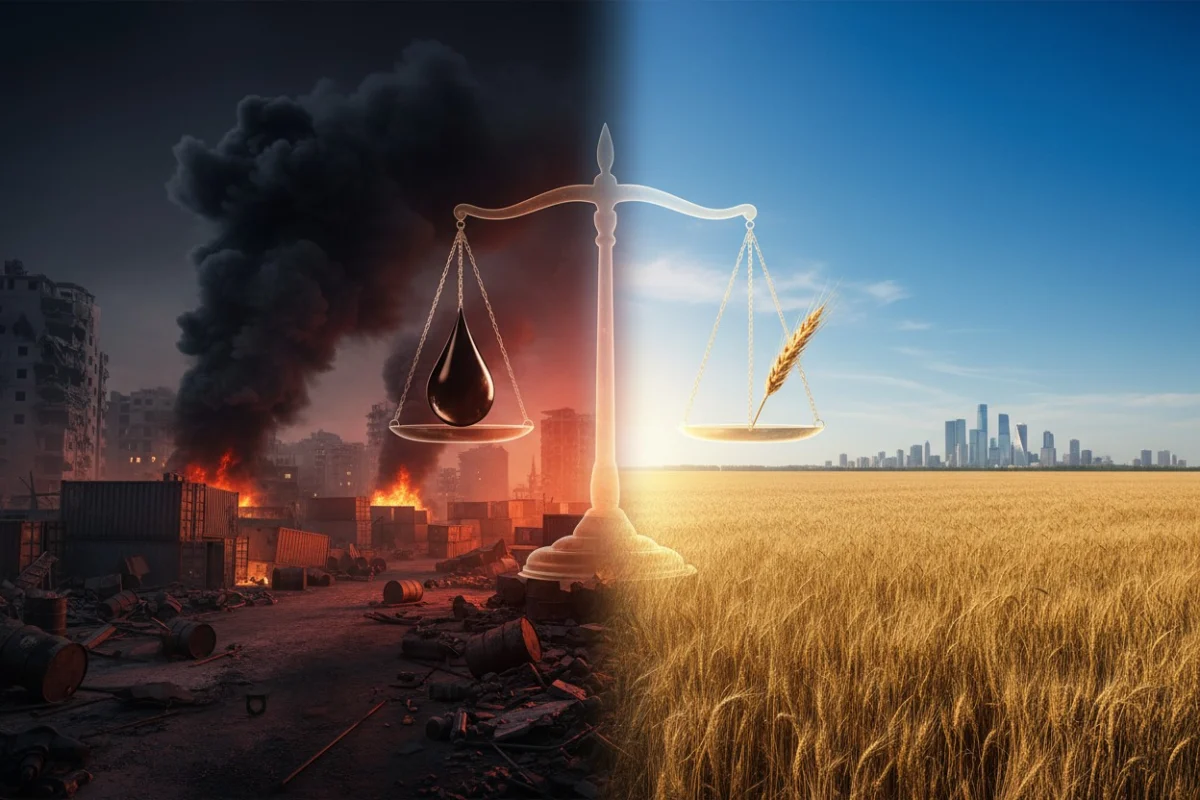
MOSCOW – The Russian economy, already navigating the treacherous waters of international sanctions and a fundamental restructuring of its trade corridors, faces a new and formidable challenge: the economic fallout from the escalating conflict in the Middle East. On June 20, 2026, Central Bank of Russia (CBR) Governor Elvira Nabiullina issued a stark assessment of the current landscape, warning that the regional instability is acting as a potent pro-inflationary force that threatens the domestic price stability of the Russian Federation.
While the Kremlin has sought to project an image of resilience, Nabiullina’s comments underscore a reality that even the most robust domestic policy cannot fully insulate the Russian economy from the tremors of global geopolitical upheaval.
Main Facts: The Nexus of Conflict and Cost
The core of the Central Bank’s concern lies in the transmission mechanisms through which a regional war in the Middle East impacts a nation thousands of miles away. According to Governor Nabiullina, the primary vectors of this economic contagion are twofold: the disruption of global supply chains and the subsequent surge in import prices.
"The longer the conflict continues, the greater the pro-inflationary risk becomes," Nabiullina stated during a press conference in Moscow. She emphasized that domestic businesses are currently grappling with ballooning transport and logistics costs. Because Russia has reoriented much of its trade toward the Global South and the East, the volatility in Middle Eastern transit corridors—essential for energy and commodity flow—has created a "price friction" that forces Russian importers to pay a premium for essential goods.
The CBR has maintained a high key interest rate of 18% as of June 2026, a move intended to anchor inflation expectations. However, Nabiullina noted that should the Middle East conflict reach a diplomatic resolution, the "pro-inflationary effects" currently hindering the Russian economy would likely subside, offering the bank more room to maneuver in its monetary policy.
Chronology: A Trajectory of Escalation
The economic timeline leading to this assessment is marked by a series of compounding crises:
- January 2024: The World Bank revises its global growth forecast downward to 2.5%, citing the fragility of international trade and the looming threat of regional wars.
- May 2024: Governor Nabiullina publicly addresses the threat of Western seizures of frozen Russian assets, asserting that Russia’s financial system possesses the structural integrity to withstand such actions.
- Early 2026: Middle East tensions spike, leading to a rapid climb in global oil prices, which periodically breach the $100 per barrel mark.
- June 18, 2026: A surprise memorandum of understanding between the United States and Iran provides a temporary reprieve in global oil markets, leading to a slight cooling in commodity prices.
- June 20, 2026: The Central Bank of Russia holds its press conference, explicitly linking the persistent domestic inflation rate to the ongoing, albeit fluctuating, volatility in the Middle East.
Supporting Data: The Global Commodity Crunch
The economic data surrounding the conflict highlights why the Central Bank is closely monitoring global events. The Middle East is not merely a political flashpoint; it is the central artery of global energy distribution.
Fuel and Commodity Volatility
The report cites a 47% increase in fertilizer costs, a critical input for Russia’s massive agricultural sector. Furthermore, when oil prices exceed the $100 per barrel threshold, the cost of refined products—from diesel for agricultural machinery to plastics for manufacturing—surges globally. In the United States, gas prices hit $4.56 per gallon, a bellwether for global fuel inflation that eventually trickles down into higher freight costs for every nation involved in international trade.
The "War Premium"
Analysts have observed a consistent pattern: the "war premium" on commodities is directly correlated to the duration of conflicts. As observed during the ongoing Ukraine conflict, prolonged hostilities create a floor for commodity prices, preventing them from returning to pre-war baselines. Forecasts suggest that a worst-case scenario in the Middle East could drive oil prices above $130 per barrel, a prospect that would present an existential challenge to the inflation-targeting mandates of central banks worldwide, including the CBR.
Official Responses and Diplomatic Maneuvering
The Russian government has adopted a two-pronged approach: diplomatic de-escalation abroad and defensive monetary policy at home.
Diplomatically, Moscow has engaged in back-channel efforts to encourage stability in the region. Bahraini officials have noted Russia’s active role in pushing for a de-escalation of hostilities, recognizing that further instability serves no one’s economic interests.
Domestically, the Central Bank is under intense pressure. Maintaining an 18% interest rate is a heavy burden on the Russian private sector, increasing the cost of borrowing and potentially cooling economic growth. However, Nabiullina remains steadfast. She has successfully navigated the transition to a "fortress economy," pivoting Russia toward the BRICS bloc. In her 2024 assessment, she noted that the aggregate GDP of the BRICS group has surpassed that of the G7, providing a new economic ballast for Russia as it detaches from Western financial systems.
Implications: The Path Forward
The implications of the Central Bank’s latest assessment are clear: Russia’s economic future is now inextricably tied to its ability to manage the inflation exported by regional conflicts.
The Monetary Policy Dilemma
The CBR is currently walking a tightrope. Lowering interest rates too soon could trigger a runaway inflation cycle, while keeping them high for too long could stifle the very industrial growth required to replace Western imports. Nabiullina’s message is that the "pro-inflationary risks" are exogenous—they are being imported through the high cost of global logistics. Consequently, the Central Bank is signaling that monetary policy is currently reactive to global events.
Building Resilience
Russia’s resilience under sanctions is being tested not by the sanctions themselves, but by the indirect consequences of global instability. The government’s strategy relies on building alternative financial infrastructure, bypassing traditional Western payment rails. If the Middle East conflict concludes, the cost of imports—ranging from electronics to machinery components—is expected to stabilize, allowing the CBR to potentially pivot toward a more accommodative interest rate policy.
The Long-term Outlook
While no immediate changes to interest rates were announced, the market has taken note of the Central Bank’s transparent acknowledgment of the geopolitical link to domestic inflation. Investors and domestic firms are now looking toward diplomatic developments in the Middle East as a primary indicator for when the Russian economy might see relief from current inflationary pressures.
In conclusion, Governor Nabiullina’s June 20 statement serves as a reminder that in an era of deglobalization and shifting alliances, the Central Bank of Russia is forced to function as more than just a monetary authority. It must act as a geopolitical observer, constantly adjusting its sails to the winds of conflict that blow from the Middle East to the borders of the Federation. As the global economy remains in a state of flux, the Bank’s ability to remain calm, patient, and prepared for a sudden resolution of these crises will define the economic trajectory of the Russian Federation for the remainder of 2026 and beyond.
Disclaimer: This report is based on current available data and official statements as of June 2026. Market movements and geopolitical events remain fluid and subject to change.