





Editor’s note: This story includes discussion of suicide. If you or someone you know needs help, the national suicide and crisis lifeline in the U.S. is available by calling or texting 988.
PLYMOUTH, Mass. — The courthouse in Plymouth, Massachusetts, became the epicenter of a profound national conversation on Thursday as hundreds of supporters gathered to rally for Lindsay Clancy. The 36-year-old former labor and delivery nurse stands accused of killing her three young children—Callan, 8 months; Dawson, 5; and Cora, 5—in an act that has fractured the community and ignited a fierce legal and societal debate over the intersection of severe mental illness and criminal responsibility.
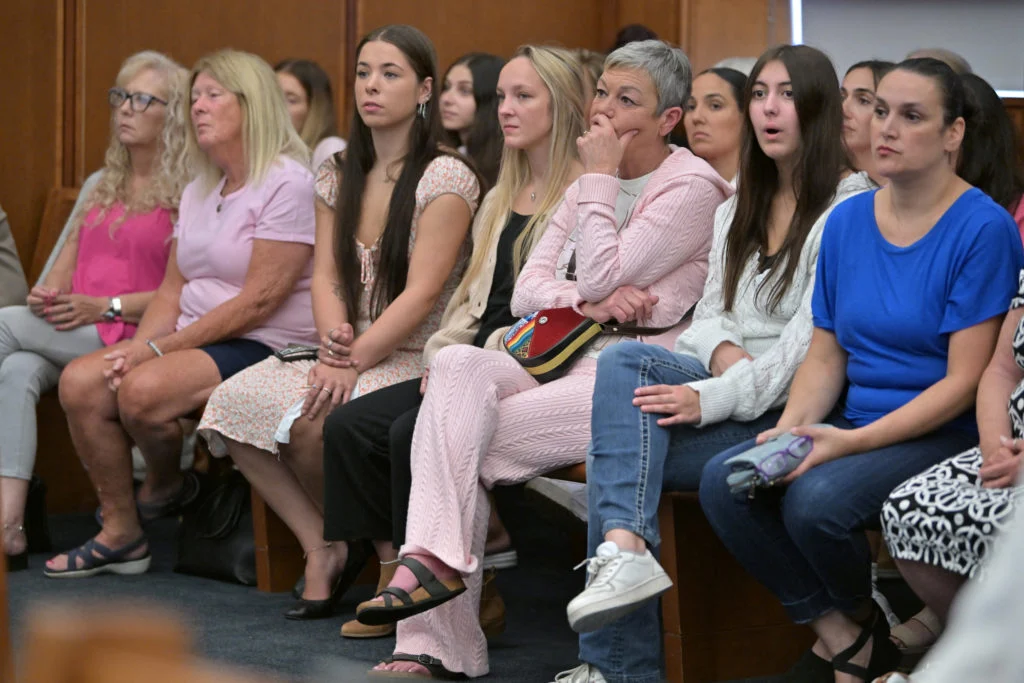
As the monthlong trial nears a critical juncture, the scene outside the courthouse served as a visual manifestation of a growing movement. Supporters, predominantly women, donned pink attire emblazoned with messages of empathy: "Believe," "She Needed Help," and "Peace For Lindsay." Their silent, hour-long vigil marked the largest public show of support to date, underscoring a belief held by many that the tragedy was not a product of malice, but a catastrophic failure of the maternal mental health system.
The Case: A Collision of Mental Health and Law
The trial of Lindsay Clancy is, at its core, a dispute over the state of the defendant’s mind on January 24, 2023. Defense attorney Kevin Reddington does not contest that Clancy killed her children. Instead, the defense argues that Clancy was suffering from postpartum psychosis—a rare, severe, and potentially life-threatening psychiatric condition—compounded by bipolar disorder and extreme sleep deprivation.
The defense maintains that Clancy, who had been a dedicated healthcare professional, was in the throes of a psychotic break. According to Reddington, she had repeatedly sought professional intervention, navigating multiple outpatient providers, trialing various medications, contacting suicide hotlines, visiting emergency rooms, and eventually checking herself into a psychiatric facility.
Conversely, the prosecution has painted a different picture. They argue that the killings were calculated and premeditated. Prosecutors allege that Clancy intentionally manipulated her husband, sending him out of the house to procure medication and food for the family, thereby creating the window of opportunity necessary to commit the act. Furthermore, the state has challenged the validity of her subsequent suicide attempt, suggesting it may not have been the result of overwhelming despair, and has pointed to testimony regarding her inconsistent adherence to prescribed medication regimens.
A Chronology of a Descent
To understand the gravity of the case, one must examine the timeline of events leading up to that January day.
- The Period of Escalation: In the weeks preceding the tragedy, friends, family, and medical professionals testified to a rapidly declining mental state. Witnesses, including her former mother-in-law, have described a woman "begging for help."
- The Night of January 24, 2023: According to the prosecution’s timeline, Clancy orchestrated the absence of her husband to carry out the strangulation of her children. Following the event, she jumped from a second-story window. The fall resulted in permanent paralysis from the waist down.
- Initial Hospitalization: In the days following the tragedy, Clancy was treated in the intensive care unit. Testimony provided by hospital chaplain Sheila Cavanaugh offers a haunting look at those early moments of consciousness.
- The Trial: The current proceedings have been livestreamed, allowing a global audience to witness the testimony of experts, family members, and those who interacted with Clancy in the immediate aftermath.
Clinical Perspectives: Defining Postpartum Psychosis
The trial has brought the reality of postpartum psychosis into the public consciousness. Unlike the more common, though still serious, postpartum depression, postpartum psychosis is estimated to affect only 1 to 2 per 1,000 women following childbirth. It is characterized by severe mood swings, confusion, delusions, and auditory or visual hallucinations.
In court, Chaplain Sheila Cavanaugh recalled a pivotal moment during her visits with Clancy at the hospital. While the defendant was recovering from her injuries, she spoke of hearing a voice—a command that insisted if she did not follow its instructions, neither she nor her children would remain safe.
"She said to me, as I held her hand to comfort her, ‘I’m so glad my children are safe,’" Cavanaugh testified. The chaplain, who has visited Clancy over 200 times, both at the hospital and later at the state facility where she resides, noted that Clancy exhibits a "flat affect" when discussing the events, yet carries "immense grief" regarding the loss of her children.
While the prosecution questioned why these specific disclosures were not documented in the medical records, Cavanaugh was firm in her role: "I’m not there to evaluate the patient; I’m there to bear witness to their suffering."
The Societal Implication: "Dismissed, Neglected, and Ignored"
For many at the rally, the trial is about more than one woman’s legal fate; it is a referendum on how the medical community treats women in the postpartum period.
"Women are being dismissed, neglected and ignored when we speak up," said April Vincent, a 52-year-old paralegal from Providence, Rhode Island. "We’re scared because nobody takes us seriously."
The sentiment was echoed by others in the crowd, including 72-year-old retired nurse Jeanne Zaborski. "I am a mother. I am a grandmother. I have a sister who had problems after birth and it’s just very sad," Zaborski said. "I hope Lindsay gets the care she needs and deserves and other women will come together like we did today."
This collective anxiety highlights a systemic distrust in the current maternal healthcare infrastructure. Supporters argue that if a nurse with access to the medical system could fall through the cracks so completely, the risk to the average mother is even greater.
Official Responses and Expert Testimony
The defense’s primary expert, a psychologist who testified earlier in the trial, concluded that Clancy was not criminally responsible for the killings. This expert testimony aligns with the defense’s strategy to prove that her psychosis rendered her unable to appreciate the wrongfulness of her actions or to conform her conduct to the requirements of the law.
The prosecution, however, continues to press on the inconsistencies in her treatment history and the alleged premeditation. They emphasize that while mental health struggles are real, they do not necessarily negate legal accountability for criminal acts. The jurors are tasked with the unenviable challenge of reconciling the image of a devoted mother and nurse with the horrific nature of the crime, all while deciphering complex psychiatric evaluations.
Looking Ahead: The Broader Impact
As the trial moves toward closing arguments, the implications extend far beyond the courtroom in Plymouth. The case has already prompted legislative and medical discourse regarding the screening of postpartum patients, the adequacy of psychiatric resources, and the stigma surrounding maternal mental health.
For the supporters who stood in the cold outside the courthouse, forming a circle and reciting the Lord’s Prayer, the trial is a moment of reckoning. They view themselves as advocates for a silent population of mothers who feel trapped by the very systems designed to support them.
Regardless of the verdict, the case of Lindsay Clancy has etched itself into the history of American criminal justice and public health. It serves as a stark reminder of the fragile balance between physiological health and psychological stability during the most vulnerable period of a woman’s life. As the nation watches, the trial remains a testament to the fact that, in the eyes of many, the justice system is currently struggling to reconcile the clinical realities of mental illness with the rigid requirements of the law.
The trial continues, and with it, the unresolved questions of how society can better protect those who, like Lindsay Clancy, found themselves in the grip of a nightmare from which they could not wake.