






For millennia, the Indian subcontinent has nurtured a profound understanding of the human body, not merely as a biological machine, but as a dynamic energetic system. At the heart of this ancient wisdom lies Ayurveda, the "Science of Life." Among its most potent tools for health and longevity is the practice of Ayurvedic massage—a sophisticated, intentional form of therapeutic touch that bridges the gap between physical relief and spiritual equilibrium.
Far from a modern luxury spa trend, Ayurvedic massage is a clinical practice rooted in deep anatomical and energetic study, serving both palliative (Shamana) and purificatory (Shodhana) roles. By exploring the nuanced techniques documented in seminal Vedic texts, we can uncover a system of healing that remains as relevant today as it was in the time of the great sages.
A Legacy of Wisdom: The Chronology of Ayurvedic Touch
The roots of Ayurvedic massage are firmly planted in the brhat trayi, the "Great Three" foundational texts of Ayurveda: the Caraka Samhita, the Sushruta Samhita, and the Vagbhata’s Ashtanga Hridayam. These manuscripts, alongside later treatises like the Bhavaprakasha and Yogaratnakara, cataloged the diverse methodologies of massage that were once integral to daily life in ancient India.
Historically, these techniques were not one-size-fits-all. They were systematically employed to support the physical conditioning of warriors and athletes, to enhance reproductive health (virilization), and to provide essential postpartum care for new mothers. Beyond recovery, these practices were deeply embedded in the culture of preventative medicine, designed to maintain the body’s integrity against the inevitable stresses of time and environment.
The Foundation: Elements, Doshas, and the Energetic Body
To understand Ayurvedic massage, one must first grasp the five great elements (Pancha Mahabhuta): space, air, fire, water, and earth. In the human body, these elements manifest as three fundamental biological forces, or doshas:
- Vata: The principle of movement, composed of space and air.
- Pitta: The principle of metabolism and transformation, composed of fire and water.
- Kapha: The principle of structure and lubrication, composed of water and earth.
The guiding philosophy of Ayurvedic treatment is simple yet profound: "like increases like." If a body is suffering from an excess of dry, erratic Vata energy, the practitioner introduces the opposing qualities of heat, oil, and stability. Conversely, if a body suffers from the heavy, stagnant nature of Kapha, the practitioner employs stimulating, dry, and warming techniques. This core principle allows Ayurvedic massage to transcend simple muscle relaxation, acting instead as a corrective intervention for the entire energetic constitution.
Individualized Care: The Art of the Practitioner
The hallmark of any legitimate Ayurvedic treatment is its hyper-customization. No two sessions are identical because no two individuals possess the same Prakruti (unique constitution) or Vikruti (current state of imbalance).
When a practitioner approaches a client, they evaluate several critical factors:
- Agni: The state of the individual’s "digestive fire."
- Ama: The presence and concentration of toxins within the tissues.
- Doshic Imbalance: The specific excess that requires mitigation.
The Science of Oil Selection
Oil is the primary medium of Ayurvedic therapy. In Sanskrit, the word Snehan means both "oil" and "love." The choice of carrier oil and the herbs infused within it are not incidental; they are selected to penetrate the skin and deliver therapeutic compounds directly to the deeper tissues.
- For Vata: Heavy, warming oils like sesame are preferred to ground the nervous system.
- For Pitta: Cooling, soothing oils such as coconut or sunflower are used to pacify internal heat.
- For Kapha: Light, stimulating oils like mustard are employed to break up stagnation.
In instances where Ama (toxins) is high, the standard oil massage is contraindicated. Instead, practitioners utilize Udvartana—a vigorous, dry massage using herbal powders. This technique acts as a mechanical exfoliant and a systemic detoxifier, proving that the tradition is as much about removal as it is about nourishment.
Special Considerations: The Mind and the Nervous System
According to Samkhya philosophy, the air element governs the sense of touch (Sparshendriya). Because Vata is composed of air and space, the mind—which also resides within these subtle elements—is uniquely responsive to touch. This makes Ayurvedic massage an exceptional tool for managing stress, anxiety, and mental health.
Furthermore, the skin (Tvak) acts as the primary interface between the external world and our internal physiology. Governed by bhrajaka pitta, the skin possesses its own "digestive fire" capable of absorbing nutrients. Regular massage feeds the skin, allowing essential oils and herbal extracts to reach the nerves, muscles, bones, and organs. This regular, deep-tissue nourishment improves not just the surface complexion, but the systemic resilience of the entire body.
Categories and Modalities of Ayurvedic Massage
The diversity of techniques within the Ayurvedic tradition is vast, ranging from full-body applications to localized therapy.
Abhyanga: The Practice of External Oleation
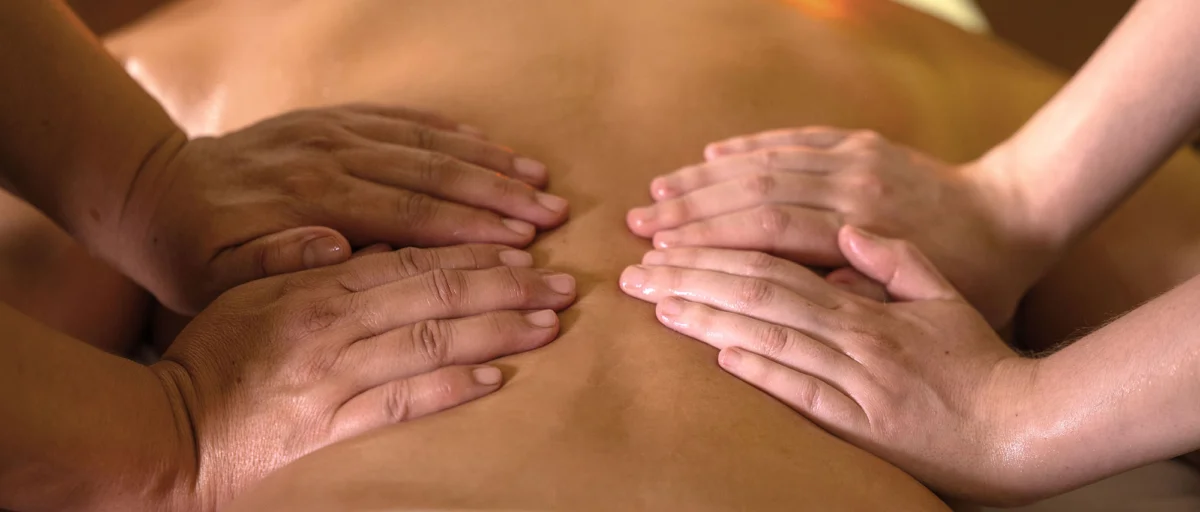
Abhyanga is the most recognized form of Ayurvedic bodywork. It involves the rhythmic application of warm, herbalized oil. Whether performed as a self-massage or by one or two practitioners in a synchronized four-handed session, the goal remains the same: to loosen deep-seated toxins and prepare them for elimination. It is a cornerstone of Panchakarma, the traditional five-fold detoxification process.
Dry and Paste Therapies
- Udvartana: Massage with hot, dry herbal powders, highly effective for Kapha-related weight management and lymphatic stagnation.
- Udsadana: A beauty-focused procedure using dry herbs to enhance skin texture and luster.
- Udgarshana: The application of herbal pastes to address specific dermatological concerns.
Technical Precision: Strokes and Directionality
The practitioner’s hands follow the body’s energy flow through specific strokes. Anuloma (moving away from the heart) is used to ground Vata and calm the mind, while Pratiloma (moving toward the heart) is often employed to stimulate lymphatic drainage and improve circulation. Techniques such as Peedana (kneading), Udvesthana (twisting), and Sandhi Calana (joint mobilization) ensure that every layer of the musculoskeletal system is addressed.
Marma Therapy: The Energetic Gateway
Perhaps the most sophisticated dimension of Ayurvedic massage is Marma Therapy. Marmani are specific energy points—the junctions where muscles, veins, ligaments, bones, and joints meet. Unlike the points used in traditional Chinese acupuncture, which are often microscopic, Marmani can vary in size and serve as gateways to the body’s "inner pharmacy."
By applying precise pressure to these points, practitioners can clear blockages in the nadi (energy channels) and restore the healthy flow of prana (life force). This is the bridge where physical massage becomes an energetic surgery, capable of profound shifts in mental, emotional, and physical states.
Implications for Modern Wellness
In an era defined by chronic stress and sedentary lifestyles, the ancient methodologies of Ayurveda offer a compelling alternative to symptomatic, quick-fix health solutions. By viewing the body as an interconnected web of elements and energy, Ayurvedic massage provides a holistic path to longevity.
The implications for modern health are clear: we are moving toward a paradigm where personalized, nature-based therapies are becoming essential. Whether addressing the systemic exhaustion of a Vata-dominant lifestyle or the inflammatory heat of a Pitta-dominant imbalance, the "healing touch" of Ayurveda provides a roadmap to return the body and mind to a state of Sama—perfect balance.
As we continue to integrate these ancient techniques into contemporary practice, we gain more than just physical relief; we regain our connection to the fundamental laws of nature, allowing us to thrive with the grace and resilience that our ancestors understood so well. For those interested in the profound depth of these practices, the study of Marmani and the continued exploration of herbalized oleation represent the next frontier in personal, holistic health.