







By Global News Desk
The World Health Organization (WHO) has issued a cautious assessment of the Ebola epidemic currently gripping the Democratic Republic of the Congo (DRC), suggesting that while international and local containment efforts are finally "catching up" with the rapid spread of the virus, the crisis remains in a precarious, volatile state. With confirmed cases surpassing 340 and the virus successfully crossing international borders into neighboring Uganda, the medical community is bracing for what could be a prolonged and complex battle against one of the world’s most lethal pathogens.
The current situation highlights the harrowing intersection of a public health emergency and a protracted humanitarian catastrophe. As medical teams fight to establish treatment centers and initiate contact tracing, they are simultaneously navigating a landscape defined by armed conflict, mass displacement, and systemic infrastructure failure.
The Scope of the Crisis: A Rapidly Evolving Threat
Since the outbreak was officially declared on May 15, the trajectory of the virus has been relentless. What began as a localized cluster of infections in the provinces of Rwampara, Mongbwalu, and Bunia—the capital of the North Ituri province—has metastasized into a regional emergency.
Expanding Footprint
Health officials report that the virus has now permeated more than 20 distinct health zones across the northeast. The geographical expansion has severely strained the DRC’s medical infrastructure. In the early stages of the surge, many local facilities were forced to turn away patients, not due to a lack of medical expertise, but because they had run out of beds and basic life-support supplies.
The death toll, currently standing at 60, serves as a grim indicator of the virus’s virulence. With 344 confirmed infections, the case-fatality rate underscores the necessity for immediate, high-level intervention. The scale of the challenge is further magnified by the sheer size of the country; the epicenter in the northeast is roughly 950 miles from the capital, Kinshasa—a distance equivalent to the stretch between Jackson, Mississippi, and Washington, D.C., posing massive logistical hurdles for the delivery of vaccines, protective equipment, and personnel.
Chronology of the Outbreak
The progression of the current Ebola crisis in the DRC can be broken down into distinct phases of escalation:
- Mid-May: The official declaration of the outbreak is issued by the DRC Ministry of Health following a cluster of unexplained hemorrhagic fever cases in North Ituri.
- Late May: The virus spreads from the initial three health zones to encompass a wider territory, overwhelming local clinics and sparking an urgent appeal for international aid.
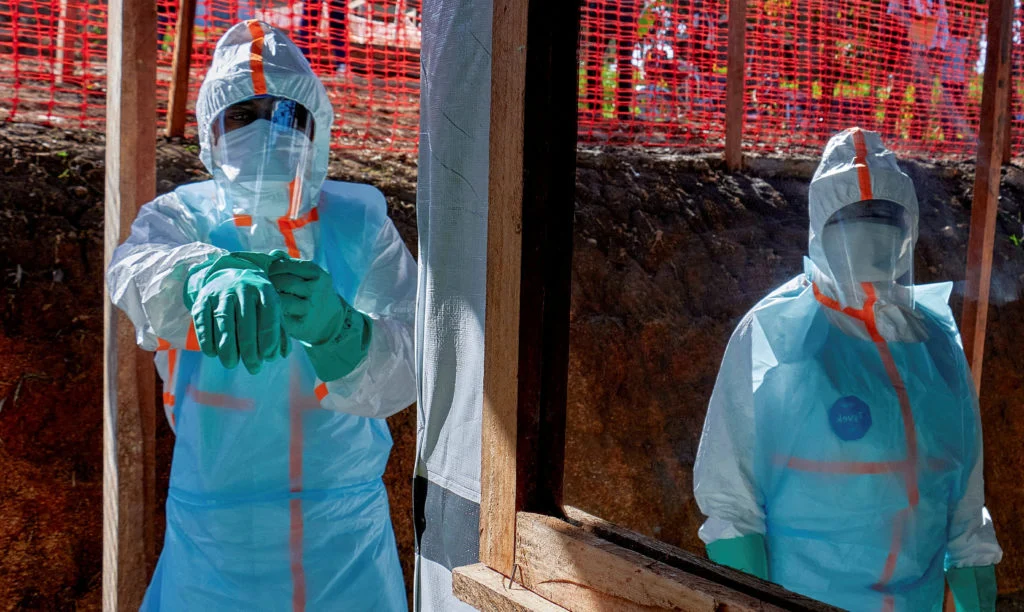
- Early June: The international community responds with a significant influx of funding and medical supplies. Airlifts deliver critical equipment to Bunia to establish new, dedicated Ebola Treatment Centers (ETCs).
- Mid-June: The virus reaches the border with Uganda, prompting the Ugandan government to implement strict border closures. Reports confirm the presence of the virus in regions controlled by various non-state armed groups.
- Present Day: The WHO confirms that while the response infrastructure is maturing, the combination of regional instability and cross-border migration makes the situation highly unpredictable.
Supporting Data and Medical Challenges
The struggle to contain Ebola is fundamentally a race against the biological clock of the virus. Identifying cases, tracing contacts, and breaking the chain of transmission requires a level of mobility and access that is currently obstructed by the region’s instability.
The Impact of Conflict
The northeastern DRC is home to a dense concentration of armed militias, including CODECO, the Allied Democratic Forces (ADF), and various "Zaire" factions. These groups frequently clash with one another and with government forces, forcing thousands of civilians to abandon their homes and seek refuge in overcrowded, makeshift displacement camps.
These camps are essentially "hot zones" for disease transmission. In environments where social distancing is a physical impossibility and sanitation is minimal, Ebola can spread with terrifying efficiency. Health workers have noted that their ability to perform "contact tracing"—the cornerstone of Ebola containment—is paralyzed by the violence. Tracking individuals who have been exposed to the virus requires safe passage through contested territory, a luxury that currently does not exist in much of the eastern and northeastern DRC.
Official Responses and International Intervention
The international response has been swift but cautious. The WHO, in conjunction with the DRC government, has spearheaded a multi-million-dollar mobilization effort. These funds have been utilized to airlift essential medical supplies, deploy specialized epidemiology teams, and construct new treatment facilities designed to isolate patients and prevent nosocomial (facility-based) transmission.
The Debate on Border Controls
A significant point of contention has been the closure of international borders. Uganda’s decision to shutter its border with the DRC was a sovereign choice intended to protect its own population, yet it has had devastating economic consequences for the border communities. Many residents of Ituri province rely on informal, cross-border trade with Uganda and South Sudan to survive.
The WHO has consistently discouraged the complete closure of borders, arguing that such measures often push trade and travel underground, making it harder to track potential carriers of the virus. Instead, the WHO advocates for:
- Enhanced Screening: Implementing robust thermal scanning and health checks at all official border crossings.
- Surveillance: Strengthening local surveillance networks to identify symptomatic individuals before they cross into neighboring jurisdictions.
- Humanitarian Corridors: Establishing safe passages to ensure that essential goods and medical aid can reach trapped populations.
Implications: A Region at a Crossroads
The ramifications of this outbreak extend far beyond the immediate medical toll. For the people of the DRC, the virus is an added layer of trauma in an already fractured society.
Socioeconomic Collapse
The disruption of daily life is profound. In regions where formal employment is scarce, the collapse of petty trade—driven by border closures and the fear of infection—has pushed families into deeper poverty. As the economy stalls, the ability of local communities to support their own health needs diminishes, creating a vicious cycle of poverty and disease.
The Future of Containment
The path forward is fraught with uncertainty. The DRC government, alongside international partners, has issued appeals to the warring factions to observe a "humanitarian ceasefire." The objective is clear: create a window of peace long enough to allow health workers to vaccinate, treat, and monitor the affected population. Whether these militant groups will prioritize the survival of the civilian population over their territorial objectives remains the central question of the crisis.
As the WHO continues to coordinate the global response, the message to the international community is one of vigilance. The "catching up" phase is a victory for logistics and science, but it is not a victory over the virus itself. The true test of this response will be in the coming months, as authorities attempt to secure the cooperation of armed groups, maintain the flow of aid through a war zone, and prevent the virus from establishing a permanent foothold in neighboring nations.
In the words of those on the ground in Kinshasa, the crisis is not merely a medical event; it is a profound test of international solidarity and the resilience of a nation that has endured decades of instability. For now, the world watches as the medical teams continue their work, hoping that the progress made in the last few weeks is enough to turn the tide.