










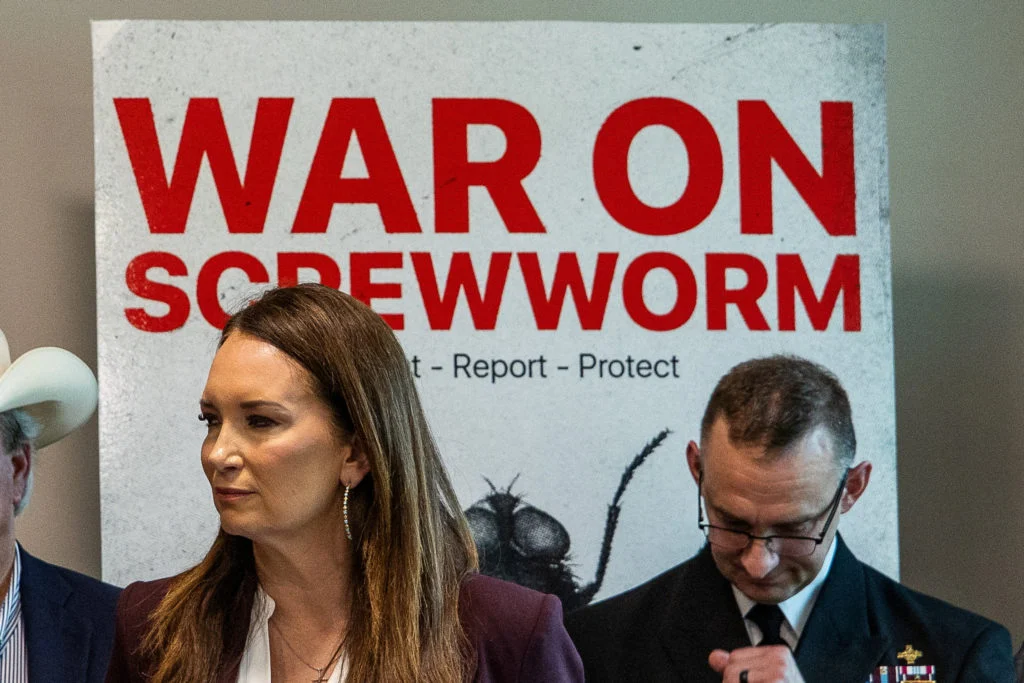
The United States, having declared victory over the New World screwworm sixty years ago, now finds itself locked in a desperate, high-stakes battle to push the deadly parasite back across its southern border. As U.S. Agriculture Secretary Brooke Rollins observed the release of sterile flies in Texas this week, the symbolic gesture underscored a sobering reality: the American cattle industry—a cornerstone of the nation’s food security—is facing its most significant biological threat in decades.
With cases emerging in Texas and New Mexico, the U.S. Department of Agriculture (USDA) is launching a massive $1 billion containment strategy. The parasite, which feeds on the living flesh of warm-blooded animals, has triggered international trade bans, sparked a fierce political blame game between the Trump and Biden administrations, and highlighted the complex intersection of climate change and biosecurity.
Main Facts: The Nature of the Threat
The New World screwworm (Cochliomyia hominivorax) is not a typical fly. Unlike common houseflies that feed on decaying organic matter, the female screwworm fly is attracted to the open wounds of living animals, including livestock, wildlife, and, in rare instances, humans. Once it locates a wound—such as an umbilical cord, a tick bite, or a branding mark—it deposits its eggs. Within hours, the eggs hatch into larvae, which burrow into the host’s flesh, feeding on live tissue.
If left untreated, an infestation can be fatal to cattle within days. The biological urgency of the threat has prompted the USDA to enforce strict quarantine zones extending 12 miles around every confirmed case. Despite the gravity of the situation, Secretary Rollins has urged vigilance, emphasizing that the parasite can be managed if ranchers monitor their herds closely and apply immediate medical treatment to any detected wounds.
A Chronology of the Reemergence
The return of the screwworm marks the end of a six-decade success story.
- 1960s–2022: Through decades of aggressive international cooperation and the use of the Sterile Insect Technique (SIT), the U.S. and its partners successfully pushed the screwworm population down to a "containment zone" in the narrow isthmus of Panama.
- 2023: Scientists and agricultural officials noted a disturbing shift as the parasite broke through the Panama containment zone, beginning a northward migration that caught the international community off guard.
- 2024: The crisis intensified as Mexico reported over 28,000 cases. The northward spread continued, affecting both Mexican and American agricultural sectors.
- 2025 (Present): Seven confirmed cases have been detected in Texas and New Mexico. In response, the U.S. has shuttered its southern ports to Mexican livestock, and nations including Canada have implemented temporary import bans on U.S. livestock to protect their own herds.
Supporting Data and Technical Strategy
The cornerstone of the U.S. response is the revival and expansion of the Sterile Insect Technique (SIT). The USDA is allocating approximately $750 million toward constructing a state-of-the-art facility capable of mass-producing 300 million sterile flies per week.
The strategy is elegant in its simplicity: female screwworms mate only once in their lifetime. By releasing massive quantities of laboratory-sterilized males into the wild, scientists ensure that the majority of wild females mate with sterile partners, resulting in unviable eggs. This effectively crashes the population density over time.
However, the efficacy of this program is being challenged by two major factors: climate change and the unknown variables of the fly’s sudden resurgence.
"The fly is a creature of warmth," explains Lee Haines, an associate research professor at the University of Notre Dame. "Its entire life cycle, from egg to adult, can be completed in as little as three weeks under tropical conditions."
As global temperatures rise, the "comfort zone" for the screwworm has expanded. The parasite thrives in humid environments with temperatures exceeding 77°F (25°C). As these conditions become more prevalent in northern latitudes, the geographical window for potential spread has widened significantly, complicating the USDA’s mission.
Official Responses and the Political Divide
The response to the screwworm has become as volatile as the parasite itself, with the USDA’s leadership clashing with Democratic lawmakers over the root cause of the outbreak.
Secretary Rollins has repeatedly pointed to the previous administration, arguing that the conditions for the parasite’s return were fostered under the Biden presidency. During her testimony before the U.S. Senate Agriculture Committee, Rollins alleged that the movement of undocumented immigrants and the activities of Mexican cartels—who she claims are smuggling illicit, uninspected livestock—created a vector for the parasite to re-enter the U.S.
"People moving north to America, bringing their livestock with them… we knew it was coming," Rollins stated.
Conversely, Democratic leaders have characterized these claims as a deflection from the Trump administration’s own fiscal policies. A letter signed by nearly a dozen Democratic senators challenged the USDA’s current operational capacity, noting that nearly 20% of U.S. counties that began 2025 with at least one federal Animal and Plant Health Inspection Service (APHIS) employee ended the year with none.
Representative Ted Lieu (D-CA) took a harsher tone, labeling the administration’s focus on the previous term as "shortsighted."
"The life cycle of a screwworm is about 14 to 54 days," Lieu remarked. "The Trump administration has been in office for over 500 days. This is on them. They need to own up to it, and they need to apologize."
In defense of her department, Secretary Rollins noted that she has reassigned over 100 USDA staff members specifically to the screwworm response, categorizing it as a top-tier national priority.
Implications for the Industry and the Economy
While the situation remains critical, the immediate economic outlook for the American consumer remains cautiously stable. Industry experts suggest that the parasite is unlikely to trigger an immediate spike in beef prices, provided the USDA can prevent a widespread outbreak where mass livestock mortality occurs.
Because screwworms do not affect the safety of the meat supply, the primary economic impact is felt by the producers. The disruption of trade with Mexico and Canada—a vital component of the North American agricultural supply chain—creates a ripple effect of uncertainty. Ranchers are facing increased costs related to preventative care, heightened labor requirements for herd inspections, and the potential loss of export markets.
For the scientific community, the mystery of the "Panama Breakout" remains unresolved. "I don’t have the answer to that one," admitted Jonathan Cammack, a professor of livestock entomology at Oklahoma State University. "It doesn’t help us to speculate. Our focus must remain on ramping up the sterile fly program and achieving the international cooperation necessary to push this pest back to the Isthmus of Panama."
Conclusion: A Long Road Ahead
The battle against the New World screwworm is far from over. As summer temperatures peak, the USDA, ranchers, and international partners are engaged in a race against a biological clock that moves faster as the planet warms. Whether the solution lies in a return to traditional eradication techniques, a massive influx of funding, or a more nuanced approach to international border policy, one thing is clear: the screwworm has proven that even after 60 years of absence, nature remains an unpredictable adversary to modern agriculture.
As Secretary Rollins continues to oversee the deployment of sterile flies, the nation watches closely. The success of this billion-dollar effort will not only determine the survival of individual herds in Texas and New Mexico but will serve as a bellwether for the federal government’s ability to manage the emerging, complex threats of a changing global climate.