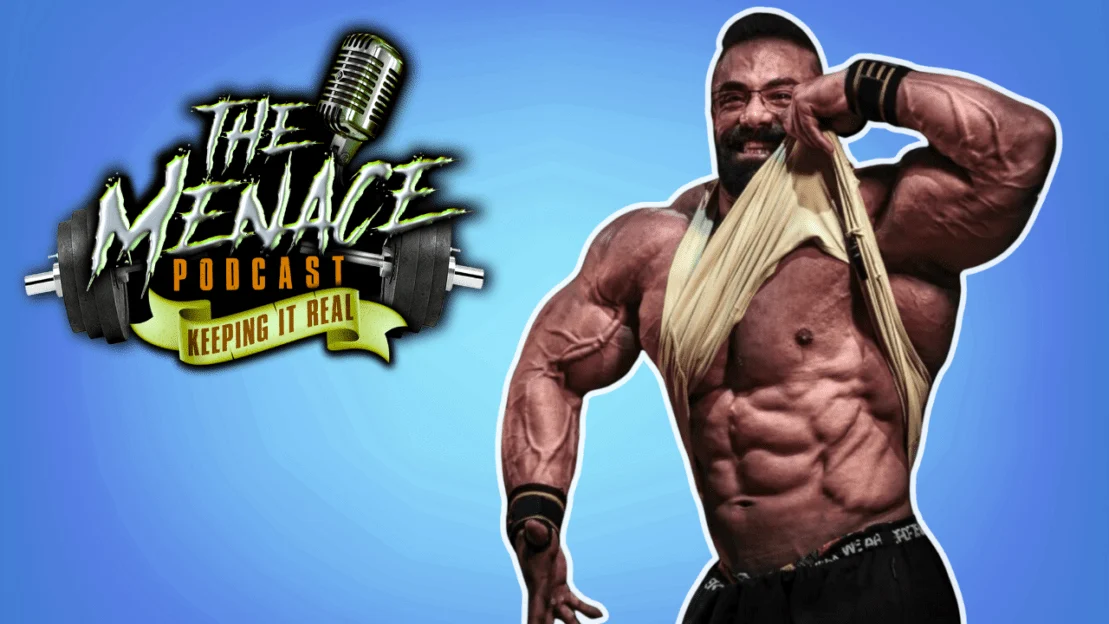
In the high-stakes world of professional bodybuilding, athletes often fall into the trap of “more is more.” The pursuit of sheer mass, the grinding obsession with heavy iron, and the relentless cardiovascular endurance required to achieve contest-ready conditioning often overshadow the most critical element of the sport: the presentation. On Episode 289 of The Menace Podcast, legendary bodybuilder Dennis “The Menace” James sat down with peers Jose Raymond and Milos Sarcev to engage in a candid retrospective of his storied career. While James remains one of the most respected figures in the sport, his reflection was marked by a poignant realization—one that serves as a masterclass for the next generation of competitors. If he could turn back the clock, James wouldn’t change his diet or his training split; he would change how he presented his physique.
A Legacy Built on Three Decades of Iron
To understand the weight of James’s advice, one must first appreciate the magnitude of his career. Competing across three distinct decades, Dennis James was a force of nature. His journey began in the 1990s, where he climbed the ranks to become a Mr. Universe. As he transitioned into the 2000s, he solidified his reputation as a top-tier professional, securing a victory at the Europa Super Show and remaining a perennial threat on the world’s biggest stages.
Perhaps most impressive was his consistency at the Mr. Olympia, the sport’s ultimate proving ground. James stepped onto the Olympia stage ten times throughout his career, consistently holding his own against the greatest names in history, including Ronnie Coleman, Jay Cutler, and Dexter Jackson. His career culminated in a stellar fourth-place finish in 2003, a testament to his freakish muscularity and dedication. Yet, even with these accolades, James looks back at his tenure with a “what if” mentality. He contends that while his physique was undeniably elite, his failure to master the art of posing—and his prioritization of size over flow—might have cost him higher placings on the scorecard.
The Shift in Philosophy: Size vs. Presentation
During the podcast, James was remarkably blunt about his past training priorities. When asked what he would change about his preparation, he didn’t hesitate. “I would pay all the attention on posing,” he declared. “If I could change, if I could turn back the time, I would f*****g pose.”
For many bodybuilders, posing is viewed as an afterthought—a chore to be performed once the “real” work of lifting is finished. James admits that he was once part of this mindset. Working alongside the renowned coach Milos Sarcev, James would often finish grueling training sessions completely exhausted, feeling that his muscles were too depleted to focus on the nuanced art of hitting poses. He viewed posing as an energy-draining endeavor that took away from the recovery time his body desperately needed after a heavy session.
In hindsight, James sees this as a fundamental error in judgment. He contrasts his own approach with that of Melvin Anthony, a contemporary known for his fluid, graceful, and masterful stage presence. “Melvin Anthony was one of those guys,” James recalled. “He couldn’t keep his shirt on long enough. But you could see, on stage, he held his s**t, and it was always perfect.”
The Physiological Cost of Ignoring the Stage
The implications of James’s revelation extend beyond mere vanity; they touch upon the structural integrity of the sport. James suggests a concrete trade-off for any athlete looking to optimize their performance: “The two hours of cardio that I did, I would just do one hour, and one hour posing.”
This proposal is radical in a sport obsessed with calorie expenditure and fat loss. However, James’s point is logical: a bodybuilder’s primary objective is not to be a cardio athlete or a powerlifter, but a visual artist. “No one asks you, when you step on stage, how much you bench or how many reps you do,” James noted. “They want to see what you look like, and if you don’t practice the posing, how are you going to get on stage?”
Milos Sarcev, a guest on the podcast and a coach known for his emphasis on muscle fullness and aesthetic flow, echoed these sentiments. Sarcev highlighted the crucial role of posing in abdominal control. As modern bodybuilding has faced criticism regarding the “distended midsection” look, Sarcev argued that constant, disciplined posing is the primary tool for maintaining a tight, vacuum-like core under pressure. “For posing, the biggest thing is keeping that midsection,” Sarcev explained. “From every angle, that’s it.”
Chronology of a Masterclass: Lessons Learned
The evolution of posing in bodybuilding has been erratic. In the golden era, athletes like Frank Zane and Lee Labrada treated posing as a choreographed dance—a way to highlight strengths and mask weaknesses. As the sport moved into the late 90s and 2000s, the emphasis shifted heavily toward mass, and the art of the “hit” became secondary to the sheer circumference of the athlete’s limbs.
Dennis James represents the bridge between these two eras. His career highlights reflect this transition:
- 1990s: The foundation phase. Mastering the basics of muscle building to achieve Mr. Universe status.
- 2003: The peak. Achieving his highest Olympia placing (4th) using a heavy, high-volume approach that relied on sheer size.
- 2012: The veteran phase. Competing in the Masters Mr. Olympia, where the limitations of his previous posing-averse training began to show in comparison to more technical posers.
By examining his career through this timeline, it becomes clear that James’s success was built on physical dominance, but his potential for even greater victories was capped by the lack of aesthetic refinement.
Why Posing is the Ultimate “Performance Enhancer”
The pedagogical consensus provided by James and Sarcev is that posing is, in itself, a resistance exercise. When performed correctly, posing requires intense isometric contractions. Holding a “most muscular” or a “side chest” pose for 60 seconds is incredibly taxing, requiring the athlete to control their breathing, stabilize their core, and maximize muscle fiber recruitment under extreme fatigue.
The Technical Benefits:
- Muscle Maturity: Constant contraction and relaxation teach the nervous system to fire more efficiently, resulting in a “harder” look on stage.
- Midsection Control: As noted by Sarcev, the abdominal wall is a muscle. Training it to remain tight while the rest of the body is under tension prevents the “spill-over” look that plagues many modern competitors.
- Shadowing and Lighting: Posing teaches the athlete how to manipulate their body to catch the light, creating the illusion of deeper cuts and more pronounced muscle separation.
- Confidence: A bodybuilder who knows their posing routine inside and out is a bodybuilder who can command the stage. They spend less time “searching” for their poses and more time projecting their physique to the judges.
Implications for the Modern Competitor
The takeaway for today’s aspiring bodybuilders is clear: do not treat your posing practice as an afterthought. It should be as integral to your program as your back day or your leg day. The industry has reached a point where the playing field for mass is incredibly level; almost everyone has access to advanced nutrition, pharmacology, and training science. What differentiates the winner from the runner-up is the ability to present that mass with grace, control, and surgical precision.
Dennis James, a man who gave everything to the iron, now offers the most valuable gift of all: the clarity of hindsight. By urging athletes to trade an hour of cardio for an hour of posing, he is challenging the culture of “more work” and replacing it with the culture of “better work.”
Conclusion
The story of Dennis James is not one of regret, but one of evolution. His transparency on The Menace Podcast serves as a reminder that even at the highest levels of professional sport, the most basic elements—like how one holds their own body—can be the deciding factor between a good career and a legendary one. As the sport moves forward, the athletes who listen to the wisdom of the veterans and prioritize the aesthetic art of posing will undoubtedly be the ones to dominate the stage. The iron will build the foundation, but the pose will tell the story. For those who want to be remembered, the lesson is simple: stop chasing the scale, start chasing the perfection of the pose, and never underestimate the power of a well-held flex.