









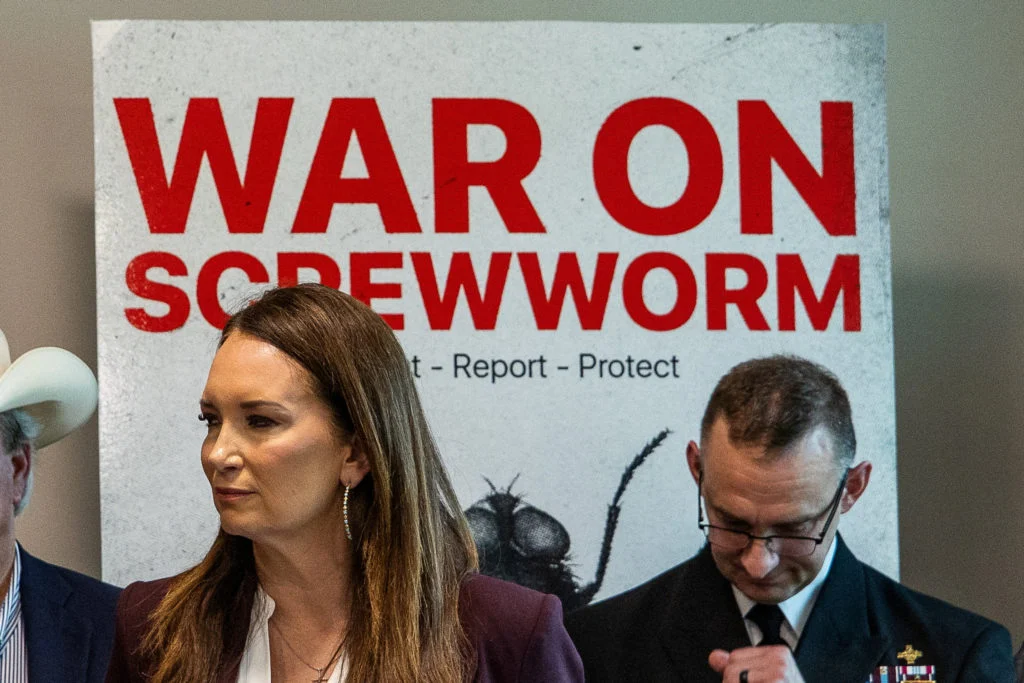
Sixty years after the United States declared a historic victory by eradicating the New World screwworm, the parasitic pest has returned to American soil, sparking a multi-agency crisis and a fierce political firestorm. Agriculture Secretary Brooke Rollins has announced an ambitious $1 billion federal initiative to combat the infestation, which threatens to devastate the nation’s multi-billion-dollar cattle industry and disrupt international trade.
As the U.S. Department of Agriculture (USDA) rushes to deploy millions of sterile flies to halt the parasite’s progress, the situation has become a lightning rod for partisan debate. While the administration points to border security and previous policy failures, Democratic lawmakers argue that systemic budget cuts to federal inspection agencies have left the country’s agricultural defenses dangerously porous.
The Biological Threat: A Parasite of Living Flesh
The New World screwworm (Cochliomyia hominivorax) is not merely a nuisance; it is a specialized predator. Unlike common houseflies that feed on decaying matter, the female screwworm lays her eggs in the open wounds of warm-blooded animals. Upon hatching, the larvae—or "screwworms"—burrow into the living flesh of the host, feeding on tissue and potentially killing the animal within days.
"Screwworms are on their way to becoming a billion-dollar international problem," Secretary Rollins noted during a visit to a Texas ranch where a recent case was identified. The infection was discovered in a calf’s umbilical wound, highlighting the need for extreme vigilance among ranchers.
The biological challenge is compounded by a changing climate. Screwworms thrive in hot, humid conditions, where their life cycle—from egg to adult—can complete in as little as three weeks. As global temperatures rise, the temperate zones that previously acted as a natural barrier are becoming increasingly hospitable to the fly.
Chronology of the Crisis
The return of the screwworm marks the end of a six-decade period of stability. Following a massive, decades-long effort in the 20th century, scientists successfully pushed the screwworm population down to a "containment zone" in the Isthmus of Panama. For years, the barrier held.
- 2023: The parasite inexplicably broke through its containment in Panama, beginning a slow, steady migration northward through Central America and Mexico.
- Early 2025: The threat reached critical levels in Mexico, where over 28,000 cases were reported in two years.
- Mid-2025: The first confirmed cases appear in Texas and New Mexico. The USDA responds by establishing 12-mile quarantine zones around every detection site.
- Late 2025: The U.S. southern ports are closed to Mexican livestock, and Canada follows suit, halting the import of livestock from Texas to prevent the spread across the border.
The $1 Billion Strategic Response
To address the emergency, the USDA is preparing what Secretary Rollins describes as an "all-out assault." The cornerstone of this strategy is the Sterile Insect Technique (SIT), a proven method that has been refined since the 1950s.
The $1 billion funding package is largely earmarked for the construction and operation of a massive laboratory capable of producing up to 300 million sterile flies per week. The logic is elegant in its simplicity: female screwworms mate only once in their lifetime. By releasing millions of sterilized males into the wild, the USDA aims to ensure that the vast majority of female flies fail to produce offspring, effectively driving the population into a terminal decline.
"We have to get the pests back down to the Panama barrier," says Jonathan Cammack, a professor of livestock entomology and parasitology at Oklahoma State University. Cammack emphasizes that while the situation is dire, it is contained—provided that ranchers and federal agents work in lockstep. "I don’t have the answer as to how they breached the barrier in the first place, and I don’t know if anyone does. It doesn’t help us to speculate. We must focus on the ramp-up of the sterile fly program."
Official Responses and Political Friction
The crisis has triggered a sharp division in Washington. Secretary Rollins has consistently blamed the previous administration, suggesting that the parasite’s return was facilitated by porous borders. During testimony before the Senate Agriculture Committee, Rollins alleged that the flies arrived via "illicit cattle traffic" facilitated by cartels and the migration of animals alongside humans.
"People moving north to America, bringing their livestock with them—we knew it was coming," Rollins told the committee.
However, Democrats have pushed back, citing evidence of declining oversight. A letter signed by nearly a dozen Democratic senators challenged the USDA’s current operational capacity, noting that nearly 20% of U.S. counties that began 2025 with an Animal and Plant Health Inspection Service (APHIS) employee ended the year with none.
Representative Ted Lieu (D-CA) was particularly vocal, dismissing the administration’s attempt to blame the Biden team. "The life cycle of a screwworm is about 14 to 54 days," Lieu stated. "The Trump administration has been in office for over 500 days. This is on them. They need to own up to it, and they need to apologize."
In response, Secretary Rollins stated that she has reallocated over 100 USDA staff members to the front lines of the screwworm response, labeling it one of the highest priorities of her tenure.
Economic Implications: Beef Prices and Trade
For the average American consumer, the immediate concern is the price of beef. Currently, beef prices are hovering near record highs. While the screwworm does not affect human food safety—the parasite does not survive the cooking process—the potential for an industry-wide collapse is real.
Agricultural economists note that as long as the cases remain isolated and do not turn into widespread outbreaks, the impact on grocery store shelves should remain muted. However, the international trade fallout is already significant. The closure of the U.S.-Mexico border to livestock trade has disrupted the supply chain, and Canada’s import restrictions have added another layer of economic complexity.
"The goal is to protect the U.S. cattle industry," says one USDA official. "If we cannot contain this quickly, we are looking at not just an animal health crisis, but a major inflationary event for the meat sector."
Scientific Outlook: Can the Barrier be Restored?
The scientific community remains cautiously optimistic, provided the government maintains long-term funding. Lee Haines, an associate research professor of biological sciences at the University of Notre Dame, underscores the importance of the climate factor.
"The fly is a creature of warmth," Haines explains. "Because its life cycle can complete in three weeks under tropical conditions, the northward expansion is a direct result of both the parasite’s resilience and changing habitat suitability."
Ultimately, the battle against the screwworm is a race against time and biology. The success of the $1 billion sterile fly initiative will depend on the ability of the USDA to work across borders—coordinating with both Mexican and Central American partners—to re-establish the biological blockade at the Isthmus of Panama. Until that barrier is restored, the U.S. cattle industry remains on high alert, with ranchers serving as the first line of defense in a war against a pest that was once thought to be a relic of history.