








Published June 28, 2026
In the digital age, the term "shadow work" has become a ubiquitous hashtag, trending across social media platforms with promises of quick emotional catharsis. A 90-second video might suggest that a quick journal entry or a conversation with your "inner child" is the key to unlocking hidden psychological depth. However, beneath the veneer of pop psychology, shadow work remains a profound, complex, and often uncomfortable process of excavation. True shadow work is not merely a self-help trend; it is an ancient, rigorous engagement with the unconscious aspects of the human experience, including our deepest traumas, shames, and latent potentials.
The Foundations of the Shadow: From Jung to the Vedas
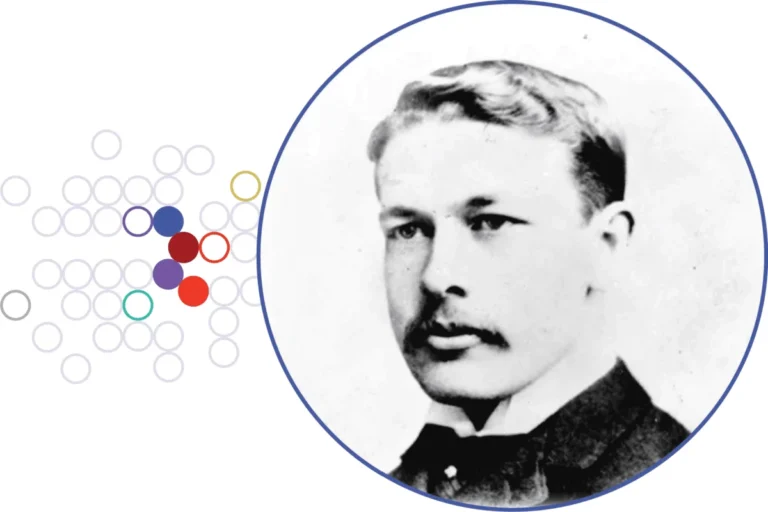
To understand shadow work, one must look beyond the screen and into the history of analytical psychology. The concept is largely attributed to the 20th-century Swiss psychiatrist Carl Gustav Jung. Jung posited that the "shadow" consists of the repressed or unconscious parts of the personality that the conscious ego refuses to acknowledge. By integrating these dark or hidden elements, individuals can achieve a greater sense of wholeness.
However, Jung’s framework did not emerge in a vacuum. His writings frequently drew upon Vedic and Hindu philosophies that have been in circulation for millennia. While his work is often critiqued for its Eurocentric lens, Jung openly acknowledged his debt to Eastern concepts. He famously correlated the ancient Hindu idea of Atman (the individual self) and Brahman (the universal consciousness) with his own theories of the "Self" and the "collective unconscious."
At its core, both Jungian psychology and ancient yogic traditions agree on a singular, transformative premise: self-study (Svadhyaya) is the primary vehicle for uncovering hidden truths. This process requires moving beyond surface-level introspection to become intimately aware of—and eventually accepting—all facets of the authentic self. This is the true definition of shadow work: the ability to recognize one’s individual struggles as part of a larger, universal tapestry.
Chronology and Context: The Evolution of Shadow Work
The trajectory of shadow work has shifted significantly over the last century, moving from the clinical, often elitist, confines of early 20th-century psychoanalysis to the mainstream, democratized landscape of modern wellness.
- Pre-20th Century: Rooted in Vedic tradition, shadow work was historically practiced through rigorous yoga, meditation, and inquiry into the nature of the self. The focus was on the dissolution of the ego to realize unity with the divine.
- 1920s–1950s: Carl Jung formalizes the concept of the "Shadow" in Western clinical settings, framing it as a necessary step for psychological maturation and individuation.
- 1960s–1990s: The "New Age" movement integrates these concepts into Western spiritual practices, focusing heavily on healing and therapeutic release.
- 2020–Present: Digital platforms have accelerated the spread of shadow work. While this has increased accessibility, it has also led to the "gamification" of trauma, where complex psychological processes are often reduced to simplified, bite-sized content.
Supporting Data: Why the "Back Body" Matters
A critical oversight in modern wellness is the focus on the "front body." In contemporary yoga studios, instructors frequently cue students to "open the heart," focusing on the Anahata (heart) chakra. This instruction is almost exclusively oriented toward radiating compassion outward. However, in traditional yogic systems, the heart center is a two-way street.
The back side of the heart chakra is symbolically and somatically aligned with the "shadow"—the past experiences, hidden resistances, and internalized emotions we often avoid. While the front of the heart expresses love to the world, the back of the heart holds the record of our personal history.
When we turn our attention to the back body, we are not looking away from our pain; we are holding it with compassionate awareness. This shift in perspective is supported by somatic research, which suggests that physical tension, particularly in the thoracic spine and between the shoulder blades, is a common site for stored emotional stress. By utilizing heart-opening postures that specifically target the posterior heart space, practitioners can begin to release the physical manifestations of their unconscious shadows.
Implications: The Synthesis of Movement and Mind
The integration of shadow work into a physical yoga practice changes the nature of the exercise from a fitness routine to a therapeutic intervention. This approach implies that we are not just stretching muscles; we are "stretching" our capacity to witness our own history.
When we tune into the hidden parts of ourselves through the physical body, we become more aware of the Self. This awareness is the bridge to the universal. If the shadow is the "dark" space we ignore, then the practice of yoga is the lantern we bring into that space. The implication is profound: by consistently addressing the back of the heart, we can cultivate a more stable, resilient, and compassionate version of ourselves that is better equipped to engage with the world.
Practical Application: Heart-Opening Yoga for the Shadow
To begin this process, one must approach these postures not as a means to achieve flexibility, but as an opportunity for stillness and observation. Allow ample time in each pose; the shadow does not reveal itself in a hurry.
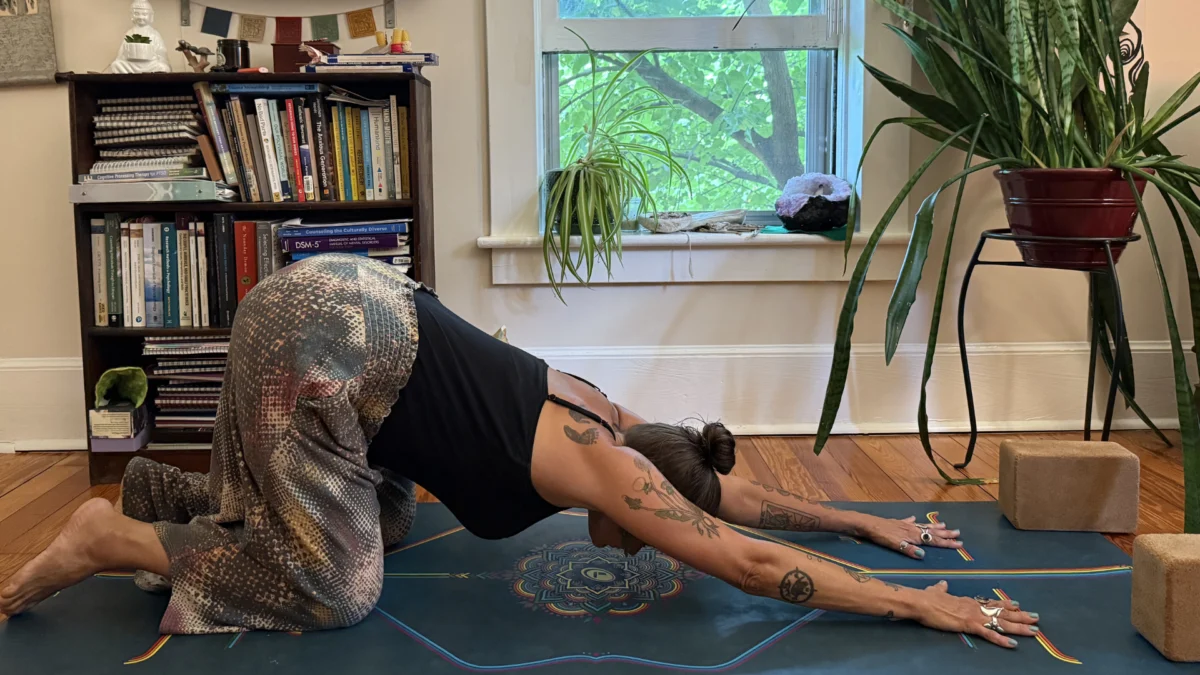
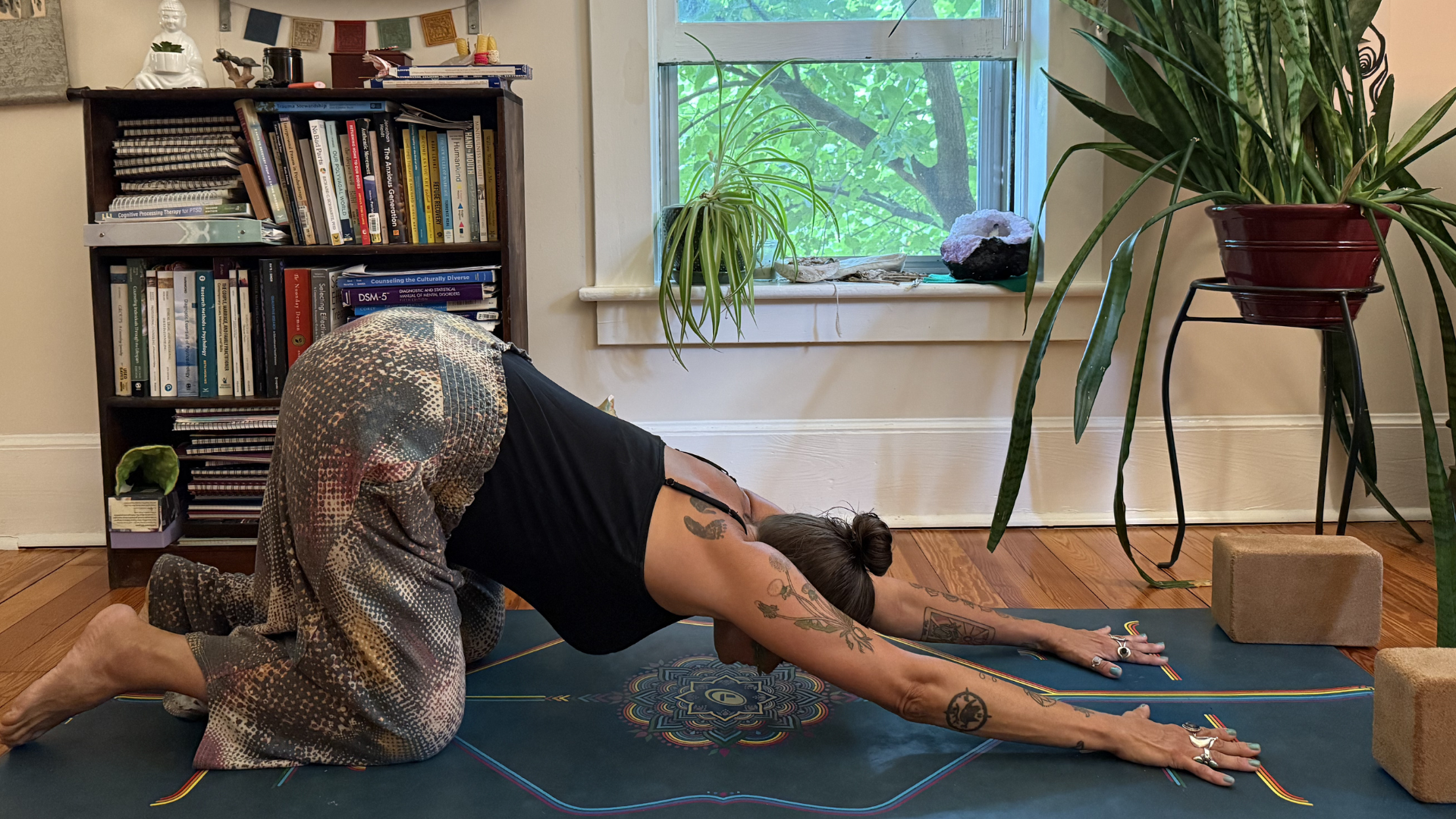
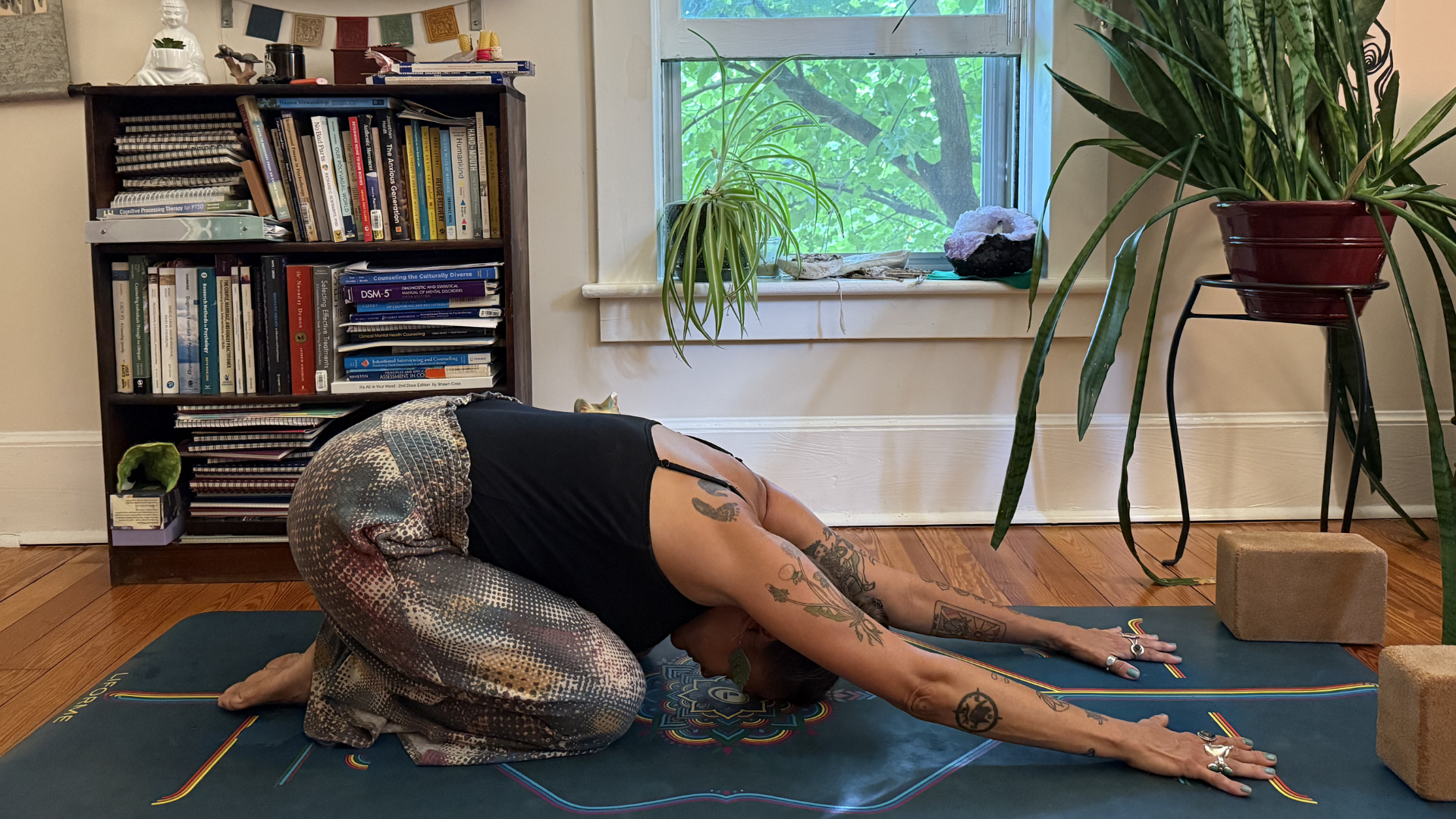
1. Child’s Pose (Balasana)
Derived from the Sanskrit bala (child), this pose invites us to return to our origins. It serves as a physical reminder to send grace to the emotions and patterns developed in our youth.
- The Technique: Knees together for upper back expansion, or knees wide for lower back release. Use blocks under your hands to heighten the sensation in the upper back.
- The Focus: Breathe into the space between the shoulder blades. Visualize the breath traveling from the nose to the nape of the neck and down into the back of the heart.
2. Puppy Pose (Anahatasana)
Often called "Melting Heart," this posture is an inversion that encourages the heart to sink toward the earth—a literal surrender of the ego.
- The Technique: Keep hips stacked over knees. Walk hands forward until the chest lowers toward the mat. Keep the tailbone reaching toward the ceiling.
- The Focus: Draw the shoulder blades toward one another. Notice the slight backbend as a way of accessing the deep tissues of the posterior chest.
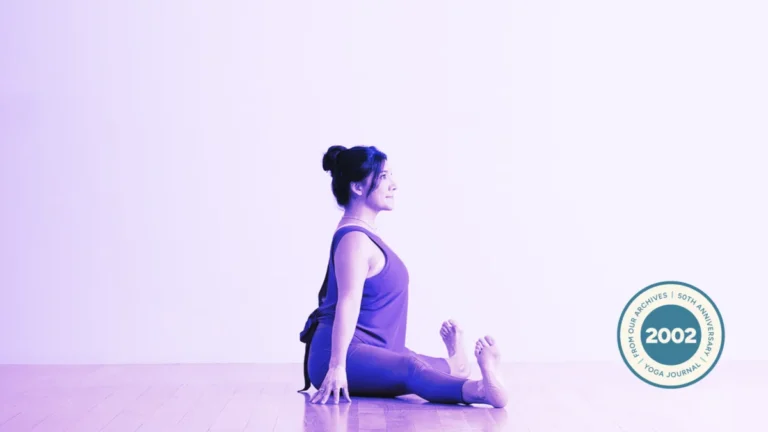
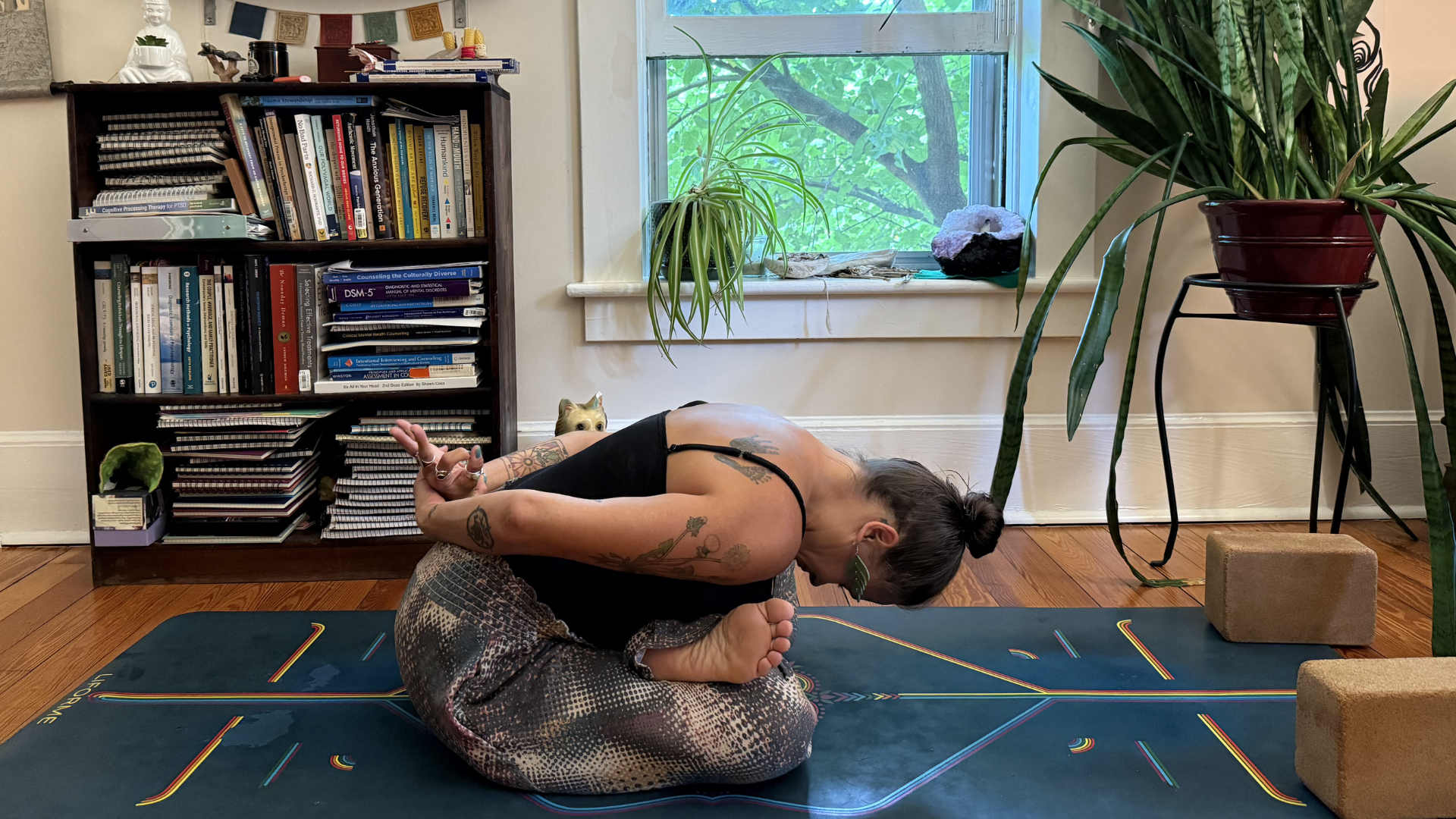
3. Yoga Mudrasana
This forward fold is designed to stimulate the flow of prana (life energy) from the base of the spine upward.
- The Technique: Sit in Easy Pose or Lotus. Bind your hands behind your back, using a strap if needed. Inhale to lengthen, exhale to fold.
- The Focus: The bind is the point of interest. It mimics the sensation of being held, which can often trigger deep emotional responses. Stay with the sensation without judgment.
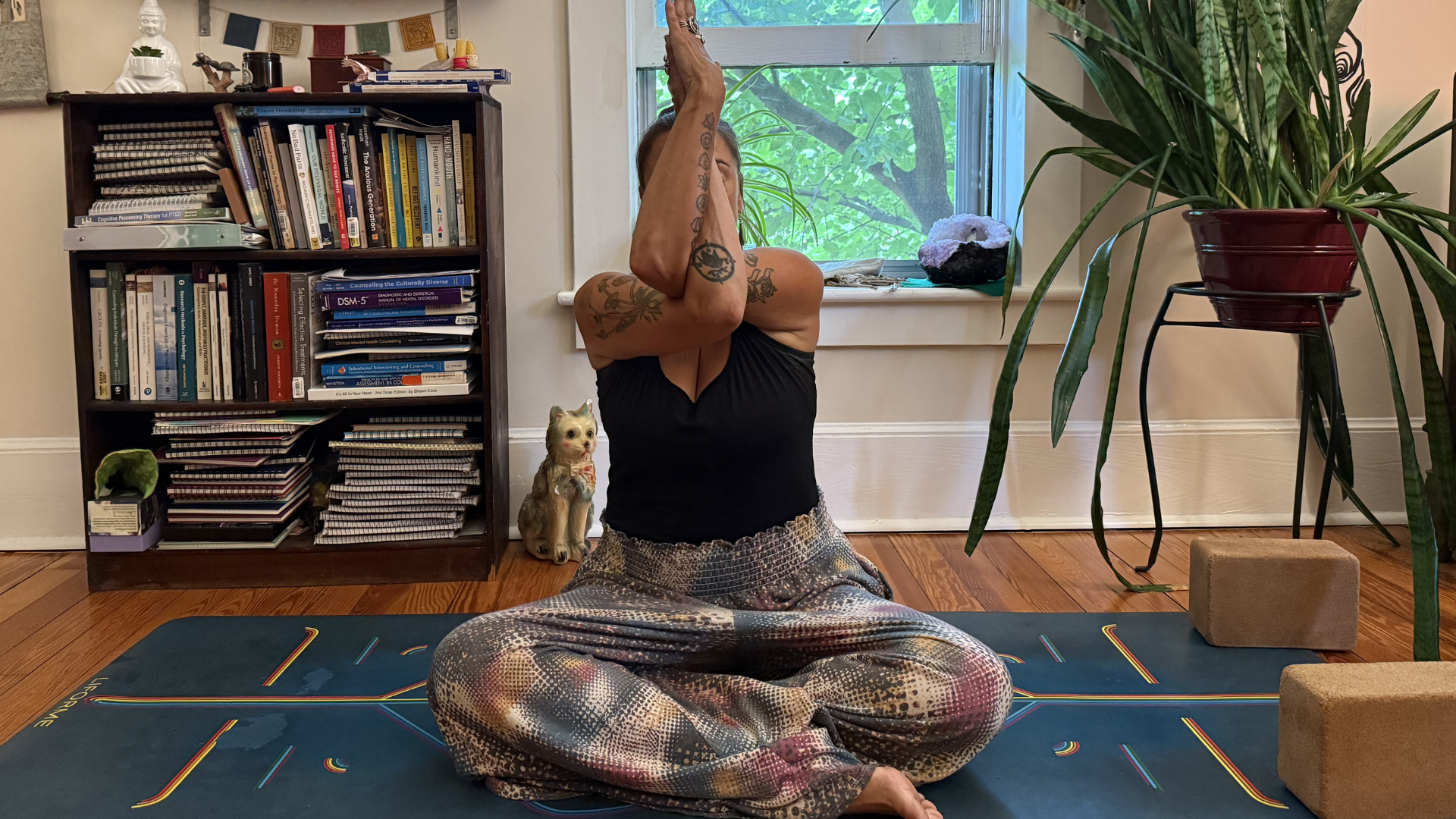
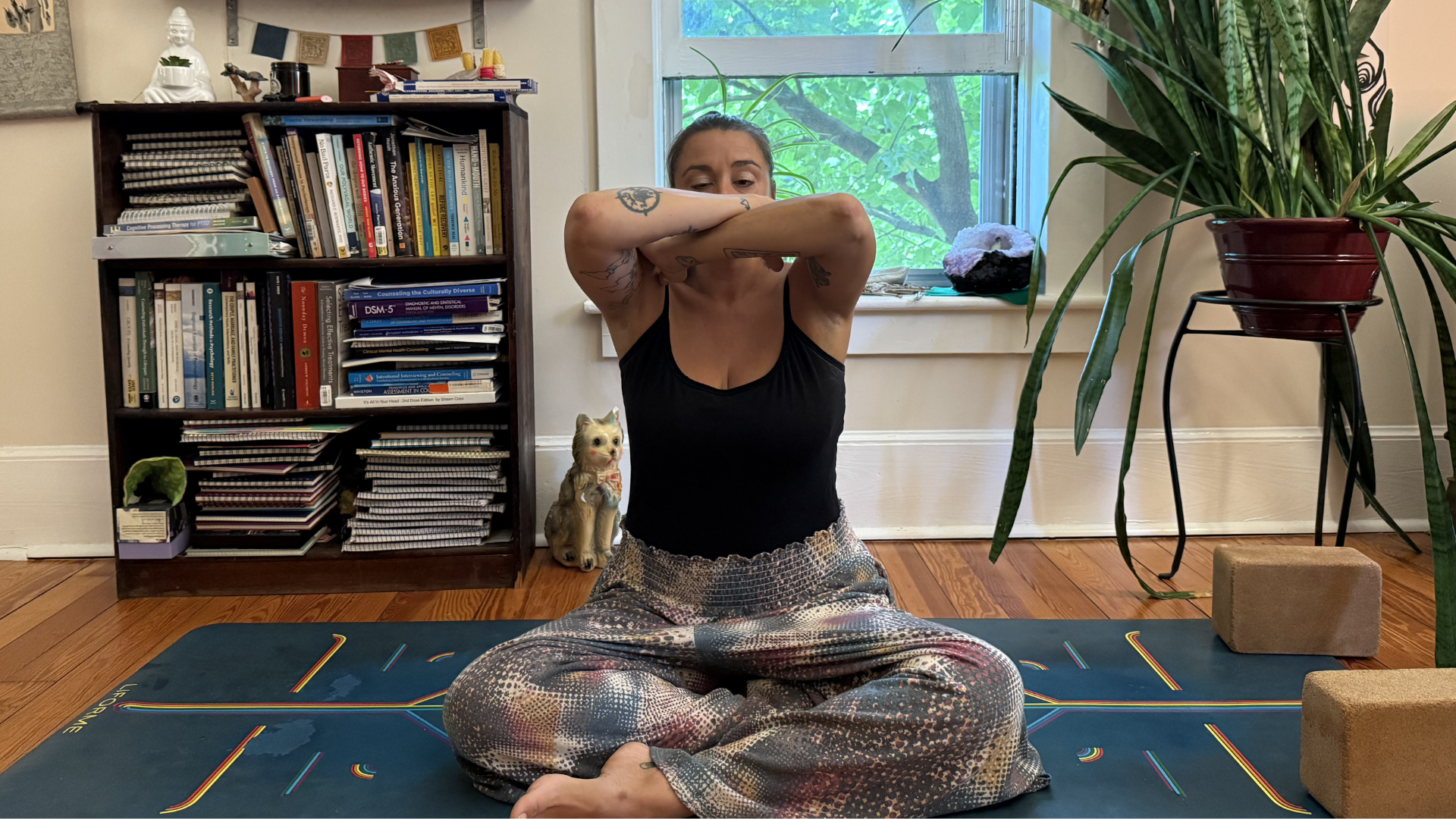
4. Eagle Arms
A powerful way to stretch the space behind the heart.
- The Technique: Cross your arms, stacking elbows. Options include touching palms together (traditional) or simply reaching forearms forward (self-hug).
- The Focus: Notice the difference between the two variations. One may feel like a protective barrier, the other like an embrace. Both are effective for accessing the hidden, "shadow" side of the heart space.
5. Cow Face Arms (Gomukhasana)
Symbolizing humility and selflessness, this pose challenges the practitioner to abandon the need for "perfect" alignment.
- The Technique: One arm reaches over the shoulder, the other behind the back. Use a strap to bridge the distance between hands.
- The Focus: This is a destination for the breath. Do not force the hands to touch. Instead, focus entirely on the space between the shoulder blades and the emotional weight that may be stored there.
Conclusion: The Responsibility of the Shadow
The integration of the shadow is not a destination but a lifelong practice. Whether through the lens of Jungian psychology or the ancient, somatic wisdom of the chakras, the work remains the same: it is the courageous act of turning toward what we have hidden. As we learn to breathe into the back of our heart space, we do more than just improve our posture; we acknowledge our past, integrate our experiences, and expand our capacity for universal compassion. Shadow work, when done with patience and integrity, is ultimately the path toward becoming fully, unapologetically human.