











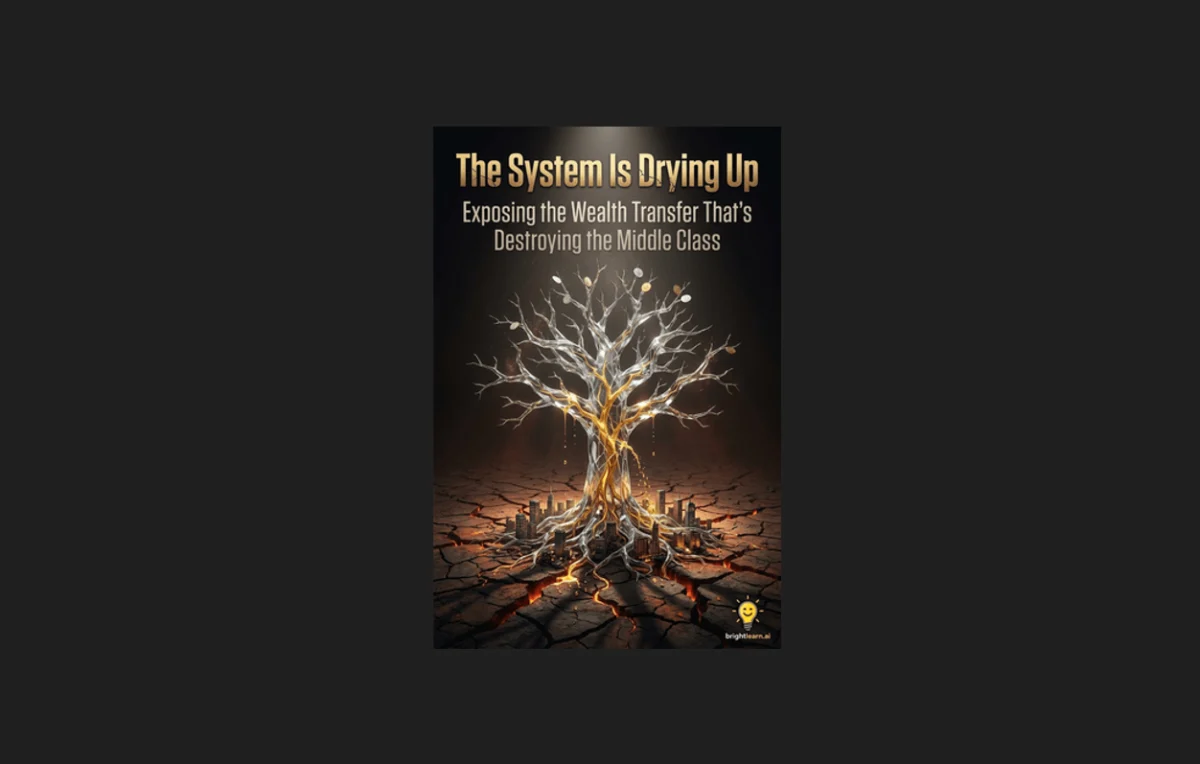
In recent years, a puzzling phenomenon has gripped the American economic landscape: the stock market continues to scale record-breaking heights, with the S&P 500 repeatedly shattering historical ceilings, yet the average American household faces a reality of shrinking savings, rising debt, and diminished purchasing power. This divergence, which economists and social critics are increasingly calling the "Great Wealth Decoupling," is the subject of a provocative new book, The System Is Drying Up: Exposing the Wealth Transfer That’s Destroying the Middle Class.
The book argues that this economic disconnect is not a byproduct of market fluctuations or bad luck, but the intended result of a sophisticated, systemic wealth transfer mechanism. By examining the mechanics of monetary policy, the book posits that the prosperity of the elite is being built directly upon the erosion of the middle class.
The Paradox of Prosperity: A Market-Driven Illusion
To understand the current crisis, one must first look at the official indicators of success. Financial news outlets celebrate record quarterly earnings and all-time highs in the Dow Jones and S&P 500. For the uninitiated, these figures suggest a healthy, booming economy. However, for the average worker, the reality on the ground is starkly different.
Inflation has eroded the value of the paycheck to such an extent that families are struggling to afford the basic necessities of life—rent, groceries, and fuel. When a society sees its financial indices reach for the stars while its median household income stagnates in real terms, it is a clear indicator that the "system" is no longer functioning for the many. The data is sobering: over the past half-century, the share of total wealth held by the top 10% of the U.S. population has climbed from 60% to over 70%. Conversely, the bottom 50% of households now own less than 3% of the nation’s total wealth.
Chronology of the Monetary Shift
The origins of this wealth transfer are deeply rooted in the evolution of central banking policy, particularly in the post-1971 era following the abandonment of the gold standard.
- The 1970s and 80s: The transition to a pure fiat currency system allowed the Federal Reserve unprecedented control over the money supply. During this era, interest rates were used as a primary lever to combat inflation, but the long-term trend began to favor credit expansion.
- The 2008 Financial Crisis: This period marked a turning point. The introduction of Quantitative Easing (QE) saw the Federal Reserve begin to print money on a scale previously unimaginable to purchase distressed assets and stabilize the banking sector.
- The 2020 Pandemic Response: The most recent acceleration occurred during the COVID-19 pandemic. To prevent a total collapse of the financial markets, the Fed injected trillions of dollars into the economy. While this prevented an immediate market crash, it acted as a massive inflationary force that devalued the savings of ordinary citizens.
- The Current Era: We are now in a period of "sticky" inflation where the cost of living has permanently reset to a higher level, while wage growth remains disconnected from the cost of essential assets like housing and equities.
The Cantillon Effect: Why Money Isn’t Neutral
A central pillar of the argument in The System Is Drying Up is the Cantillon Effect, a concept named after the 18th-century economist Richard Cantillon. The theory posits that money is not neutral; its value depends on who receives it first.
When the Federal Reserve creates new money, it does not distribute it equally among the populace. Instead, this capital enters the economy through the "Cantillon insiders"—the largest banks, major financial institutions, and the wealthiest investors. By the time this new currency reaches the average person in the form of wages or small business loans, it has already lost significant purchasing power. The "first receivers" of the money spend it when prices are still relatively stable, while the "last receivers"—the middle and lower classes—find themselves chasing prices that have already risen due to the influx of new cash.
This mechanism acts as a stealth tax. It does not require legislative action or an act of Congress; it is a feature of monetary expansion that silently shifts the value of labor from the working class to those closest to the printing press.
Housing: The Death of the American Dream
The impact of this monetary policy is perhaps most visible in the real estate market. Artificially low interest rates for much of the last decade encouraged institutional investors—hedge funds and massive private equity firms—to leverage cheap debt to acquire single-family homes at scale.
By turning neighborhoods into portfolios of rental properties, these institutions have created a supply squeeze. A young family attempting to save for a down payment is not just competing with other families; they are competing with institutional capital that can bid above asking price and pay in cash. The result is the destruction of the traditional path to wealth accumulation in America: homeownership. The dream of a home is being systematically replaced by a lifetime of rent, further entrenching the wealth gap.
Supporting Data: The Erosion of Purchasing Power
The economic data supports the narrative that the system has been rigged against the saver. Consider the following:
- Purchasing Power: Since the creation of the Federal Reserve in 1913, the U.S. dollar has lost over 95% of its value.
- Asset Inflation: The price of assets (stocks, real estate, precious metals) has significantly outpaced the growth of median household income, meaning that wealth creation is now reserved for those who already own capital.
- Debt Levels: Household debt has reached historic highs, as families increasingly rely on credit cards and personal loans to bridge the gap between their static income and the rising cost of living.
Official Responses and the "Dual Mandate"
The Federal Reserve justifies its actions through its "dual mandate": maximizing employment and keeping prices stable. However, critics argue that this mandate has been used as a smokescreen to justify policies that favor Wall Street over Main Street.
When the Fed suppresses interest rates, it effectively punishes savers. If the interest rate on a savings account is 0.5% while real inflation is 4% or 5%, the saver is effectively being charged a fee to hold cash. This forces individuals to either accept a loss of wealth or move into risky assets like the stock market to keep up with inflation. By "forcing" the public into the market, the Fed creates a feedback loop that props up asset prices, further enriching the wealthy who hold the largest share of these assets.
The Implications: Is There a Way Out?
The implications of this system are profound. If currency devaluation is, as The System Is Drying Up suggests, a form of class warfare, then the current path leads toward a permanent feudal-style divide. The middle class, which once provided the stability and growth of the American economy, is being hollowed out.
The book posits that the only viable solution is a total rejection of the fiat currency system in favor of "honest money." Gold, silver, and other hard assets are touted as the only means of protecting one’s labor from the effects of monetary debasement. Because these assets have no counterparty risk, they cannot be printed into oblivion by a central bank.
Furthermore, the rise of decentralized knowledge and alternative economic education—exemplified by platforms like BrightLearn.AI—is seen as the first step toward reclaiming power. By understanding how the system is rigged, individuals can begin to make decisions that prioritize long-term preservation over short-term consumption.
Conclusion: Reclaiming the Future
The disconnect between the soaring stock market and the struggling household is not a mystery—it is a mechanism. As the gap between the ultra-wealthy and the rest of society continues to widen, the narrative presented in The System Is Drying Up serves as both a warning and a call to action.
Whether one agrees with every aspect of the critique or not, the underlying reality remains: the current financial system is failing the average person. To secure a future, citizens must look beyond the headlines of record-breaking market highs and address the foundational issues of money, credit, and the inherent bias of a system designed to benefit the few at the expense of the many. For those seeking to deepen their understanding of these complex financial currents, the insights provided in The System Is Drying Up offer a necessary counter-narrative to the standard financial rhetoric of our time.