




As the years pass, many adults begin to notice a common physiological change: the loss of firmness in the upper arms, often referred to as "arm jiggle" or "bat wings." While this phenomenon is frequently viewed as an inevitable side effect of aging, fitness experts argue that it is a challenge that can be met head-on with the right approach to strength training.
According to Gerard Washack, owner of Fit in 42 La Quinta and a veteran fitness trainer with over 10,000 hours of hands-on experience working with clients in their 40s through 70s, the appearance of loose skin on the arms is a multifaceted issue that stems from both biology and lifestyle habits. By understanding the root causes of this change, older adults can implement targeted, home-based resistance training to rebuild muscle mass and reclaim their arm definition.
The Physiology of Aging Arms: Why "Jiggle" Happens
To effectively address the change in the appearance of the arms, one must first understand what is occurring beneath the skin. As we reach our 60s and beyond, the body undergoes several structural shifts.
"Skin loses elasticity with age, and once muscle starts to shrink—a process known as sarcopenia—the skin has less to hold onto," explains Washack. "You get the softer look, the ‘wave’ when you wave, and that loose feeling in the back of the arm. It’s not just fat; it’s loose skin draped over less muscle. The fix is the same for both: You have to put muscle back on."
This loss of muscle mass is not merely a cosmetic concern; it is a vital marker of metabolic health. Muscle tissue is metabolically active, meaning that increasing muscle mass can help support metabolic health and bone density, both of which are critical for longevity.
Why Traditional Gym Routines Often Miss the Mark
Many older adults attempt to combat arm laxity by joining local gym classes or following standard circuit machines. However, Washack notes that these environments are frequently ill-equipped to provide the specific stimuli necessary for older individuals to see results.
"A lot of gym routines for older adults barely train the arms at all," says Washack. "The classes are often cardio-focused, which is great for the heart but does little for muscle hypertrophy. The machine circuits often skip over direct arm work, and when they do include something, it’s often a cable bicep curl or a tricep pushdown performed with weight that is far too light to actually challenge the muscle."
For muscles to grow and firm up, they must be subjected to progressive overload—a stimulus that requires the muscle to work against resistance that challenges its current capacity. When workouts are too light, the body has no physiological incentive to repair and strengthen the muscle fibers, leaving the "jiggle" largely unchanged.
The 5-Step Home Resistance Blueprint
The good news is that you do not need a commercial gym membership or heavy, complex equipment to reverse these trends. With a pair of dumbbells and a sturdy chair, you can execute a highly effective routine from the comfort of your living room. Below are five foundational movements designed to target the triceps and biceps, the two primary muscle groups that dictate the shape of the upper arm.
1. Tricep Kickbacks
The triceps make up the majority of the upper arm’s mass. When these muscles are underdeveloped, the "draping" effect of the skin becomes more pronounced.
- The Move: Bend at the hips with a flat back, holding a dumbbell in each hand. Keep your elbows tucked close to your ribcage. Extend your arms backward until they are fully straight, squeezing the back of the arm. Slowly return to the starting position.
2. Overhead Tricep Extensions
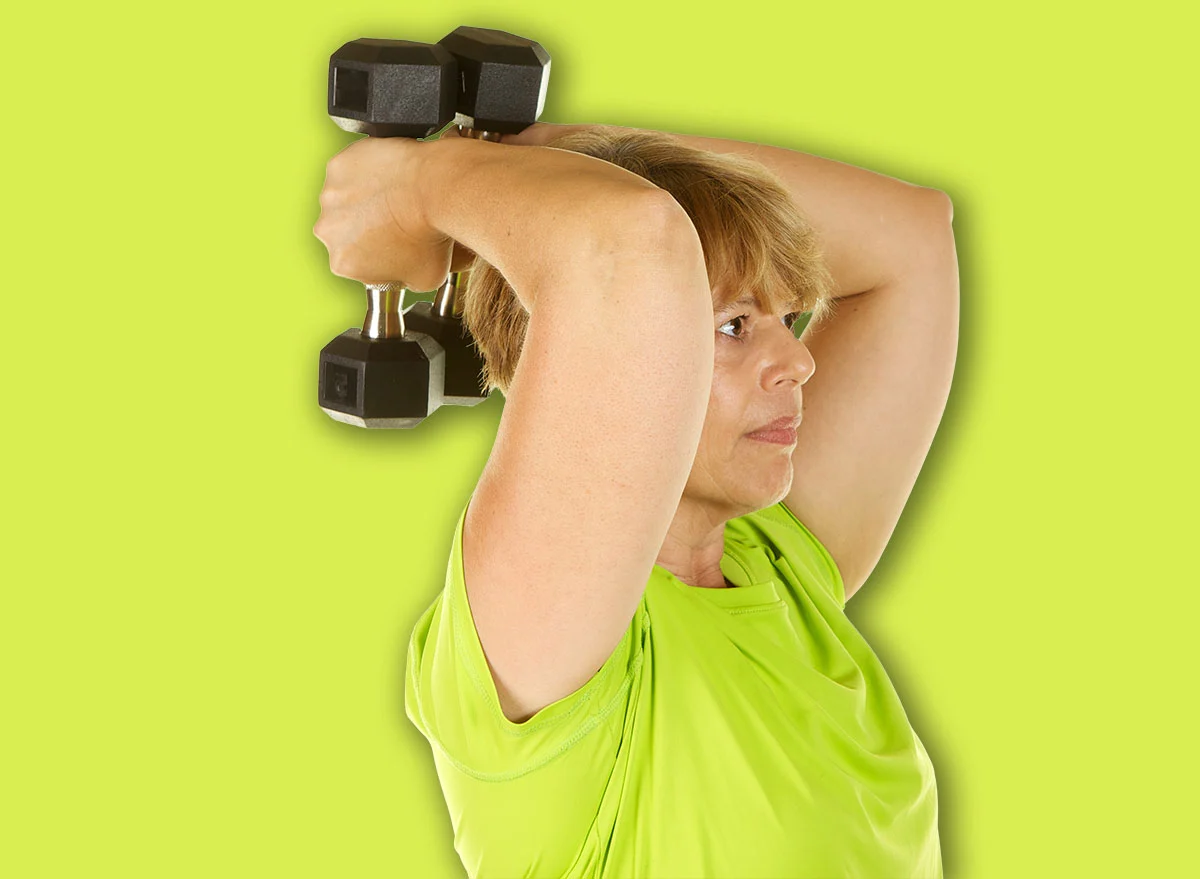
This move places the triceps in a lengthened position, which is excellent for building functional strength and muscle definition.
- The Move: Stand or sit upright. Hold a single dumbbell with both hands, lifting it overhead. Bend your elbows to lower the weight behind your head, then extend your arms back up toward the ceiling. Keep your elbows pointing forward rather than flaring them out to the sides.
3. Bicep Curls
While the triceps occupy the back of the arm, the biceps provide the necessary balance and overall structural strength to the front of the arm.
- The Move: Stand with your feet shoulder-width apart, arms at your sides, palms facing forward. Keep your elbows locked into your sides and curl the weights toward your shoulders. Control the weight on the way down; the lowering phase is just as important as the lift.
4. Chair Dips
Chair dips utilize your own body weight, providing a significant challenge to the triceps and the stabilizing muscles in the shoulders.
- The Move: Place your hands on the edge of a sturdy chair with your feet planted on the floor in front of you. Slide your hips off the chair and lower your body toward the floor by bending your elbows. Push back up using the power of your triceps. Ensure your back remains close to the seat of the chair throughout the movement.
5. Hammer Curls
Hammer curls target the brachialis and the brachioradialis, which sit beneath the bicep and can help add width and definition to the arm.
- The Move: Similar to a standard curl, but hold your dumbbells with your palms facing inward (neutral grip) throughout the entire movement. This small change in wrist orientation shifts the emphasis to different parts of the arm musculature.
Chronology of Progress: What to Expect
Fitness is not an overnight endeavor, especially for those over 60. Understanding the timeline of physical adaptation is crucial for maintaining motivation.
- Weeks 1–4 (Neuromuscular Adaptation): In the first month, you may not see massive visual changes, but you will feel stronger. Your nervous system is learning how to recruit muscle fibers more efficiently.
- Weeks 4–8 (Early Hypertrophy): By the second month, you will likely notice that the muscles feel firmer to the touch. You may find that you can handle slightly heavier weights or perform more repetitions.
- Months 3 and Beyond (Visible Transformation): With consistent, progressive overload—meaning you are gradually increasing your weight or intensity—you will begin to see visible changes in the shape and tone of the arms as the muscle fibers thicken and the skin appears more supported.
Implications for Longevity and Quality of Life
Beyond the vanity of wanting to improve the appearance of one’s arms, there are profound health implications for maintaining arm strength as we age. Strong arms and upper bodies are essential for daily tasks—carrying groceries, lifting grandchildren, maintaining balance, and ensuring independence.
When we prioritize strength training, we are doing more than just tightening the skin; we are investing in our long-term physical autonomy. "The goal is to move better and feel better," says Washack. "When you prioritize the muscle, the aesthetics often follow as a byproduct of a healthier, stronger body."
Professional Guidelines for Safety
Before embarking on a new exercise routine, especially after 60, it is always recommended to consult with a healthcare provider. Furthermore, prioritize form over heavy weight. Performing movements slowly and with control is far more effective for muscle growth than "swinging" heavy weights, which can lead to joint strain or injury.
By focusing on these five foundational movements, older adults can confidently combat the natural changes of aging, proving that it is never too late to build strength, improve tone, and feel empowered in your own skin.