









In an era defined by high-tech health tracking, biohacking, and a deluge of longevity advice from charismatic experts, many people are feeling a new kind of pressure: the mandate to "optimize." From daily ice baths and continuous glucose monitoring to a laundry list of supplements, the modern pursuit of a long life is increasingly expensive, time-consuming, and psychologically taxing.

But does this "optimization culture" actually lead to a longer, better life? For many, the answer is a surprising no. Emerging data suggests that the quest for perfection often leads to diminishing returns, causing people to abandon the very foundational habits that actually move the needle on healthspan.

The Myth of Optimization
The current health landscape is dominated by influential figures like Dr. Peter Attia, Dr. Andrew Huberman, and biohacker Bryan Johnson. While their message—that we can take control of our biological destiny—is empowering, it often creates a distorted view of what it takes to be healthy.

The central myth is that the "basics" are no longer sufficient. People often assume that because they aren’t engaging in cutting-edge protocols, they are failing. In reality, the fundamental behaviors—regular exercise, nutrient-dense eating, adequate sleep, stress management, and social connection—are the true drivers of longevity. The problem isn’t that these basics don’t work; it’s that most people don’t perform them with enough consistency.

Research from Precision Nutrition, which has coached hundreds of thousands of clients, reveals a striking truth: even individuals who practice foundational habits with only 10 to 49 percent consistency see measurable, significant improvements in their body composition and health markers. You do not need to be perfect to be healthy.

The Diminishing Returns of "More"
The "More Is Better" fallacy is perhaps the most dangerous trap in the longevity industry. There is a clear law of diminishing returns when it comes to health. While moving from a sedentary lifestyle to an active one provides an astronomical increase in life expectancy, moving from "highly active" to "extreme" yields marginal gains and may even introduce new risks.

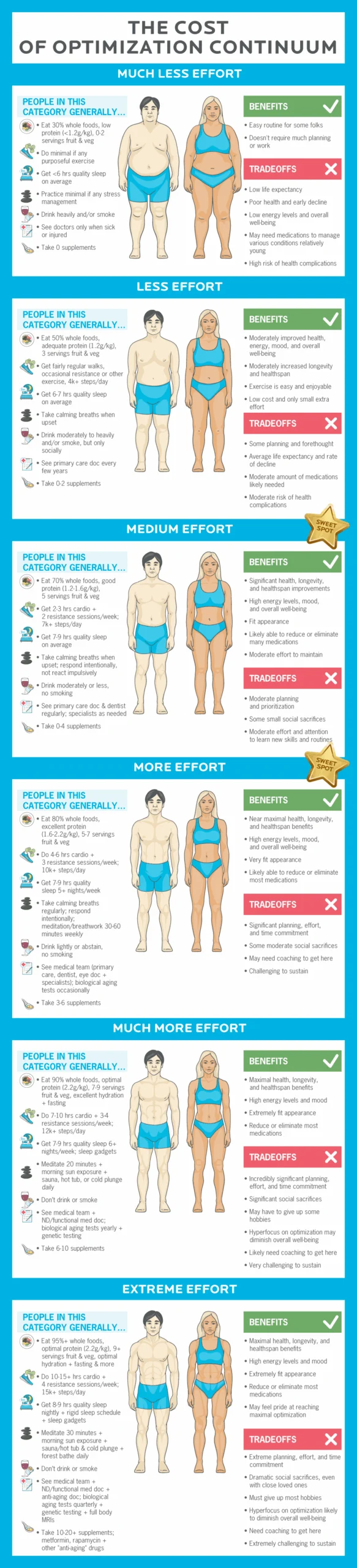
The Chronology of Health Efforts
- The Baseline: Addressing deficiencies (sedentary lifestyle, poor diet, smoking) provides the largest leap in health outcomes.
- The "Sweet Spot": Once foundational habits are established, the individual enters a phase of peak return on investment. This is where most people should focus their energy.
- The Optimization Plateau: Beyond the sweet spot, the cost in time, money, and mental energy skyrockets, while the biological benefits become increasingly speculative or incremental.
Supporting Data: What Actually Moves the Needle
Data indicates that most Americans are currently failing to meet basic health benchmarks. Only 10 percent of adults consume the recommended five servings of fruits and vegetables daily, and less than 25 percent meet the criteria for both aerobic and resistance training.

Exercise: The U-Shaped Curve
Exercise is undeniably "medicine," but it operates on a U-shaped curve. Studies show that steep risk declines in all-cause mortality occur when reaching 7.5 to 15 MET-hours of activity per week. While increasing intensity and volume beyond this provides further benefits, there is a point of "extreme exercise" where risks—such as myocardial fibrosis or atrial fibrillation—begin to climb.

Nutrition: The Power of Whole Foods
The largest study on processed foods, involving nearly 10 million participants, confirmed that ultra-processed foods are linked to 32 harmful health outcomes. However, the path to health isn’t about rigid avoidance; it’s about shifting dietary patterns. A diet consisting of 70 to 80 percent whole or minimally processed foods provides the vast majority of longevity benefits. Obsessing over the remaining 20 percent can often lead to orthorexia or social isolation.

Social Connection: The Longevity Predictor
Perhaps the most overlooked factor is social connection. The Harvard Study of Adult Development, which has spanned over 87 years, consistently identifies strong relationships as the single greatest predictor of life satisfaction and longevity. The mortality risk of social isolation is equivalent to smoking 15 cigarettes a day—a fact that remains absent from most "biohacking" protocols.

The Hidden Costs of Optimization
When we analyze the financial and time-based investment required for a "total optimization" lifestyle, the cost is staggering.

- Time Investment: An "optimizer" might spend 15–20 hours a week on health—tracking metrics, preparing hyper-specific meals, attending multiple therapy or recovery sessions, and managing complex supplement regimens.
- Financial Drain: Advanced assessments (like full-body MRIs, continuous glucose monitors, and boutique blood panels) combined with high-end supplements can easily exceed $10,000 to $20,000 annually.
For most, this investment yields an "optimization" that is statistically invisible compared to someone who simply eats their vegetables, walks daily, maintains a social circle, and gets eight hours of sleep.

Implications for Long-Term Health
The primary implication of this research is that "Deep Health"—a model incorporating social, physical, existential, emotional, and mental well-being—must be the goal, rather than a narrow focus on biological markers.

If a health protocol requires you to isolate yourself from friends to avoid "unhealthy" social situations, or creates chronic anxiety about your blood sugar readings, the protocol is actively working against your longevity. True health includes the capacity to enjoy a life that is full, messy, and inherently social.

Strategies for the Practical Longevity Seeker:
- Audit the Basics: Before adding new supplements or tech, assess your consistency with sleep, protein intake, and daily movement.
- Define Your "Why": Longevity is a means to an end. Define what you want to do with your extra years. If your health plan doesn’t support your ability to live a meaningful life, it’s time to pivot.
- Tune Out the Noise: Remember that influencers and podcasters are often marketing a lifestyle, not necessarily a scientifically validated necessity for your specific body.
- Embrace "Good Enough": 80–90 percent consistency with the basics is not a compromise; it is the gold standard for long-term, sustainable health.
Conclusion
The pursuit of longevity should not be a full-time job. By focusing on the foundational behaviors that have decades of longitudinal data behind them, you can achieve the vast majority of the health benefits promised by the optimization industry without the associated stress, cost, or complexity. Health is not just about adding years to your life; it is about ensuring those years are lived with vitality, connection, and joy. Stop optimizing, and start living the basics.