










From the viral corridors of TikTok to the bestseller lists of health-conscious bookstores, "seed oils"—commonly referred to as vegetable oils—have become the latest lightning rod in the world of nutrition. Rarely does a week go by without a new influencer labeling these ubiquitous kitchen staples as "toxic sludge," "motor oil," or the "hateful eight" behind a hidden epidemic of chronic disease.
But is the culinary world’s most common ingredient truly a silent killer, or is this simply the latest iteration of nutritional fear-mongering? To navigate the noise, we must peel back the layers of industrial processing, examine the biochemical reality of fatty acids, and distinguish between oils consumed as part of a whole-food diet and those hidden within the landscape of ultra-processed products.
The Evolution of the "Toxic" Narrative
The current backlash against vegetable oils is largely rooted in a "paleo-centric" ideology. The argument is deceptively simple: humans evolved over millennia consuming animal fats, while industrial seed oils (like soybean, corn, and canola) are a modern invention of the 20th century. Proponents of this view argue that profit-seeking corporations introduced these oils as cheap substitutes for traditional fats like butter and tallow, setting the stage for a rise in obesity, depression, and autoimmune conditions.
However, historical context offers a more nuanced view. When margarine and vegetable oils were first introduced, they were marketed as "heart-healthy" alternatives to saturated animal fats. This shift was based on early research suggesting that replacing saturated fats with polyunsaturated fats (PUFAs) could lower cholesterol. The irony, which critics rightfully point out, is that many early margarine products were loaded with trans fats—a byproduct of partial hydrogenation that we now know to be genuinely harmful. While the FDA banned the addition of trans fats in 2018, the lingering distrust toward the entire category of seed oils remains a potent force in wellness culture.
The Science of Extraction: Why Process Matters
To understand why some experts distinguish between "healthy" and "toxic" oils, one must look at how they are made. Unlike extra virgin olive oil (EVOO) or avocado oil, which are derived from fruits with high fat content, seed oils are extracted from crops where the fat content is relatively low.

- Mechanical Extraction: This involves pressing seeds under high pressure. When done without heat or chemicals (expeller-pressed), the resulting oil retains many of its original nutrients.
- Chemical Extraction: Because seeds like corn and soy contain very little oil, manufacturers use industrial solvents (most commonly hexane) to dissolve the oil from the seed. This is followed by a refining, bleaching, and deodorizing (RBD) process.
During this intense industrial refining, naturally occurring stabilizing nutrients, such as polyphenols and antioxidants, are stripped away. Furthermore, the high-heat conditions of industrial processing can cause a small percentage of unsaturated fats to oxidize or transform into trans fatty acids. While these levels are often low, the lack of protective compounds makes these oils more susceptible to further oxidation when used in home or commercial cooking.
Head-to-Head: The Hierarchy of Fats
To provide clarity, we can categorize oils based on their stability, nutritional profile, and the evidence supporting their health outcomes.
The Gold Standard: Extra Virgin Olive Oil (EVOO)
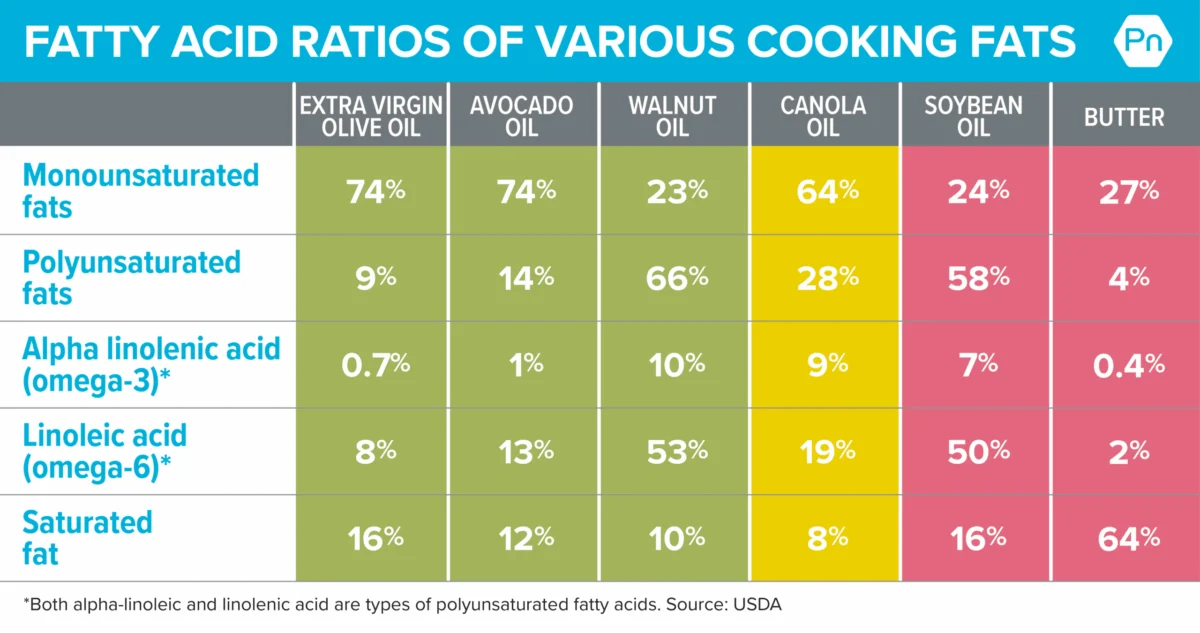
EVOO stands alone as the most studied cooking fat in existence. Research involving tens of thousands of participants in the Mediterranean region has consistently linked high EVOO consumption to lower risks of cardiovascular disease, stroke, and early mortality. Unlike refined oils, EVOO is mechanically pressed, preserving the polyphenols that combat inflammation and protect cells from damage. Despite old myths regarding its "low smoke point," modern studies show that EVOO is remarkably stable at high temperatures due to its high monounsaturated fat content and antioxidant profile.
The Budget-Friendly Contender: Expeller-Pressed Canola
Canola oil occupies a middle ground. While it lacks the dense polyphenol content of EVOO, it is rich in monounsaturated fats and contains alpha-linolenic acid, a plant-based omega-3. When expeller-pressed—avoiding the solvent-heavy refining process—it serves as a heart-healthy, neutral-flavored, and budget-friendly alternative to saturated fats. It is definitively superior to highly processed, refined soybean or corn oils.
The Controversy: Omega-6 Fatty Acids
Much of the "toxic" label assigned to seed oils stems from their high omega-6 fatty acid content. Critics argue that because the modern diet contains an omega-6 to omega-3 ratio of nearly 20:1, it promotes chronic, low-grade inflammation. While it is true that an imbalance can be problematic, the scientific community is shifting its perspective. Research published in Circulation suggests that omega-6 fats may actually reduce the risk of heart disease when consumed as part of a whole-food diet. The distinction lies in the delivery system: omega-6s found in walnuts or sunflower seeds are packaged with fiber, vitamins, and minerals. Omega-6s found in a bottle of refined industrial oil are "naked" fats, stripped of their biological protective matrix.

The Real Villain: Ultra-Processed Foods
The most critical takeaway for consumers is that the concern over seed oils is often misdirected. The vast majority of problematic vegetable oil intake in the modern diet does not come from a home-cooked stir-fry using a tablespoon of canola oil. It comes from the "ultra-processed" food environment: cookies, chips, salad dressings, and frozen meals.
These products contain oils that have undergone multiple rounds of high-heat processing and are often consumed alongside excess sodium, refined sugars, and additives. These foods are designed to be hyper-palatable, calorie-dense, and difficult to regulate, leading to the metabolic dysfunction that critics often blame on the oil alone. When you consume refined oils within a diet rich in whole plants, fiber, and lean proteins, the potential for oxidation is mitigated by the antioxidants present in the rest of your meal.
Practical Implications: How to Choose
If you are looking to optimize your diet, the following hierarchy of fat consumption is supported by current nutritional consensus:
- Prioritize Whole Foods: Your primary source of fat should be whole-food matrices—avocados, olives, nuts, seeds, and fatty fish. These provide fats in their most stable and nutrient-dense forms.
- Choose Quality Oils: For cooking and dressing, prioritize extra virgin olive oil. For high-heat cooking where a neutral flavor is required, high-oleic sunflower or expeller-pressed canola are safe, budget-conscious choices.
- Minimize Ultra-Processed Products: The best way to reduce "bad" seed oil intake is not to obsess over the oil in your pantry, but to reduce the intake of packaged, ultra-processed goods. If the ingredient label lists partially hydrogenated oils or a long list of unpronounceable additives, the oil within is likely the least of your health concerns.
- Avoid Excessive Frying: Regardless of the oil type, deep-frying alters the chemical structure of fats and introduces unwanted calories and oxidation products. This method of cooking should be relegated to the "eat less" category.
Final Verdict
The demonization of all seed oils is a form of nutritional reductionism—it takes a complex issue and turns it into a meme. While it is scientifically sound to prefer minimally processed oils like EVOO over industrially refined seed oils, the "toxic" narrative is largely a distraction from the true culprit of modern metabolic health: the overwhelming consumption of ultra-processed, nutrient-poor foods.
By shifting the focus from "avoiding the oil" to "prioritizing the whole food," individuals can move past the anxiety of the current online debate and build a sustainable, science-backed approach to their health. Whether you are an athlete, a coach, or simply someone looking to feel better, the truth remains: a balanced diet is built on the foundation of whole-food sources, not the exclusion of a single ingredient.