







In the modern fitness landscape, the prevailing metrics of health—max bench press, marathon pace, or body fat percentage—often fail to capture the reality of aging. For adults over the age of 60, true physical vitality is not found in a gym’s specialized machinery, but in the seamless execution of daily existence. Can you rise from a low chair without using your hands? Can you put on your socks while standing? Can you traverse a grocery store with confidence and stamina?
According to Tyler Read, a seasoned personal trainer with 15 years of experience in human performance, these mundane tasks are the true "fitness tests" of the second half of life. "Fitness after 60 isn’t about how much weight you can lift; it shows up in the movements you perform every day without thinking twice," Read explains. "As a trainer, I’ve found that a few simple standing exercises reveal far more about someone’s overall health than most traditional gym workouts."
The Shift Toward Functional Longevity
For decades, the fitness industry focused on aesthetics and raw power. However, as medical literature pivots toward "functional longevity," the focus has shifted to maintaining the biological capacity for independent living. Many older adults fall into the trap of comparing themselves to their younger selves, or worse, to unrealistic media portrayals of athleticism.
Functional movements—exercises that mimic the activities of daily living (ADLs)—are the gold standard for healthy aging. They challenge the musculoskeletal system, cardiovascular endurance, and the vestibular system (balance) simultaneously. If you can perform these functional benchmarks with control, you are likely in a superior state of physiological health than you realize.
Chronology of Mobility: Why These Tests Matter
The decline of mobility is rarely a sudden event; it is a gradual erosion of strength and stability that often goes unnoticed until a slip or a fall occurs. By utilizing periodic assessments, individuals can establish a baseline, monitor their progress, and address potential weaknesses before they manifest as chronic pain or injury.
The Science of the Sit-to-Stand
The "Sit-to-Stand" test evaluates the kinetic chain of the lower body. As we age, sarcopenia—the natural loss of muscle mass—primarily targets the type II (fast-twitch) muscle fibers in the quadriceps and glutes. If these muscles atrophy, the simple act of standing up becomes a precarious task. By monitoring your ability to complete this movement without momentum, you are effectively testing your independence.
The Physics of Balance
Balance is a complex integration of sensory input from the eyes, the inner ear, and the proprioceptors in our feet. Research indicates that balance begins to decline noticeably in the late 50s and 60s. The Single-Leg Balance Hold is a window into the nervous system’s ability to make micro-adjustments. A lack of stability here is a leading indicator of fall risk, the primary cause of injury-related mortality in the elderly.
The Mechanics of Endurance
The Standing March is not just a cardiovascular test; it is an assessment of hip-flexor strength and core stability. Walking requires the body to support its weight on one leg while the other advances. If the hip flexors are weak or the core is unstable, the gait becomes shorter, slower, and less efficient, leading to fatigue and an increased risk of tripping.
Exercise 1: The Sit-to-Stand Test
This movement is the ultimate litmus test for lower-body strength. It requires the synchronized engagement of the quadriceps, hamstrings, glutes, and core.
How to Perform It:
- Position a standard-height chair against a wall to ensure it remains stationary.
- Sit on the edge of the seat, feet flat on the floor, hip-width apart.
- Cross your arms over your chest.
- Using only your leg muscles, stand up to a full, vertical position.
- Return to a seated position with control.
Benchmark: For most adults over 60, completing 12 to 17 controlled repetitions within 30 seconds without using your hands indicates excellent functional strength.
Exercise 2: Single-Leg Balance Hold
Stability is the foundation of physical confidence. This test forces the ankles, hips, and core to communicate in real-time.
How to Perform It:
- Stand near a counter or wall for safety, but do not lean on it.
- Lift one foot slightly off the floor, keeping your weight centered on the standing leg.
- Keep your torso upright and your gaze fixed on a stationary point in front of you.
- Start your timer.
- Record how long you can maintain the position without putting your foot down or wobbling excessively.
Benchmark: Holding the position for 30 seconds or longer on each leg is considered the gold standard for stability in adults over 60.
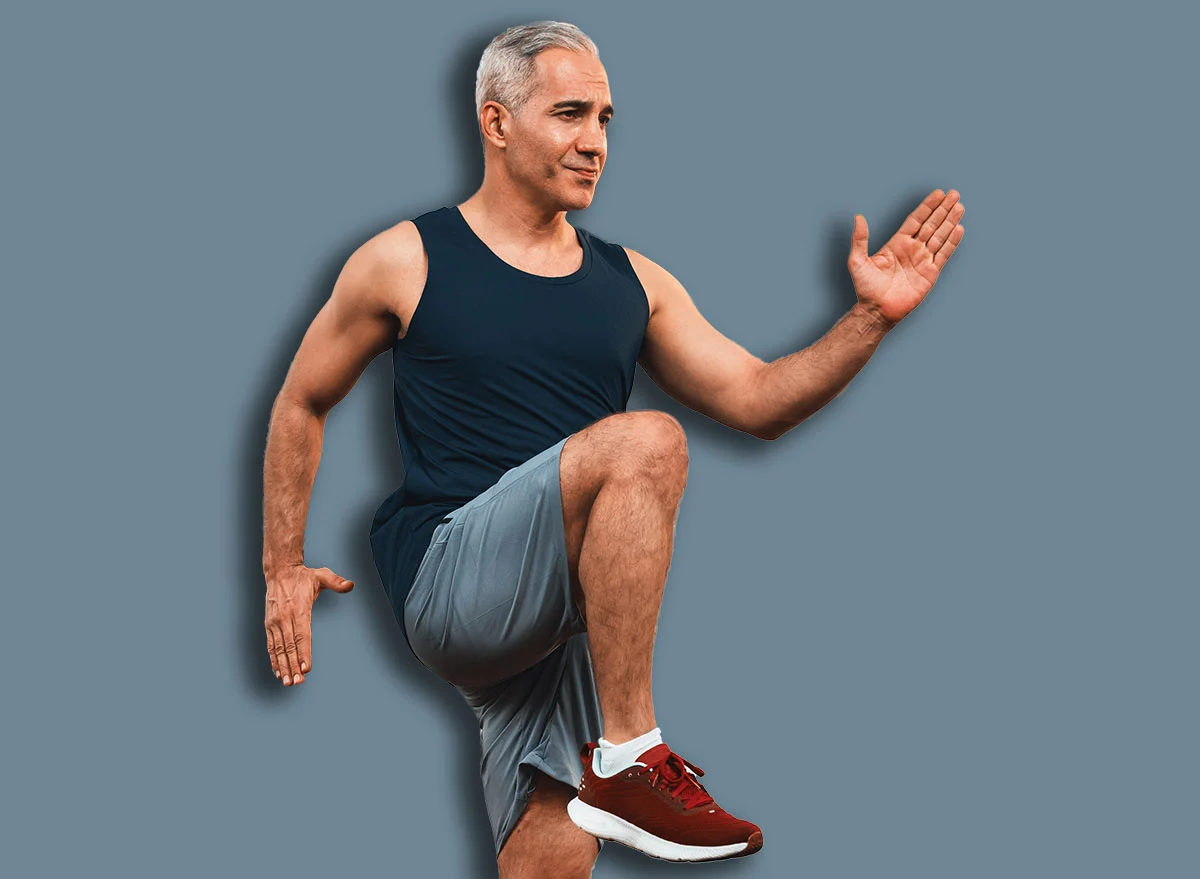
Exercise 3: Standing March Endurance
This exercise measures how your body handles sustained movement, mirroring the stamina required for travel, hiking, or simply navigating a busy day.
How to Perform It:
- Stand tall with your feet hip-width apart.
- Lift your right knee toward your chest, ensuring it reaches at least hip height.
- Lower the right foot and immediately lift the left knee.
- Continue this marching rhythm for 60 seconds.
- Maintain an upright posture—do not lean forward or hold onto support.
Benchmark: Completing the full 60 seconds without losing form, shortening your stride, or needing support places you well above average for functional endurance.
Supporting Data and Clinical Implications
Data from the Centers for Disease Control and Prevention (CDC) underscores the importance of these metrics. Falls are the leading cause of injury-related death among adults aged 65 and older. By training the specific muscle groups utilized in these tests, individuals can significantly reduce their risk profile.
Furthermore, these tests are highly predictive of "all-cause mortality" in older populations. A study published in the British Journal of Sports Medicine found that individuals who could not stand on one leg for 10 seconds had a significantly higher risk of all-cause mortality over the following decade. While this data sounds alarming, it highlights the immense potential for improvement: unlike genetics, functional fitness is highly plastic and responsive to consistent, targeted training.
Implications for Your Routine
If you find that your results fall below these benchmarks, there is no cause for panic. Rather, view these findings as a personalized roadmap.
- If you struggle with the Sit-to-Stand: Focus on "box squats," where you sit onto a chair and stand back up, eventually reducing the height of the chair as you gain strength.
- If your balance is weak: Practice the Single-Leg Balance Hold near a kitchen counter daily while brushing your teeth or waiting for the coffee to brew.
- If your endurance is low: Incorporate short, frequent walks into your day and slowly increase the duration of your Standing March sessions.
Final Thoughts: The Goal is Independence
"Don’t worry about perfection or speed," says Read. "Focus on maintaining good form from beginning to end."
The objective of these assessments is not to win a competition against your neighbors; it is to secure your independence. By focusing on these fundamental movements, you are investing in a future where you can continue to travel, play with grandchildren, and live life on your own terms. Your body is a machine designed for movement; keep it well-maintained, and it will serve you for decades to come.
Tyler Read, BSc, CPT, is a personal trainer with 15 years of experience in health and human performance. He specializes in functional training and longevity-based fitness for older adults.