In our modern, tech-centric world, poor posture has become a silent epidemic. Whether you are hunched over a laptop, collapsing into a sofa after a long day, or perpetually peering down at a smartphone, your body is gradually adapting to these sedentary shapes. Over time, these habitual positions cause your muscles and connective tissues to shorten and tighten, leading to chronic misalignment.
While many turn to yoga or clinical physical therapy for relief, experts are increasingly pointing toward standing-based mobility work as the most effective, functional antidote for posture-related pain. By integrating specific standing movements into your daily routine, you can restore your body’s natural alignment and significantly improve your quality of life.
The Anatomy of Misalignment: Why Posture Matters
Maintaining good posture is about far more than just "standing up straight" for aesthetic reasons. It is a fundamental necessity for physiological health. When your spine is properly aligned, your body weight is distributed evenly across your skeletal structure. This balance reduces the workload on your muscles, ligaments, and tendons, effectively preventing the nagging neck, shoulder, and lower back pain that plagues millions of adults.
Beyond pain relief, proper alignment facilitates better internal function. When you are hunched over, your lungs are compressed, which limits your breathing capacity and can lead to increased fatigue. Furthermore, a slouched posture puts unnecessary pressure on your abdominal cavity, which can hinder digestion. By restoring an upright, neutral spine, you create the necessary space for your organs to function at their peak.
The Case for Standing Exercises
While floor-based mobility drills and yoga remain excellent tools for flexibility, they do not always translate perfectly to the demands of everyday life. Standing exercises, however, offer a unique advantage: they challenge your balance systems and proprioception—the body’s ability to sense its position in space—while you are upright.
"While yoga and floor-based mobility work are excellent for flexibility and range of motion, standing exercises challenge the postural muscles, balance systems, and body awareness required for everyday activities such as standing, walking, climbing stairs, and carrying groceries," explains Jenna Armitage, a seasoned yoga, Pilates, and wellness instructor and founder of GoodGood Studio in London.
According to Armitage, the benefits of standing exercises transfer more directly into daily life because they train the nervous system to maintain alignment against the constant pull of gravity.
Redefining "Perfect" Posture
It is a common misconception that achieving "perfect" posture requires a rigid, military-style stance with shoulders pinned back and chest thrust forward. In reality, this forced rigidity can often lead to further muscle strain and injury.
Andrew Menechian, Co-Founder and Head of Fitness at FitCommit, advocates for a more sustainable approach. With over 12 years of industry experience and a history of mentoring hundreds of personal trainers, Menechian emphasizes the "relaxed tall" position.
"I would rather see a relaxed tall position: head over ribs, ribs over pelvis, feet steady, shoulders not jammed back," Menechian says. "That is the version people can actually keep. If you have to fight to hold your posture, it isn’t functional. You want your body to default to a neutral, supported alignment."
Four Essential Standing Exercises to Restore Alignment
To help you achieve this "relaxed tall" state, Armitage and Menechian recommend the following four exercises. These moves are designed to wake up dormant muscles and release the tension caused by prolonged sitting.
1. Wall Angels
The Wall Angel is the gold standard for correcting rounded shoulders and a forward-leaning head.
- The Science: This exercise teaches the upper back and shoulders to open and retract without forcing the lower back to arch. It builds the necessary strength in the rhomboids and mid-trapezius to keep your chest open.
- How to perform: Stand with your back flat against a wall, feet a few inches away. Place your arms against the wall in a "goalpost" position (elbows bent at 90 degrees). Keeping your wrists and elbows in contact with the wall, slowly slide your arms upward, then back down. Focus on keeping your ribcage knitted in and your spine neutral.
2. Standing Band Pull-Aparts
If you find yourself constantly hunching over a keyboard, your upper back muscles are likely becoming "lazy" and overstretched.
- The Science: "A lot of rounded posture is not just tight chest muscles. The upper back also gets lazy, and this wakes it up fast," explains Menechian. By providing constant tension, resistance bands force the posterior chain to engage.
- How to perform: Stand tall with your feet shoulder-width apart. Hold a resistance band in front of you with both hands, palms facing the floor. Keep your arms straight as you pull the band apart, bringing it toward your chest by squeezing your shoulder blades together. Control the return to the starting position; the release is just as important as the pull.
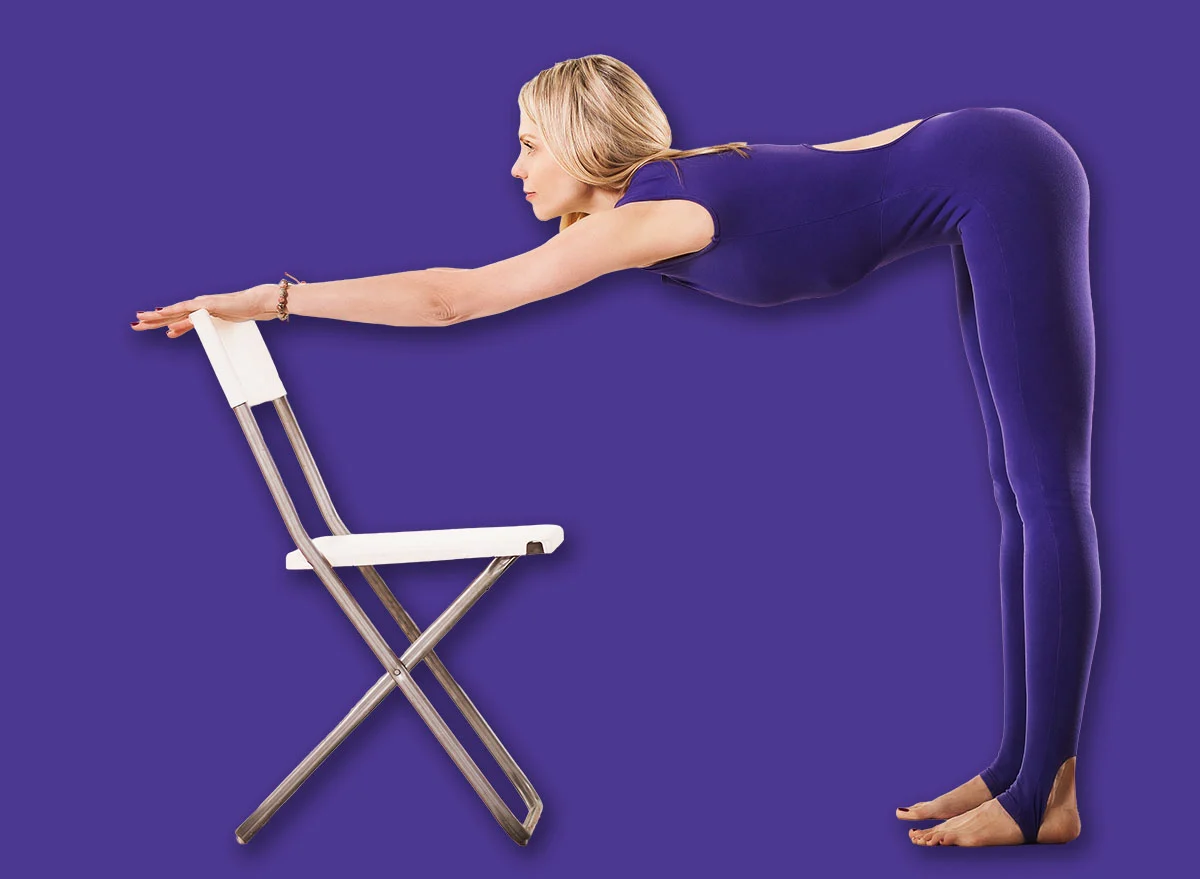
3. Supported Standing Spine Lengthener
Compression is one of the primary culprits of chronic back discomfort. This move acts as a gentle, gravity-assisted traction for your spine.
- The Science: This creates space through the vertebrae, relieves compression, and can feel particularly beneficial for those experiencing tightness through the upper and mid-back.
- How to perform: Place your hands on a sturdy countertop or a high chair back. Walk your feet back until your body forms a slight "L" shape. Keep your spine long and neutral—do not let your chest collapse toward the floor. Focus on reaching your tailbone away from your fingers, creating length through the entire length of your spine.
4. Supported Hip Flexor Stretch
You cannot talk about posture without addressing the hips. When we sit for hours, the hip flexors become shortened and tight, which tilts the pelvis forward and causes the lower back to overcompensate.
- The Science: "Tight hip flexors are one of the biggest contributors to poor posture, particularly in adults who spend long periods sitting," says Armitage. "Opening the front of the hips helps the body return to a more neutral standing position."
- How to perform: Stand near a wall or sturdy support for balance. Step one foot back into a shallow lunge. Keep your torso upright—do not lean forward. Engage your glute on the back leg and tuck your pelvis slightly under until you feel a gentle stretch in the front of your hip. Hold for 30–60 seconds, then switch sides.
Implications for Long-Term Health
The journey to better posture is a marathon, not a sprint. By incorporating these four movements into your daily routine—perhaps as a morning ritual or a "desk break" intervention—you are signaling to your nervous system that you value structural integrity.
The long-term implications are profound. Aside from avoiding the debilitating back pain that often leads to decreased mobility in later life, you are improving your circulation, enhancing your respiratory efficiency, and boosting your overall energy levels.
As you progress, remember the advice of our experts: aim for consistency over intensity. You do not need to perform these exercises for an hour to see results. A few minutes of intentional movement, practiced daily, will do more to restore your posture than an occasional, grueling workout. Listen to your body, maintain that "relaxed tall" position, and give your spine the support it needs to carry you through the years to come.