







As we cross the threshold of 55, the physical demands of daily life—walking, climbing stairs, and rising from a chair—begin to rely heavily on the integrity of our hips. Yet, many active adults find that traditional "go-to" movements like standard squats often fall short of their intended purpose. Instead of firing up the glutes, these movements frequently shift the burden onto the lower back, knees, or thighs, leading to discomfort and suboptimal results.
Rebuilding the glutes at this stage of life requires more than just high-intensity training; it requires a targeted, intentional approach that prioritizes engagement, stabilization, and biomechanical precision. By focusing on direct resistance and controlled movement, you can restore your lower body’s structural foundation.
The Biomechanics of Gluteal Decline
The gluteal complex—comprising the gluteus maximus, medius, and minimus—is the powerhouse of the human body. When these muscles weaken, the kinetic chain suffers. The gluteus maximus is responsible for hip extension, while the medius and minimus are critical for pelvic stability and lateral movement.
When these muscles become inhibited or "dormant" due to sedentary habits or aging, the body compensates by overusing the lumbar spine (lower back) and the quadriceps. This leads to the all-too-common "knee pain" or "back ache" syndrome that discourages many from staying active. The primary objective for anyone over 55 is to "wake up" these muscles before adding heavy external loads. A solid glute rep should feel controlled through the hip joint, with the core braced and the knees tracking perfectly. Once this mind-muscle connection is established, strength builds exponentially.
The Four-Step Routine for Functional Strength
The following four exercises have been curated to target the glutes from the floor and seated positions, ensuring safety while maximizing engagement.
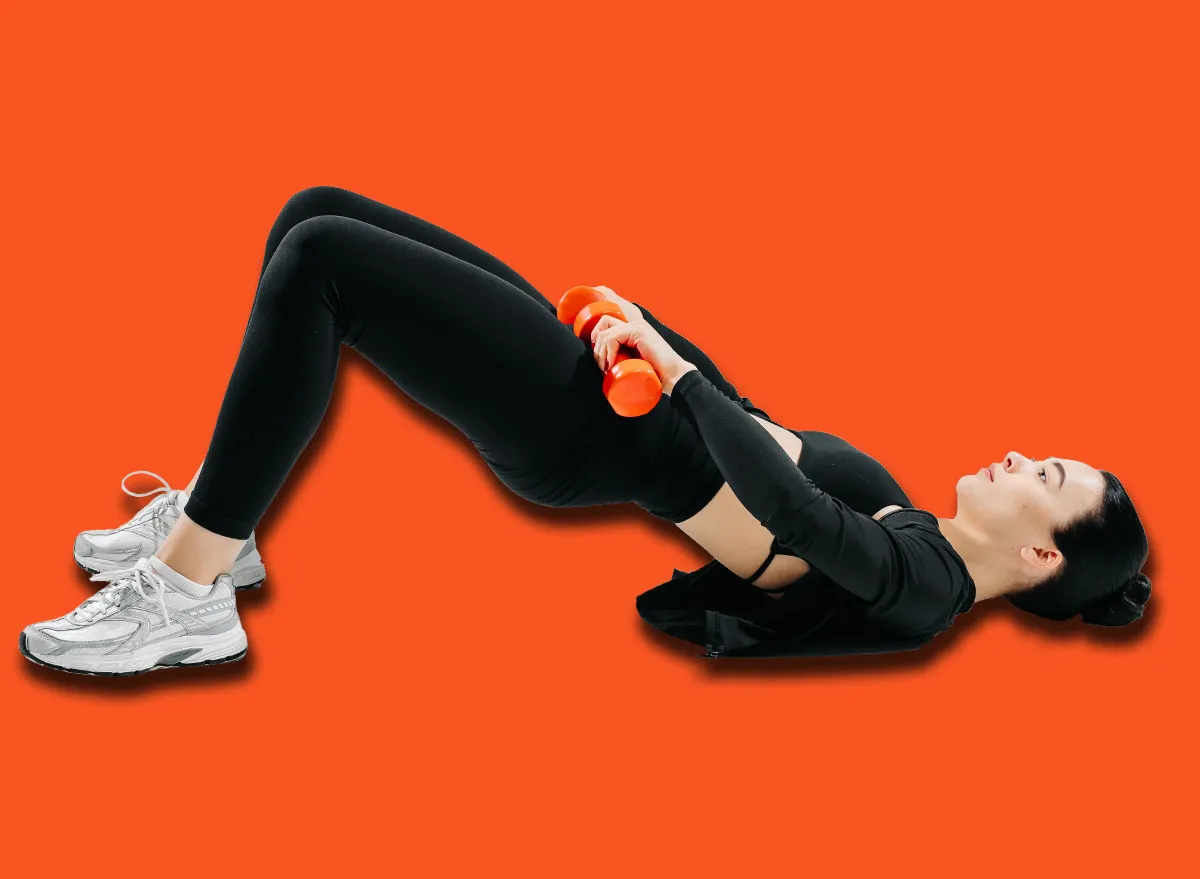
1. The Dumbbell Glute Bridge: Mastering Hip Extension
The glute bridge is the gold standard for restoring hip extension without the axial loading of a barbell back squat. By placing a light dumbbell across the hips, you increase the challenge to the gluteus maximus while keeping the spine neutral.
- The Science: This move isolates the glutes by removing the calves and quads from the primary work.
- Execution: Lie on your back, knees bent, feet flat on the floor. Place a dumbbell across your pelvis. Driving through your heels, lift your hips toward the ceiling. Pause at the top, squeezing your glutes firmly.
- Pro Tip: Keep your ribs tucked down. If your ribcage flares upward, you are likely arching your lower back to complete the movement, which defeats the purpose of the exercise.
2. Single-Leg Glute Bridge Hold: Correcting Imbalances
Asymmetry is a silent thief of stability. Most individuals have one side that is significantly stronger than the other. The single-leg hold forces the working hip to function independently while the core works overtime to prevent the pelvis from tilting.
- The Science: This is a stabilization exercise that mimics the single-leg stance of walking. It is essential for preventing falls and maintaining gait efficiency.
- Execution: Lie in a standard bridge position. Extend one leg straight out. Drive through the heel of the planted foot to lift the hips, holding the position for 10–20 seconds.
- Pro Tip: Imagine you are holding a level between your hip bones. If one side drops, the glute is not fully engaged.
3. The Banded Clamshell: Targeting Lateral Stability
The gluteus medius is often ignored in traditional gym settings, yet it is the primary muscle responsible for preventing the knees from collapsing inward during daily movement.
- The Science: By using a light resistance band above the knees, you provide direct feedback to the outer hip. This strengthens the muscles that prevent hip "hiking" or wobbling during movement.
- Execution: Lie on your side, knees bent at a 45-degree angle. With the band around your thighs, lift your top knee while keeping your heels touching.
- Pro Tip: Do not allow your torso to roll backward. The goal is to isolate the hip joint, not to use your lower back to swing your knee open.
4. Seated Band Abduction: The "Chair-Bound" Power Move
For those who prefer seated exercises or are rehabilitating from injury, the seated band abduction is an exceptional way to build outer hip strength.
- The Science: This exercise focuses on abduction—moving the leg away from the midline. It is highly effective for seniors as it requires no balance, allowing the user to focus entirely on the gluteal contraction.
- Execution: Sit on the edge of a sturdy chair with a band around your knees. Keeping your feet planted, press your knees outward against the resistance of the band. Control the return slowly.
- Pro Tip: Do not lean back. Maintaining a tall, upright posture ensures the glutes—not the hip flexors—are performing the work.
Chronology of Progress: A Strategic Approach
Rebuilding muscle after 55 is not a sprint; it is a long-term architectural project.
- Weeks 1-2 (The Activation Phase): Focus exclusively on bodyweight versions. Use this time to identify your "dead zones"—the side or muscle group that feels less responsive.
- Weeks 3-6 (The Resistance Phase): Introduce light dumbbells and resistance bands. At this stage, focus on time under tension. A three-second descent during a glute bridge is more effective than ten fast, sloppy reps.
- Weeks 7+ (The Maintenance Phase): Integrate these moves into your daily lifestyle. The goal is to make these movements second nature, ensuring your hips remain the "brakes" and "engines" of your body.
Supporting Data: Why This Matters
According to research published in journals such as The Journal of Gerontology, sarcopenia (the age-related loss of muscle mass) disproportionately affects the lower body. Clinical studies have shown that individuals over 55 who incorporate resistance training focused on the hip abductors and extensors report a 40% reduction in lower back pain and a significant improvement in balance tests.
Furthermore, the "Glute-First" approach to training has been endorsed by modern physical therapists as a preventative measure against hip arthroplasty (hip replacement). By keeping the surrounding musculature strong, you reduce the mechanical wear and tear on the hip joint itself.
Professional Perspectives
Experts in sports medicine, including those associated with the National Strength and Conditioning Association (NSCA), emphasize that the "mind-muscle connection" is not a myth—it is a physiological reality. When we age, the neurological pathways to the glutes can become less efficient. By slowing down the tempo of exercises, we essentially "re-map" the nervous system, teaching the brain to recruit the glutes before the lower back or quads.
"The goal is not to lift the heaviest weight in the room," says Jarrod Nobbe, CSCS. "The goal is to ensure that the muscles intended to move the load are the ones actually doing the work. If you feel it in your lower back, you haven’t succeeded. Adjust your form, decrease the resistance, and try again."
Implications for Longevity
The implications of a strong posterior chain extend far beyond the gym. A strong glute complex provides the structural integrity needed for:
- Fall Prevention: The glutes provide the stability needed to recover from a stumble.
- Metabolic Health: Larger muscle groups, like the glutes, are metabolically active and help manage blood glucose levels more effectively.
- Independence: The ability to stand up from a deep couch or climb a flight of stairs without assistance is directly correlated to gluteal strength.
Conclusion: Building a Foundation for Life
If you are over 55, your fitness journey should be defined by the quality of your movement rather than the quantity of your reps. By incorporating these four exercises into a five-to-seven-day-a-week routine, you are doing more than just "toning"—you are investing in your long-term mobility.
Start small, keep the resistance manageable, and focus on the sensation of the glutes firing. As your hip strength increases, you will find that the activities you once found daunting become effortless, allowing you to move through your later years with the confidence and stability you deserve.
Recommended Weekly Protocol:
- Daily: Perform one round of each exercise (3 sets of each) as a warm-up or "strength block."
- Intensity: Use moderate resistance on 3 days (challenging but controlled).
- Recovery: Use light resistance or bodyweight only on the remaining days to facilitate muscle recovery.
- Consistency: The secret to success is the cumulative effect of these small, controlled movements over time.