












For many, crossing the threshold into their sixties comes with an unwanted companion: chronic lower back pain. It is the single most common reason individuals in this age bracket seek professional training, yet it is also a condition often met with a sense of resignation. Many believe their back issues are structural "damage" that cannot be reversed. However, after nearly 40 years as a personal trainer and director of TRAINFITNESS, I have observed a different reality: in the vast majority of cases, the pain is not caused by broken parts, but by forgotten ones.
The muscles of the lower back have not necessarily failed; they have simply lost the ability to "fire" correctly after decades of sedentary living. When this physical inactivity is paired with the psychological fear of triggering a flare-up, the result is a cycle of avoidance that further weakens the very muscles needed for stability.
The Anatomy of the Struggle: Why Backs "Complain" After 60
To understand why back pain becomes more prevalent after 60, we must look at the biomechanics of aging. The most common culprit is a fundamental imbalance: the glutes—the powerhouse of the posterior chain—have become dormant, the hip flexors have tightened due to excessive sitting, and the deep abdominal muscles have effectively "switched off."

When these primary stabilizers are inactive, the lower back muscles are forced to compensate for every movement—lifting, walking, and standing. These muscles were never designed to be the primary load-bearers for the entire body. By age 60, this chronic over-recruitment results in the persistent, dull ache that many consider an inevitable part of aging.
Furthermore, this is a crisis of strength. Many people over 60 struggle to maintain a simple plank for 30 seconds or lift a light bag of groceries with proper form. This isn’t a lack of effort; it is a lack of neuromuscular conditioning.
Beyond the Gym: Why Chairs Outperform Machines
There is a common misconception that "back strengthening" requires high-end gym equipment. In reality, machines like the traditional back extension often isolate the muscle in an unnatural way, locking the body into a path of motion that does not translate to real-world strength.

Chair-based exercises provide a superior alternative. They train the body to maintain trunk stability while the limbs are in motion—the exact pattern required for daily tasks like reaching for a high shelf or rising from a sofa. Furthermore, the accessibility of a chair removes the intimidation factor. There is no need for gym memberships or complex equipment, allowing individuals to modify intensity by simply adjusting their range of motion or adding support.
The Four Pillars of Back Resilience
The following four exercises are designed to restore function and build lasting resilience.
1. Seated Pelvic Tilts
This is the foundational movement. By mobilizing the lumbar spine and engaging the deep core, this exercise "reboots" the communication between your brain and your lower back muscles.
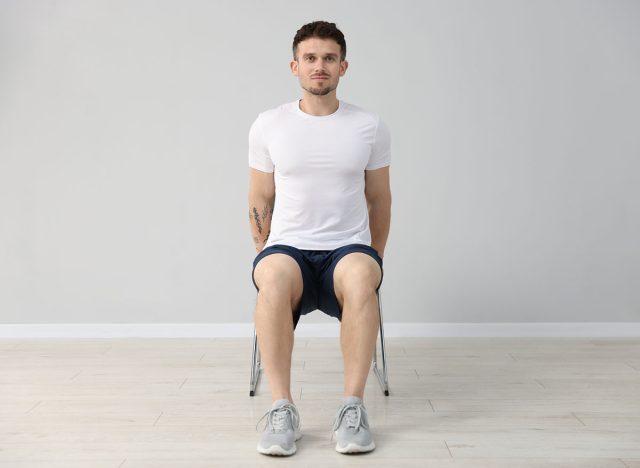
- The Goal: Wake up the deep stabilizers.
- Execution: Sit upright with feet flat on the floor. Gently tilt your pelvis forward and backward, creating a subtle arching and rounding motion in the lower back.
- Form Tip: If you are experiencing high stiffness, start with a very small range of motion. Precision is more important than depth.
2. Seated Hip Hinge
This movement teaches you to keep the spine "long" while bending forward, a critical skill for preventing injury when lifting objects.
- The Goal: Protect the lower back during daily forward-bending tasks.
- Execution: Sit on the edge of your chair, place hands on your hips, and hinge forward from the hip joint while keeping your back perfectly straight. Return to center using your glutes and lower back muscles.
- Key Avoidance: Do not round the shoulders or allow the spine to curve.
3. Sit-To-Stand
Often used by physical therapists as a benchmark for functional independence, this move strengthens the entire posterior chain.
- The Goal: Build strength in the glutes, hamstrings, and lower back simultaneously.
- Execution: From a seated position, lean slightly forward, engage your core, and stand up using your leg strength. Control the descent as you sit back down.
- Modification: If standard chair height is difficult, use a higher seat or a firm cushion to reduce the depth of the movement.
4. Standing Hip Extension with Chair Support
Weak glutes force the lower back to work "double duty." This exercise isolates the glutes to ensure they take the load off your spine.
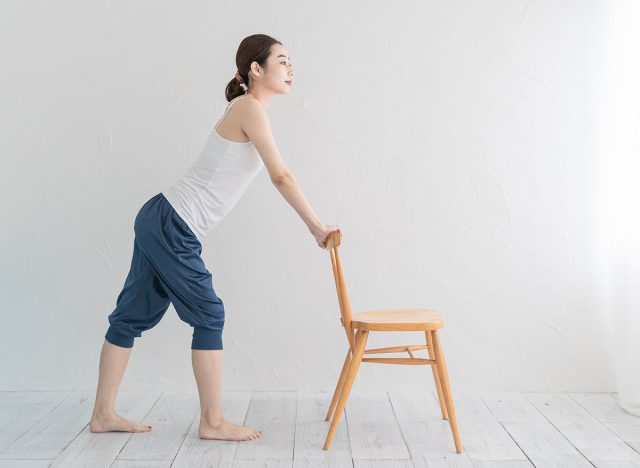
- The Goal: Strengthen the glutes to protect the back.
- Execution: Hold the back of a chair for balance. Keeping one leg straight, slowly extend it backward, squeezing the glute at the peak of the movement.
- Form Tip: After a month of training, add a two-second hold at the top of the movement to maximize glute activation.
Implementation: A Realistic Weekly Plan
Consistency, not intensity, is the goal. Aim for three to four days a week. Each session should take approximately 10 to 12 minutes.
Progression Timeline:
- Weeks 1-2: Focus on mastering form. Two sets of each exercise. You will notice everyday tasks, like lacing your shoes, feel less "strenuous."
- Weeks 3-4: Introduce a third set for the pelvic tilts and hip extensions. You should notice a significant decrease in the persistent, daily lower back ache.
- Weeks 5-6: The "Strength Phase." Increase the intensity of the glute holds. By this stage, you should feel a noticeable difference in your posture and ease of movement.
When to Seek Professional Guidance
While these exercises are safe for the general population, they are not a substitute for medical advice in specific clinical scenarios. If you have a history of spinal stenosis, osteoporosis, recent back surgery, or diagnosed disc issues, you must consult your GP or a physical therapist before beginning.

Warning Signs:
Stop immediately if you experience sharp, stabbing pain (rather than a dull muscle burn) or if pain persists for more than a few hours post-exercise. Furthermore, any numbness, tingling, or pain that radiates down the leg—especially past the knee—suggests a potential nerve issue that requires a clinical assessment. Any sudden loss of bladder or bowel control is a medical emergency and requires immediate attention.
The Long-Term Implication: Moving with Freedom
The most important takeaway is that back health is a practice, not a destination. These twelve minutes of exercise are an investment in your future independence. By shifting the focus from "repairing damage" to "restoring function," you move away from a life defined by avoidance and toward a life defined by movement. After 60, the goal is not to have a back that is perfectly still, but a back that is strong enough to handle everything life throws at it.