







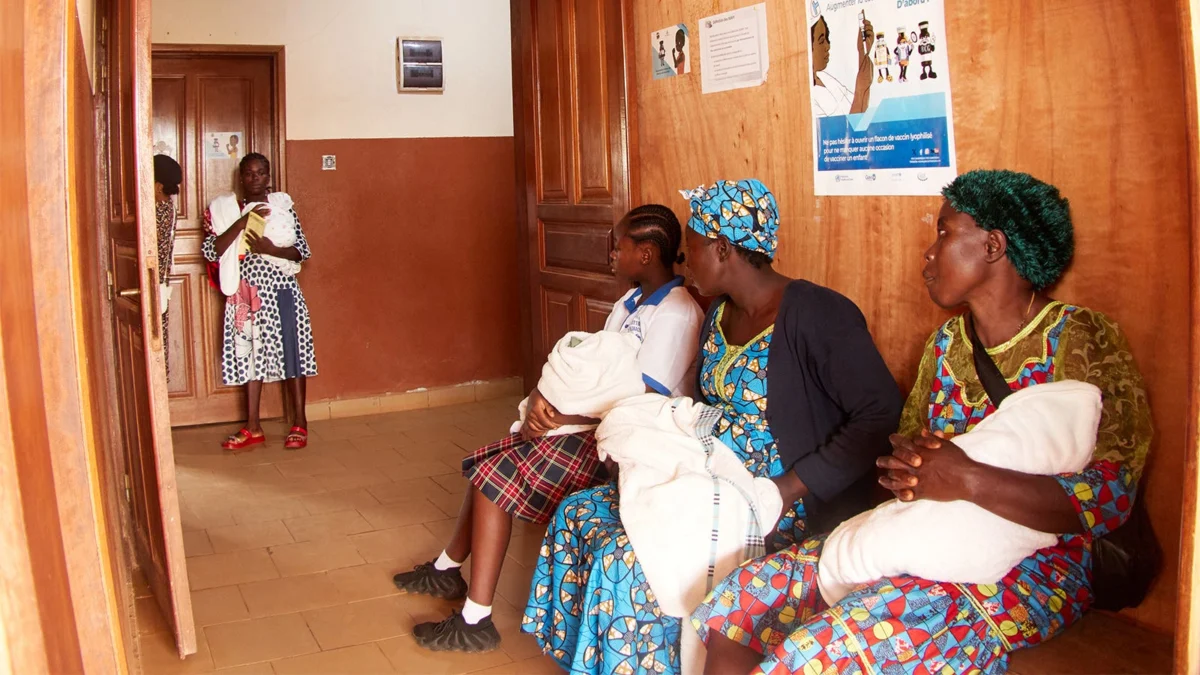
YAOUNDE, Cameroon — The dirt road leading to the Soa District Hospital had been transformed into a treacherous expanse of thick, sucking mud by the seasonal rains. Yet, for Mabel Djoumessi, the physical toll of the journey was secondary to a singular mission: ensuring her nine-month-old son, Kenfack, received his scheduled malaria vaccination.
For generations, families across the African continent have viewed the onset of malaria as an inevitable, if devastating, rite of passage. It is a disease that haunts the nursery, claiming the life of a child under the age of five almost every single minute. For Djoumessi, the arrival of the malaria vaccine—a medical breakthrough that has long been the subject of scientific pursuit—is nothing short of a miracle. While her older children have endured cycles of fever and clinical exhaustion, Kenfack remains vibrant, a reality she credits entirely to the immunization campaign.
“My other children who have never taken the vaccine frequently fall ill,” Djoumessi said, cradling her son in a waiting room filled with mothers sharing similar hopes. “When my son turns two, I will make sure I return for the fourth dose. I don’t want him to suffer like the others.”
However, Djoumessi’s resolve is the exception rather than the rule. While the introduction of the RTS,S (Mosquirix) vaccine has marked a historic turning point in public health, Cameroon and its neighbors face a critical bottleneck: the "booster gap." As health systems struggle to ensure children return for their fourth and final shot, the efficacy of this life-saving intervention hangs in the balance.
The Chronology of a Medical Breakthrough
The battle against malaria in Africa has been a decades-long war of attrition. For years, the primary defenses were limited to insecticide-treated bed nets, indoor residual spraying, and prompt access to anti-malarial medication. The introduction of a vaccine was long considered the "Holy Grail" of tropical medicine.
- 2021: The World Health Organization (WHO) formally recommended the widespread use of the RTS,S vaccine following successful pilot programs in Ghana, Kenya, and Malawi. The data revealed a modest but vital reduction in severe malaria cases among children.
- 2024: Cameroon made history by becoming the first nation to fully integrate the RTS,S vaccine into its routine national immunization program. This signaled a shift from pilot projects to a systematic, country-wide defensive strategy.
- 2024–2025: As the rollout matured, data began to emerge from the field. While initial doses saw strong uptake, the "fourth dose" barrier became increasingly apparent, with completion rates lagging significantly behind the initial series.
- Present Day: Cameroon and other high-burden nations are now recalibrating their public health messaging to emphasize the necessity of the full four-dose schedule, even as international funding streams face unprecedented volatility.
Supporting Data: The Efficacy-Uptake Paradox
The statistical reality of the malaria vaccine rollout presents a dichotomy of success and systemic failure. According to data published in the peer-reviewed Malaria Journal, coverage for the first dose of the malaria vaccine in pilot regions reached approximately 80%. However, this momentum dissipated by the time children reached the 22-to-24-month window for their final booster, with coverage plummeting to 46%.
In Cameroon, the trends mirror this continental struggle. While authorities reported an uptick in coverage for the first three doses—rising from 66% to 68% for the first dose and 48% to 59% for the third between 2024 and 2025—the fourth dose stagnated at a concerning 25%.
This drop-off is particularly alarming given the clinical necessity of the booster. Dr. Bomba Amougou, head of prevention at Cameroon’s National Malaria Control Program, notes that while the vaccine has undoubtedly contributed to a reduction in cases—with 33,000 fewer malaria-related hospitalizations recorded in 2025 compared to the previous year—it is not a "silver bullet."
“Isolating the specific impact of malaria interventions requires complex modeling,” Dr. Amougou explained. “We do not yet have a model to quantify the vaccine’s sole contribution. It is accurate to say that the vaccine has contributed to the reduction in cases and deaths, rather than being the exclusive cause. The full four-dose regimen is what makes the protection truly potent.”
Official Responses and the Funding Crisis
The global health community is currently navigating a period of profound uncertainty. With the support of Gavi, the Vaccine Alliance, more than 52 million doses of malaria vaccine have been distributed to 25 high-risk African nations. Yet, Gavi leadership has publicly acknowledged that the rollout faces "stark constraints."
Sweeping foreign aid cuts, most notably from the United States under the Trump administration, have threatened to destabilize these programs. Despite these fiscal headwinds, Gavi CEO Dr. Sania Nishtar maintains a pragmatic outlook.
“The lower vaccination rates for the fourth dose are initial teething problems that I don’t think should take the spotlight away from the value of this vaccine,” Dr. Nishtar said in an interview. She noted that parental hesitancy is remarkably low compared to other vaccines, largely driven by the visceral, daily fear of losing a child to malaria. “There is huge demand from governments and communities. Our challenge is logistical, not ideological.”
In response to the data, Cameroon has launched "Big Catch-up" campaigns. These initiatives are designed to bridge the gap between clinics and communities, offering reminders and attempting to reduce the "friction" that prevents parents from returning for the final dose.
Implications: Poverty, Logistics, and the Future of Care
The failure to complete the vaccination series is rarely a matter of negligence; it is a matter of survival. For families in Cameroon, where nearly 40% of the population lives in poverty, the logistical hurdles of returning to a clinic are immense.
The Economic Burden
For parents like Georgette Caroline Mengbwa, the vaccine represents not just a health intervention, but an economic lifeline. Her two older children, born before the vaccine was available, have been a constant source of medical expenditure.
“They fall ill every two or three months, and I have to spend between $53 and $107 each time one or all of them fall ill,” Mengbwa said. In a country where the monthly minimum wage hovers around $76, these costs are catastrophic. For Mengbwa, the vaccine is the difference between keeping her family out of debt and falling into cycles of destitution caused by medical emergencies.
The Search for a Simpler Solution
The logistical difficulty of the four-dose schedule has prompted a new wave of research. Dr. Nishtar emphasized that the scientific community is aggressively pursuing a single-dose malaria vaccine.
“The fewer the doses, the higher the uptake and the easier the administration,” she noted. Until such a solution is available, the focus must remain on strengthening health infrastructure—improving transport links, establishing robust digital reminder systems, and ensuring that healthcare workers can reach rural populations during the rainy season when the burden of malaria is at its peak.
A Multi-Pronged Defense
Health officials are adamant that even with a successful vaccine rollout, complacency cannot be allowed to set in. Vaccination must remain part of a broader, integrated strategy.
“The vaccine must complement bed nets, prompt treatment, and good sanitation,” Dr. Amougou said. “We are fighting a resilient parasite in a challenging environment. We cannot afford to drop our guard on any front.”
As the sun sets over the Soa District Hospital, the empty pediatric wards stand as a testament to the progress made. Yet, for the thousands of children who remain at risk, the mission is far from finished. The challenge for the coming year is clear: transforming the high initial demand for the vaccine into a consistent, sustainable, and completed immunization journey for every child in the country.