











From the viral corridors of TikTok to the bestseller lists of health-conscious authors, a singular nutritional debate has roared back to life: the controversy surrounding vegetable and seed oils. Often branded as "toxic sludge," "motor oil," or the "hateful eight," these fats have become the latest target for those advocating for a return to ancestral eating patterns. But is the demonization of these oils grounded in rigorous science, or is it a case of internet-fueled hyperbole?
To understand the truth, we must peel back the layers of marketing, industrial processing, and historical dietary shifts to determine how these oils truly impact human health.
The Core Debate: Why the Anti-Seed Oil Sentiment?
The modern "anti-seed oil" movement, heavily influenced by the rise of the carnivore diet and metabolic health influencers, rests on a specific narrative: that humans evolved eating animal fats, while industrial seed oils are a recent, profit-driven invention designed to replace "healthy" traditional fats like butter and lard.
Proponents of this view argue that the industrialization of oils—specifically soybean, corn, canola, cottonseed, sunflower, safflower, grapeseed, and rice bran oils—has led to a surge in chronic diseases, including obesity, anxiety, depression, and inflammatory conditions like ulcerative colitis. They posit that these oils are chemically unstable, pro-inflammatory, and fundamentally incompatible with human biology.
Conversely, mainstream nutritional organizations and many independent researchers argue that these oils are not only harmless but, when chosen correctly, can actually serve as heart-healthy alternatives to saturated fats. The reality, as is often the case in nutrition science, lies in the nuance between the source of the oil and the process used to create it.
A Chronological Shift: From Traditional Fats to Industrial Processing
To understand the current climate, one must look at the timeline of human fat consumption. For millennia, human diets relied on fats derived from animal sources or simple, mechanical pressing of high-fat fruits like olives and coconuts.
The Rise of Industrial Extraction
At the turn of the 20th century, the landscape changed. As food technology advanced, manufacturers sought ways to turn cheap, abundant crops—such as corn and soybeans—into shelf-stable cooking fats. Unlike olives, which are naturally brimming with oil, these crops contain a relatively low percentage of fat.

To extract oil from these sources, the industry developed a multi-step, high-heat, and often solvent-heavy process:
- Cleaning and De-hulling: Removing extraneous plant matter.
- Pressing: Extracting the raw oil.
- Solvent Extraction: Using chemical solvents (like hexane) to pull the remaining oil from the meal.
- Degumming and Refining: Removing impurities using acids and caustic chemicals.
- Bleaching and Deodorizing: Achieving a uniform, neutral flavor and appearance.
During this intensive processing, the natural polyphenols and stabilizers inherent in the plant are stripped away. Furthermore, if these oils are processed at high temperatures or used repeatedly in commercial fryers, small amounts of unsaturated fats can oxidize or transform into trans fatty acids. While the FDA banned the addition of industrial trans fats to processed foods in 2018, the process of cooking remains a critical variable in how these oils affect the body.
Supporting Data: The "Head-to-Head" Matchups
To differentiate between health-promoting fats and those that should be used sparingly, it is helpful to look at the research through direct comparisons.
Extra Virgin Olive Oil (EVOO) vs. Canola Oil
EVOO is the gold standard of culinary fats. It is produced by mechanical cold-pressing, which preserves the olive’s polyphenols—plant compounds that combat inflammation and oxidative stress. Large-scale studies, including research conducted in Southern Italy, have shown that high consumers of EVOO experience significantly lower rates of all-cause mortality.
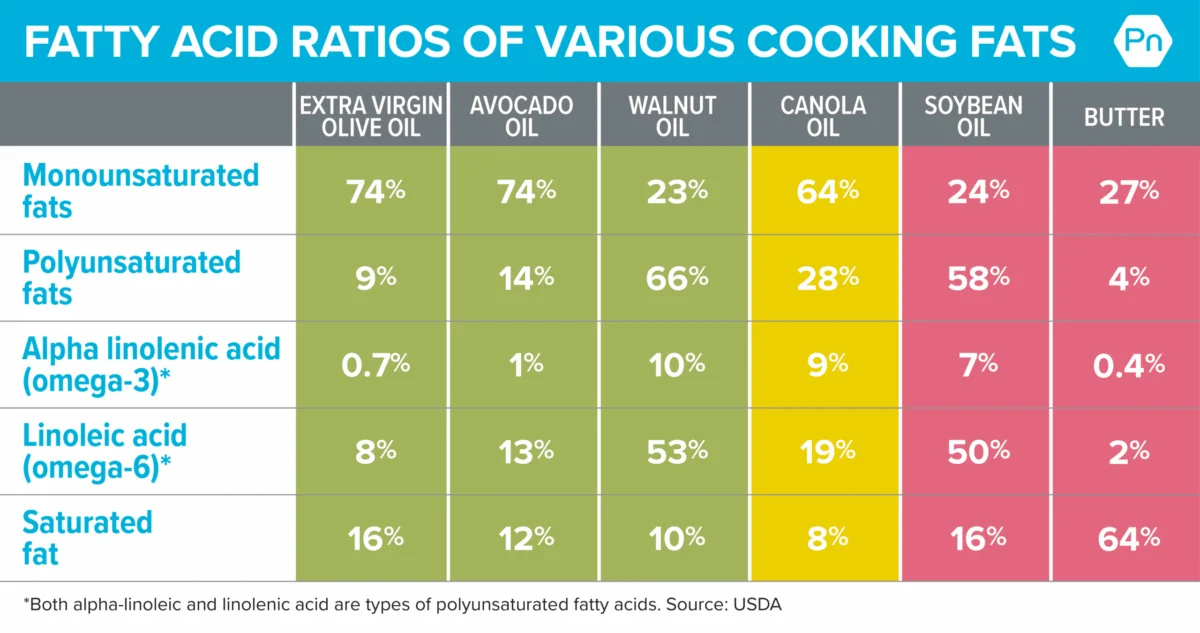
Canola oil, while often maligned, presents a different profile. It is derived from the rapeseed plant and is generally low in saturated fat and high in monounsaturated fats. While it lacks the dense phytonutrient profile of EVOO, expeller-pressed (mechanically extracted) canola oil remains a neutral, cost-effective, and heart-healthy alternative when used to replace butter or lard.
The Omega-6 "Inflammation" Theory
The most common critique of seed oils is their high concentration of omega-6 fatty acids. The typical Western diet provides an omega-6 to omega-3 ratio that is heavily skewed, leading some to argue that this triggers systemic inflammation.
However, recent research from the American Heart Association and Harvard Health has challenged this. Studies indicate that omega-6 fats, when consumed in their whole-food matrix (like in nuts and seeds), are actually associated with reduced cardiovascular risk. The problem arises not from the omega-6s themselves, but from the lack of protective compounds in highly processed oils compared to the nutrient-dense, fiber-rich whole foods they are derived from.

Official Responses and Scientific Consensus
The scientific community generally discourages the "all-or-nothing" approach to dietary fats. The primary health concern identified by major health organizations is not necessarily the existence of seed oils, but the ultra-processed food environment.
Highly processed oils are the "silent" ingredient in almost every ultra-processed food on the market—from crackers and chips to salad dressings and frozen dinners. When these oils are consumed as part of a calorie-dense, low-nutrient diet, the risk of metabolic dysfunction increases. The issue, therefore, is two-fold: the loss of natural stabilizers through industrial refining and the overconsumption of ultra-processed goods that utilize these oils as a cheap, caloric base.
Implications for Your Diet: A Practical Strategy
If you are looking to optimize your health, you do not necessarily need to purge your pantry of every bottle of sunflower or canola oil. Instead, adopt a hierarchy of fat consumption:
- Prioritize Whole Food Fats: Get the majority of your fat from avocados, olives, nuts, seeds, and fatty fish. These come "packaged" with fiber, protein, and antioxidants.
- Choose Minimally Processed Oils: For cooking and dressings, extra virgin olive oil and avocado oil are the best choices. They are stable, nutrient-dense, and supported by extensive clinical evidence.
- Use "Eat Some" Oils in Moderation: Expeller-pressed canola, high-oleic sunflower, and safflower oils can be used as budget-friendly, neutral-flavored options. They are not inherently "toxic," but they lack the health-promoting benefits of the oils in category two.
- Limit Ultra-Processed Foods: This is the most critical step. By reducing your intake of commercially prepared, ultra-processed products, you will naturally lower your exposure to the most highly refined, oxidized, and potentially problematic vegetable oils.
- Avoid Deep-Fried Foods: Regardless of the oil type used, deep-frying causes high-heat oxidation that degrades the quality of any fat.
Final Thoughts
The "seed oil" debate is often a proxy for a much larger issue: the shift toward a highly industrialized food system. While the "toxic" label is a gross exaggeration, it is true that modern processing techniques have stripped many oils of their natural health benefits.
Ultimately, your health is not determined by a single ingredient, but by your overall dietary pattern. If you focus on minimally processed, whole-food-based nutrition, you will naturally mitigate the risks associated with industrial oils while benefiting from the satiety and nutritional value of a balanced, fat-inclusive diet. Whether you are a home cook or a professional coach, the path forward is clear: choose quality, prioritize whole foods, and view oils as a supportive element of your nutrition, not the foundation of your health.