








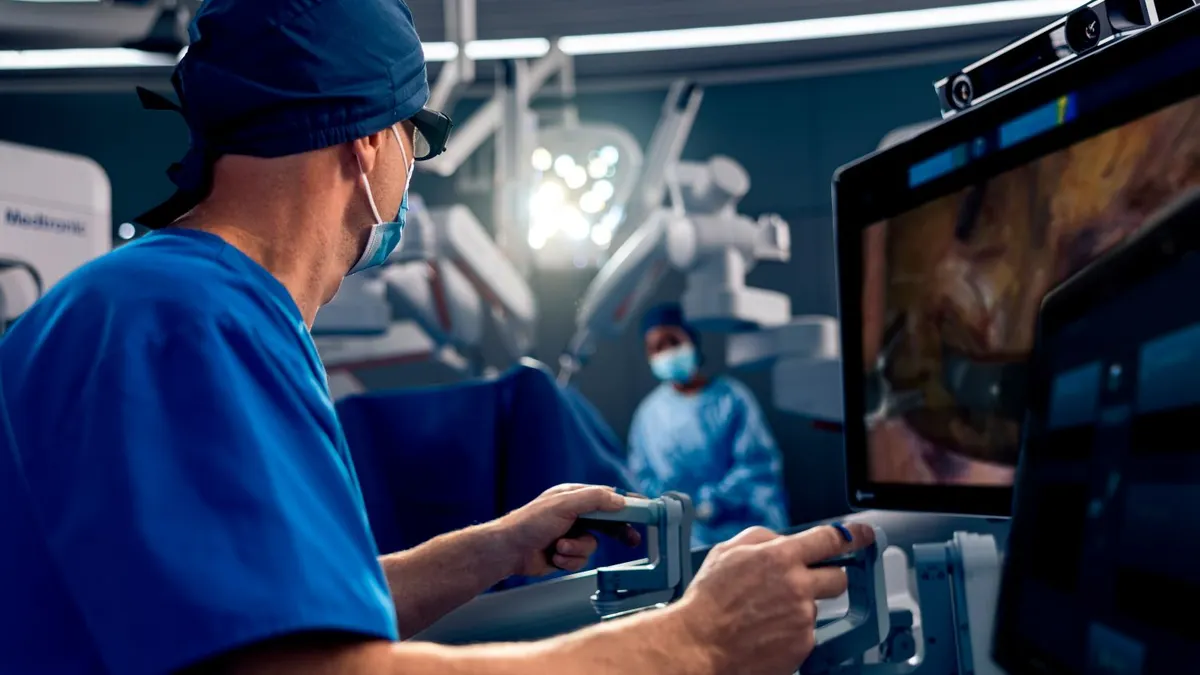
Medtronic is set to redefine the landscape of digital surgery this week at the Society of Robotic Surgery (SRS) meeting, marking a pivotal moment in its ongoing strategic campaign to challenge Intuitive Surgical’s long-standing hegemony in the U.S. robotic soft tissue market. The medical technology giant has officially unveiled its "Touch Surgery Aide" computing platform, a sophisticated, AI-driven ecosystem designed to assist surgical teams in real-time.
At the heart of this launch is the platform’s first application: the Intelligent Instrument Exclusion Zone (IEP). By integrating advanced computer vision with live procedural data, Medtronic is moving beyond the traditional role of robotic arms as mere extensions of a surgeon’s reach, instead positioning them as cognitive partners that actively process the operating room environment.
The Core Innovation: What is Touch Surgery Aide?
The Touch Surgery Aide platform is not merely a software update; it is an expansion of Medtronic’s established "Touch Surgery" ecosystem, which already maintains a footprint in over 1,500 operating rooms globally. While the ecosystem previously focused on pre-operative planning, training, and post-operative analysis, the introduction of real-time AI brings the technology directly into the heat of the surgical procedure.
The Intelligent Instrument Exclusion Zone (IEP)
The IEP application serves as the flagship feature of this new platform. Utilizing sophisticated algorithms, the system monitors surgical instruments and provides instant visual notifications if they stray beyond the intended field of view. While this may seem like a subtle safety enhancement, it represents a fundamental shift in surgical oversight. By processing visual feeds in real-time, the system acts as a digital "guardrail," ensuring that surgical focus remains calibrated to the patient’s anatomy, thereby reducing the margin for human error during high-stakes maneuvers.
Chronology: Medtronic’s Ascent in Robotics
Medtronic’s journey toward this announcement has been marked by methodical, regulatory-focused progress.
- The Foundation: Medtronic spent years building out its digital surgical ecosystem through the acquisition of Touch Surgery, a company specializing in surgical video analytics and training software. This provided the data infrastructure necessary to train future AI models.
- December 2024 – The Breakthrough: The Hugo robotic-assisted surgery system received FDA clearance for urologic procedures. This was the watershed moment, as it allowed Medtronic to officially enter the U.S. market, positioning the Hugo as a direct competitor to the market-dominant Da Vinci systems manufactured by Intuitive Surgical.
- Expansion Efforts: Following the initial clearance, Medtronic aggressively filed for additional indications, seeking to expand the Hugo’s utility into gynecological and general surgery—areas where robotic-assisted intervention has seen the most rapid adoption.
- The Present Day: The debut of the Touch Surgery Aide at the Society of Robotic Surgery meeting marks the transition from hardware-centric competition to a software-first value proposition.
Supporting Data and Technical Architecture
The technical prowess of the Touch Surgery Aide lies in its ability to handle "simultaneous multi-tasking." Unlike legacy systems that might process a single stream of data, the Touch Surgery Aide runs multiple AI applications concurrently during a live procedure.
Continuous Learning
A core design philosophy of the system is that it is a "living" architecture. As more procedures are performed and more data is ingested, the system is designed to learn, evolve, and refine its predictive capabilities. The platform uses computer vision to analyze thousands of hours of surgical video, allowing it to recognize anatomical structures and surgical steps with increasing accuracy.
Scalability
While currently optimized for the Hugo robotic platform, Medtronic has explicitly stated that the platform is engineered with the intent to scale into the broader laparoscopic surgery market. This suggests that the company’s vision is not just to capture the robotic niche, but to provide a universal digital "assistant" that can be applied to standard minimally invasive procedures, significantly broadening its potential market share.
Official Responses and Strategic Vision
The leadership at Medtronic frames this advancement as a necessary evolution of surgical medicine. Jim Peichel, Medtronic’s Chief Technology Officer, emphasized that the shift is one of fundamental philosophy:
"Real-time AI marks a new frontier for healthcare—it is a fundamental evolution in how surgery is supported, moving from technology that assists the surgeon’s hand to technology that helps teams work smarter, move faster, and deliver greater impact in the moment."
The company’s focus on "team-based" support is a critical distinction. By providing real-time data to the entire operating team—not just the surgeon at the console—Medtronic aims to increase the efficiency of the entire workflow. This focus on "team-based efficiency" is a direct appeal to hospital administrators looking to reduce operating room turnover times and improve procedural outcomes in an era of tightening healthcare budgets.
Implications: The Battle for the OR
The introduction of Touch Surgery Aide significantly alters the competitive landscape. For years, the robotic surgery market has been a battle of hardware specifications—who has the most flexible arm, the highest-definition camera, or the most ergonomic console.
A Shift to Software-as-a-Service (SaaS)
By prioritizing AI and real-time computing, Medtronic is signaling a shift toward a software-centric model. Hospitals are increasingly looking for platforms that provide quantifiable data insights that can lead to cost savings. If Medtronic can demonstrate that their AI reduces the length of stay or decreases the rate of complications, they will gain a powerful lever in hospital procurement negotiations.
Challenging Intuitive Surgical
Intuitive Surgical has enjoyed a "first-mover" advantage for nearly two decades, establishing the Da Vinci robot as the standard of care. However, Medtronic’s strategy is built on the premise that the next frontier of surgery is not the robot itself, but the intelligence that guides it. By leveraging their existing presence in hospitals and their massive library of surgical video data, Medtronic is attempting to "leapfrog" the current standard of hardware-led competition.

The Regulatory Horizon
The success of this strategy will depend heavily on the speed of regulatory approvals. While the IEP application is an early step, the future of the platform depends on the FDA’s willingness to embrace autonomous or semi-autonomous surgical AI. As Medtronic seeks clearance for more advanced AI applications, the regulatory scrutiny regarding "algorithmic accountability" will likely increase.
Future Outlook: Where Surgery Goes Next
As the medical community convenes at the Society of Robotic Surgery meeting, the conversation has clearly shifted from "can the robot do it?" to "how much smarter can the robot make the surgeon?"
The potential for the Touch Surgery Aide extends far beyond simple "exclusion zones." In the future, such platforms could offer:
- Predictive Complication Analysis: Alerting surgeons to risks before they occur by identifying bleeding patterns or anatomical anomalies in real-time.
- Automated Documentation: Reducing the administrative burden on surgeons by automatically generating procedural reports.
- Remote Proctoring: Allowing expert surgeons to provide real-time guidance to residents or surgeons in remote or underserved areas, effectively democratizing high-level surgical expertise.
Medtronic’s latest move is a bold declaration that the era of the "dumb" surgical robot is coming to an end. By integrating artificial intelligence directly into the surgical workflow, the company is attempting to make the operating room a data-rich environment, where technology acts as a force multiplier for the surgical team.
Whether this approach will be enough to displace the incumbent remains to be seen, but one thing is certain: the competition in the U.S. robotic soft tissue market has officially moved into the digital domain. For the medical technology sector, the race to own the "surgical operating system" has only just begun.