










1 July, 2026
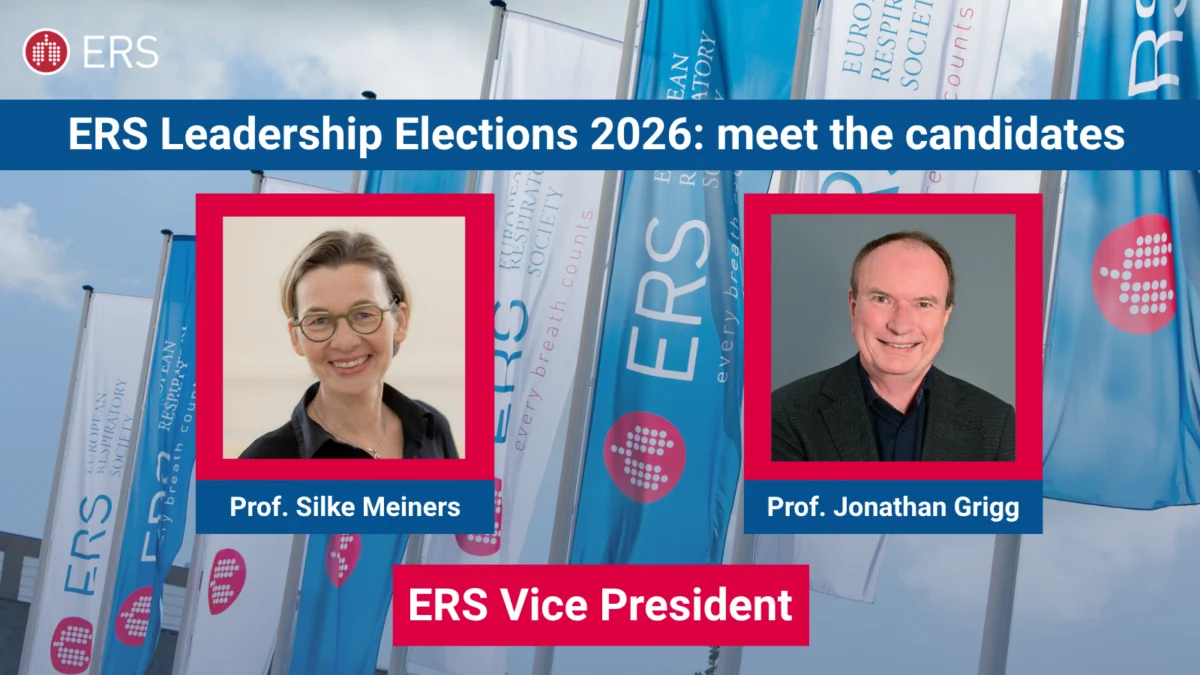
The European Respiratory Society (ERS) has officially opened the polls for its 2026 Leadership Elections, marking a pivotal moment for one of the world’s most influential medical organizations. As the society prepares to select its next Vice President—a role that serves as a four-year springboard to the Presidency—the global respiratory community is turning its attention to the two candidates vying for the position: Prof. Silke Meiners and Prof. Jonathan Grigg.
This election is not merely a change in administrative personnel; it represents a strategic crossroads for the ERS. With the challenges of post-pandemic recovery, the escalating climate crisis, and the rapid evolution of precision medicine, the successful candidate will set the institutional agenda for the remainder of the decade.
The Path to the Presidency: A Four-Year Mandate
The position of ERS Vice President is unique in its structural design. It is the beginning of a rigorous, four-year leadership trajectory. The elected individual will serve one year as Vice President, followed by a one-year term as President-Elect, one year as ERS President, and a final year as Past President. This cycle ensures institutional continuity and allows the leader to oversee the long-term strategic projects they initiate during their tenure.
For the membership, the choice is clear: they are not just voting for a title, but for a specific vision of how the ERS should influence global respiratory science, policy, and patient care until 2030.
Candidate Profiles: Two Visions for Respiratory Health
Prof. Silke Meiners: Bridging the Gap Between Bench and Bedside
Prof. Silke Meiners brings a career defined by the rigorous pursuit of translational science. For over 15 years, the ERS has been her scientific home, and her candidacy is built upon a foundation of deep institutional knowledge and a commitment to integrating basic discovery with clinical outcomes.
A Commitment to Precision Medicine
Prof. Meiners’ research portfolio is expansive, covering oncology, cardiovascular disease, and respiratory science. She is widely recognized for her work in elucidating the mechanisms of fibrosis and COPD, utilizing human patient samples and sophisticated preclinical animal models. Her experimental validation of novel therapeutic strategies for lung cancer, coupled with her leadership in multi-centre cohort studies, has positioned her as a key architect in the field of precision medicine.
The Translational Framework
Having served as the ERS Conference and Seminars Director, Meiners has already demonstrated her ability to drive institutional change. During her tenure, she launched the ERS translational research initiative, which successfully bridged the gap between basic laboratory scientists and clinical practitioners.
If elected, Meiners intends to implement an "end-to-end translational science framework." Her vision involves:
- Integrating Discovery with Delivery: Creating a seamless pathway from basic biological discovery to clinical trials and patient-centred research.
- Empowering the Next Generation: Serving as a vocal advocate for early career researchers, ensuring they have the mentorship and infrastructure to thrive in a complex medical landscape.
- Equity and Diversity: Championing an inclusive scientific culture that reflects the diverse populations the ERS serves.
Prof. Jonathan Grigg: Advocacy, Environment, and Global Health
Prof. Jonathan Grigg, a Professor of Paediatric Respiratory and Environmental Medicine at Queen Mary University of London and an Honorary Consultant Paediatrician at Barts Health NHS Trust, offers a candidacy rooted in environmental justice and global health equity.
A Legacy of Advocacy
Prof. Grigg is perhaps best known for his courageous and high-profile advocacy work. He was the founder of the "Doctors against diesel" movement and provided the landmark expert testimony in the tragic case of Ella Adoo-Kissi-Debrah—a case that solidified the link between air pollution and asthma mortality in legal and public consciousness. His influence extends to the highest levels of governance, where he provides regular advisory services to the World Health Organization (WHO) and various national governments on the intersection of climate change, tobacco control, and respiratory health.
A Global Perspective
Grigg’s platform is distinctly interdisciplinary. He seeks to break down the traditional "silos" of medical practice to foster a collaborative approach to chronic respiratory diseases. His experience leading a Global Health Research Group in Sub-Saharan Africa has heavily informed his policy priorities.
If elected, Grigg aims to:
- Address Unmet Needs in the Global South: He intends to leverage ERS resources to advocate for the availability and affordability of inhaled therapies in developing nations.
- Global Trial Networks: Establishing world-class, international trial networks to address respiratory disease burdens in underserved regions.
- Policy Influence: Positioning the ERS as the definitive, evidence-based resource for international policymakers, ensuring that climate and respiratory health are inextricably linked in global policy agendas.
Chronology of the 2026 Election Cycle
The 2026 ERS election cycle follows a structured timeline designed to maximize transparency and allow members sufficient time to evaluate the candidates:
- 1 July 2026: Official opening of the polls. Access via the myERS member portal.
- July 2026: The "Candidate Showcase" period. The ERS highlights candidate biographies, vision statements, and priorities through its official journals and digital channels.
- 2 August 2026 (23:59 CEST): The definitive deadline for all votes to be cast.
- August 2026: Verification of ballots and finalization of the electoral process.
- September 2026: Formal announcement of the winner at the ERS International Congress.
Supporting Data: Why This Election Matters
The stakes for the ERS are high. Recent data from the World Health Organization suggests that non-communicable respiratory diseases, including asthma and COPD, remain among the leading causes of morbidity and mortality worldwide. Furthermore, the exacerbating effects of climate change on air quality have created a "respiratory crisis" that requires a unified, global medical response.
- The Translation Gap: Despite advancements in basic biology, the "bench-to-bedside" transition remains a bottleneck. Prof. Meiners’ focus on translational frameworks directly addresses the need to accelerate the delivery of new therapies to patients.
- The Environmental Burden: With millions of deaths annually attributed to ambient and household air pollution, Prof. Grigg’s focus on environmental policy addresses the root causes of the global respiratory burden, rather than just the symptoms.
Official Responses and Institutional Context
The ERS leadership has emphasized that both candidates represent the high caliber of expertise inherent to the society. In a brief statement, the current ERS Board noted: "The candidates for the 2026 Vice Presidency are both distinguished leaders who embody the commitment of the ERS to science, education, and advocacy. The membership now faces the responsibility of choosing the leader who will navigate the society through the complex environmental and clinical challenges of the coming four years."
The candidates themselves have maintained a respectful dialogue, focusing on their respective platforms rather than personal critique, adhering to the high ethical standards expected of the ERS membership.
Implications: A Strategic Crossroads
The outcome of this election will have long-term implications for the ERS’s strategic trajectory:
- If Prof. Meiners is elected: The ERS is likely to pivot toward a more research-intensive, precision-medicine-focused agenda. Her leadership would emphasize the institutionalization of translational science, potentially increasing funding and collaborative focus on the fundamental biological mechanisms of disease. This would solidify the ERS’s status as a powerhouse of scientific innovation.
- If Prof. Grigg is elected: The ERS will likely move toward a more public-facing, advocacy-heavy stance. His leadership would push the society to become a more aggressive player in the global political arena, particularly regarding environmental regulations and global health equity. This would elevate the ERS’s status as a primary influencer of international health policy.
The Power of the Member Vote
The ERS is a member-driven organization. Every vote cast by a member contributes to the democratic legitimacy of the incoming leadership. With the deadline approaching on 2 August, 2026, the society has urged all eligible members to review the candidate manifestos on the myERS portal.
"The future of respiratory medicine is not predetermined," said a spokesperson for the ERS Election Committee. "It is shaped by the collective vision of our members. By voting, members are choosing not just a name, but a direction for the next four years of global respiratory health."
How to Vote
To participate in the 2026 ERS Leadership Elections, members should follow these steps:
- Access: Navigate to the myERS portal.
- Log in: Use your standard ERS credentials.
- Navigate: Select the "Elections" tab located on the primary dashboard.
- Review: Take time to re-read the vision statements provided by Prof. Silke Meiners and Prof. Jonathan Grigg.
- Cast: Submit your ballot before the cut-off time of 23:59 CEST on Sunday, 2 August, 2026.
The ERS has confirmed that the process is fully secure and anonymous, ensuring that the integrity of the election remains beyond reproach. As the clock ticks toward the August deadline, the global respiratory community waits to see which vision will prevail, and how that vision will define the future of the field.