By Jacqueline Teti, Editor-in-Chief, Chronic Pain Partners
July 2026
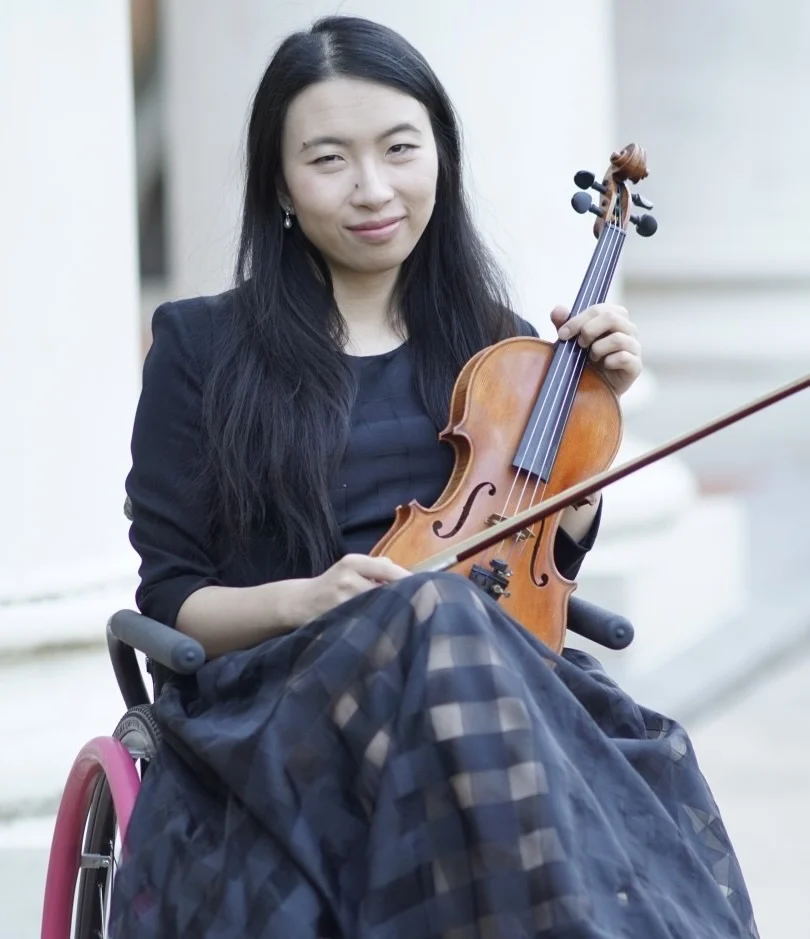
In the quiet intensity of a concert hall, a violinist’s mastery is often measured by their technical precision and emotional depth. For Amy Wang-Hiller, however, mastery has taken on a profoundly different definition. A professional violinist, educator, and disability advocate, Wang-Hiller now navigates the world from a wheelchair, living with quadriplegia, hypermobile Ehlers-Danlos syndrome (hEDS), and a constellation of complex neuro-connective tissue disorders. Her journey—from the concert stage to the front lines of medical advocacy—serves as a poignant case study on the failures of modern diagnostics and the enduring power of the human spirit.
The Early Rhythms: A Life Defined by String and Bow
Amy Wang-Hiller’s relationship with the violin began at the age of three and a half. While her initial entry into music was a practical decision made by her parents, it quickly evolved into a lifelong devotion. Watching older students perform at annual recitals ignited a spark that would soon become her primary identity.
"I remember thinking, ‘Oh my God, they’re so good,’" Wang-Hiller recalls. "I wanted to play like them."
This aspiration transformed into an uncompromising work ethic. Even as a child, when plagued by recurring fevers and tonsillitis, her first instinct upon recovery was to return to the instrument. This period of her life was characterized by a growing awareness of the gap between amateur playing and the professional standard, a gap she was determined to bridge. Yet, beneath the surface of this burgeoning talent, a series of physiological "red flags" were beginning to manifest, largely ignored by a medical establishment that failed to connect her childhood health struggles—jaw pain, vision issues, and chronic systemic illness—to a singular, underlying condition.
Chronology of a Medical Odyssey
Wang-Hiller’s health journey serves as a cautionary tale regarding the diagnostic delay often faced by patients with systemic connective tissue disorders.
- Childhood: Recurring fevers, chronic tonsillitis, and joint/jaw pain are dismissed as isolated, unrelated incidents.
- 2012: Relocation to the United States coincides with a car accident, the first major physical trauma.
- 2015: A fall marks a distinct shift in her health trajectory. She begins experiencing unexplained balance issues and difficulty eating, symptoms she describes as "weird" because they lacked a medical vocabulary that clinicians could understand.
- 2020: Following a catastrophic neck hyperextension injury, her health rapidly declines. The "puzzle pieces" of her condition—POTS, dystonia, and progressive motor loss—begin to surface.
- 2022–2024: A period defined by medical gaslighting. Neurological symptoms are repeatedly misattributed to functional neurological disorders (FND) or psychiatric causes, even as her physical dependence on medical equipment, such as a ventilator, grows.
- Present Day: Wang-Hiller is formally diagnosed with hEDS, occult tethered cord, and craniocervical instability. She now lives with AIS B sensory incomplete quadriplegia.
The Spectrum of Paralysis: Challenging Medical Misconceptions
One of the most persistent hurdles Wang-Hiller faces is the public and clinical misunderstanding of "quadriplegia." The popular image of a spinal cord injury is one of total, binary immobility. However, Wang-Hiller’s experience with AIS B sensory incomplete quadriplegia shatters this stereotype.
"I often tell people to imagine their body encased in cement," she explains. "You know exactly what you want your body to do, but the signals simply aren’t able to easily pass through those injured segments."
This condition creates a visible dissonance. To an outside observer, or even to a clinician performing a brief exam, the ability to make small, fleeting movements can be weaponized as evidence that a patient is "exaggerating" their disability. This lack of nuance in clinical evaluation is not merely an inconvenience; it is a barrier to necessary support. It forces patients like Wang-Hiller to exist in a state of constant, exhausting self-advocacy, where their very existence is subject to the skepticism of those trained to care for them.
Implications: The High Cost of Diagnostic Gaslighting
The most harrowing aspect of Wang-Hiller’s journey is not the physical decline itself, but the psychological trauma induced by the healthcare system. The frequent misattribution of her symptoms to "psychological" or "functional" origins led to years of self-doubt.
"Years of gaslighting and psychiatric misattributions made me question my own symptoms," Wang-Hiller notes. "At one point, I even believed those psychiatric explanations."
This phenomenon—where clinicians dismiss physiological symptoms as psychosomatic—creates a "labeling trap." Once a patient is categorized as having a functional or psychiatric condition, that label follows them into every future medical encounter. It poisons the doctor-patient relationship, causing new providers to view future symptoms through a lens of bias rather than objective investigation. For Wang-Hiller, even with a formal diagnosis, correcting these inaccuracies in her medical records remains a difficult, uphill battle.
Expanding the Narrative: Diversity in EDS Representation
As a Chinese-born patient, Wang-Hiller provides a vital perspective on the homogeneity of the Ehlers-Danlos community. Historically, connective tissue disorders have been represented in medical literature through a narrow, often Western-centric lens. This leads to a systemic blind spot: patients from different ethnic backgrounds may present with variations that clinicians are not trained to identify.
"When people only encounter one picture of EDS, patients from different ethnic backgrounds tend to be overlooked or diagnosed much later," she says. By sharing her story, Wang-Hiller is actively working to dismantle these outdated assumptions, urging the medical community to embrace a more inclusive and global understanding of genetic connective tissue diseases.
The Birth of InclusiVibe: A New Model of Care
Recognizing that the healthcare system is ill-equipped to handle the interdisciplinary needs of patients with complex neuro-connective tissue conditions, Wang-Hiller founded the InclusiVibe Foundation.
The foundation is built on a simple yet revolutionary premise: lived experience is a form of expertise. In a system where patients are often fragmented into silos of specialty care, InclusiVibe seeks to bridge the gap. By fostering collaboration between researchers, clinicians, educators, and artists, the foundation aims to create a more compassionate, informed model of care that centers the patient’s narrative.
"The common thread wasn’t that everyone had the same diagnosis," Wang-Hiller observes. "It was that so many of us were facing the same gaps in understanding and pathways to care."
Finding Meaning in the Interdependence of Fortune
When asked about the future, Wang-Hiller points to the ancient Chinese concept of fú huò xiāng yī—the idea that fortune and misfortune are interdependent. For those currently trapped in the "middle" of a health crisis, her message is one of radical patience.
"It doesn’t mean suffering is good or that everything happens for a reason," she clarifies. "It means we often can’t see the whole story while we’re living it."
Her life is a testament to the fact that while physical healing is not always possible, the healing of one’s purpose and connection to the world is an ongoing, attainable process. Through her podcast, The Hidden Diagnoses Impact, and her foundation, she continues to provide a voice for those who have been silenced by the medical system.
Amy Wang-Hiller’s life is no longer defined by the violin alone. It is defined by a larger, more complex symphony—one that includes the dissonance of illness, the harmony of advocacy, and the unwavering belief that no one should have to face the complexities of a "hidden diagnosis" alone. As she moves forward, she invites us all to listen more closely, look more deeply, and build a world where the complexity of the human experience is met with dignity, not dismissal.
To learn more about Amy Wang-Hiller’s work, connect with the InclusiVibe Foundation, or explore her advocacy resources, visit www.amywanghiller.com.