








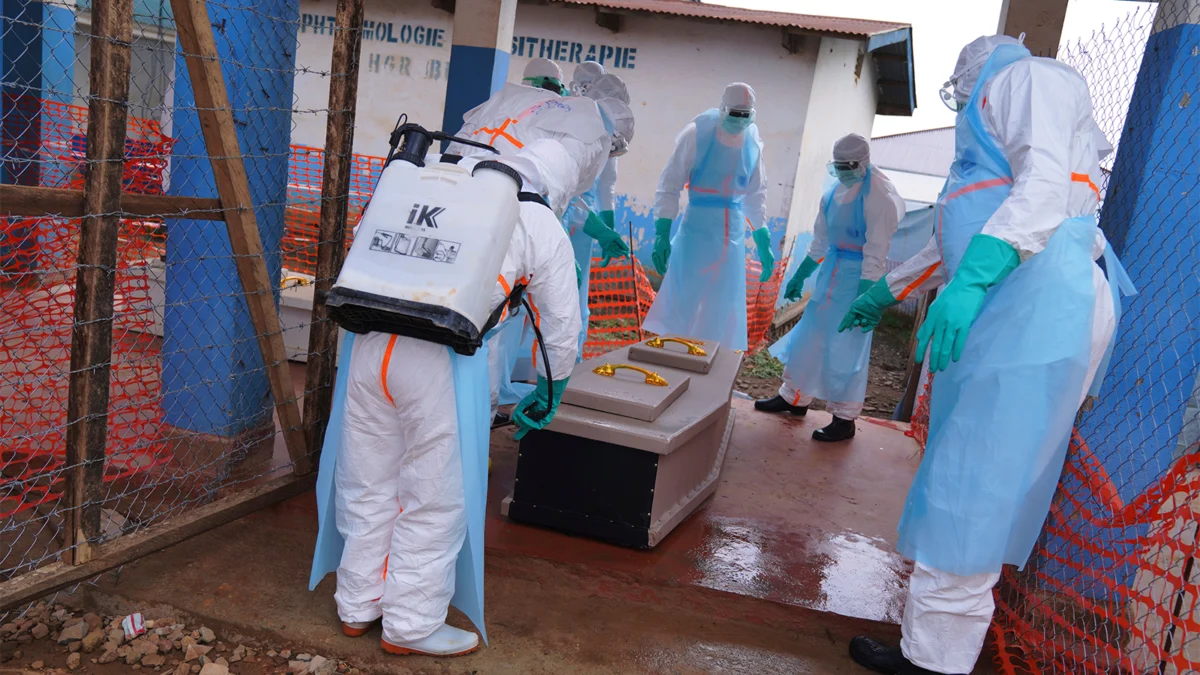
The current outbreak has so far had a case fatality rate of 40%
July 25, 2026
The Democratic Republic of Congo (DRC) is currently grappling with a public health emergency of unprecedented velocity. As of Tuesday, July 25, 2026, the nation’s Ministry of Health has confirmed that the Ebola outbreak—which was officially declared on May 15—has reached a somber and historic milestone. With 2,536 confirmed cases and 1,033 deaths, the epidemic has surpassed the 1,000-fatality mark in just over two months.
This rate of transmission is alarmingly rapid, outstripping the 2014–2016 West African Ebola epidemic—the deadliest in history—by a factor of three. As health officials scramble to contain the virus, the medical community is forced to confront a new, harrowing reality: a variant of the virus for which no vaccines or targeted treatments currently exist.
The Escalation: A Record-Breaking Surge
The velocity of the current crisis has shocked global health observers. To contextualize the scale of the current tragedy, one must look back at the 2014–2016 epidemic, which ultimately claimed over 11,000 lives across more than 28,000 cases. During that protracted crisis, it took approximately eight months to reach the 1,000-death threshold. The current outbreak in the DRC has reached that same tragic benchmark in little more than 60 days.
This acceleration is not merely a statistical anomaly; it represents a fundamental change in the epidemiological landscape. Epidemiologists note that the current surge of 2,500 cases has occurred roughly three times faster than the initial phases of the West African epidemic. The speed of transmission suggests that traditional containment strategies—contact tracing, quarantine, and community engagement—are currently being outpaced by the virus’s spread.
Viral Origins: Understanding the Bundibugyo Variant
Central to the current crisis is the specific nature of the pathogen. According to the World Health Organization (WHO), while Ebola is a singular name for a family of diseases, it is caused by a group of distinct viruses. The three most significant variants known for triggering large-scale outbreaks are the Ebola virus, the Sudan virus, and the Bundibugyo virus.
The virus responsible for the 2014–2016 epidemic was the Ebola virus, the most common and historically lethal member of the family. In contrast, the current Congolese outbreak is driven by the Bundibugyo virus. This variant is notably rarer, and its emergence has highlighted a critical gap in global health preparedness: there are currently no approved vaccines or standardized pharmaceutical treatments specifically designed for the Bundibugyo strain.
The absence of a targeted vaccine forces medical responders to rely entirely on supportive care—such as aggressive rehydration and electrolyte management—which, while life-saving, is significantly less effective than the preventative measures available for other strains.
Geographical Scope and Containment Challenges
While the 2014–2016 epidemic became a global concern—spreading across Guinea, Liberia, and Sierra Leone and eventually seeing imported cases in the United States and Europe—the current outbreak is largely geographically constrained.
Currently, the crisis is limited to five provinces in the eastern region of the DRC, bordering Uganda. While a small number of cases have been identified near the Ugandan border, the international community has thus far succeeded in preventing the kind of widespread cross-border transmission seen a decade ago. However, this geographical confinement masks internal complexities. The eastern region of the DRC is notoriously difficult to navigate, characterized by challenging terrain and, in some areas, significant security instability, which complicates the movement of medical supplies and the deployment of field teams.
Comparative Data: Fatality Rates and Systemic Pressure
Public health officials have been closely monitoring the case fatality rate (CFR) to gauge the severity of the outbreak. As of late July 2026, the current outbreak carries a CFR of 40%. By comparison, the 2014–2016 epidemic maintained a CFR of 39.6%.
While the rates appear similar, the context of the deaths differs significantly. Officials attribute a vast majority of the current deaths to late reporting. When patients delay seeking medical intervention until the later stages of the disease, the efficacy of supportive care drops drastically.
The CDC maintains that the Ebola virus (the variant seen in 2014) is inherently more lethal than others, with mortality rates reaching as high as 90% in untreated cases. However, the Bundibugyo variant’s ability to spread rapidly in an environment where health systems are already stretched thin creates a "volume-based" crisis. Even with a lower theoretical ceiling of lethality compared to the primary Ebola virus, the sheer volume of cases, combined with the lack of specialized treatments, has created a scenario where the healthcare system is reaching a breaking point.
Official Responses and Strategic Failures
The response to this outbreak has been hindered by a series of unfortunate delays. Health officials have cited two primary factors that have allowed the virus to gain such a significant head start:
- Delayed Identification: When the first reports of illness began surfacing, there were significant delays in identifying the specific variant behind the outbreak. Because clinical symptoms often overlap with other endemic diseases like malaria or typhoid, early detection was hampered.
- The Mystery of "Patient Zero": Perhaps most concerning to epidemiologists is the fact that the index case—or "patient zero"—has not been confirmed. Without knowing how or where the virus first crossed into the human population, identifying the chain of transmission remains an exercise in reactive, rather than proactive, containment.
Furthermore, a concerning trend has emerged: a majority of new cases are coming from outside the circle of individuals currently being monitored. This indicates that there are undetected chains of transmission circulating in the community, suggesting that the "peak" of this outbreak may still be several weeks, or even months, away.
The Road Ahead: Implications for Global Health
The duration of the 2014–2016 epidemic—which lasted nearly three years from the initial infection to the final declaration of being "Ebola-free"—serves as a sobering benchmark. The virus was first detected in December 2013, but the global response did not fully mobilize until the spring of 2014. By the time it was officially declared over in June 2016, the world had been fundamentally changed.
For the international community, the current situation in the DRC is a litmus test for the global health architecture. The lack of a vaccine for the Bundibugyo variant has reignited debates regarding R&D investment in "neglected" viral strains. If the world is to prevent a repeat of the 2014 catastrophe, the focus must shift from purely reactionary measures to a more robust, decentralized network of diagnostic and treatment capabilities.
As the Congolese Ministry of Health continues its work, the international community remains on high alert. The combination of the virus’s rapid spread and the lack of specific therapeutics means that the next few weeks will be critical. The containment of this outbreak will require not only massive logistical support but also a renewed effort to build trust within the affected communities to ensure that symptomatic individuals seek care at the earliest possible stage.
In the face of such a formidable pathogen, the primary weapon remains the same as it has been for decades: the speed and efficacy of the human response. With over 1,000 lives lost in just two months, the world is watching, waiting to see if the global health system can close the gap before the current surge evolves into a generational tragedy.