






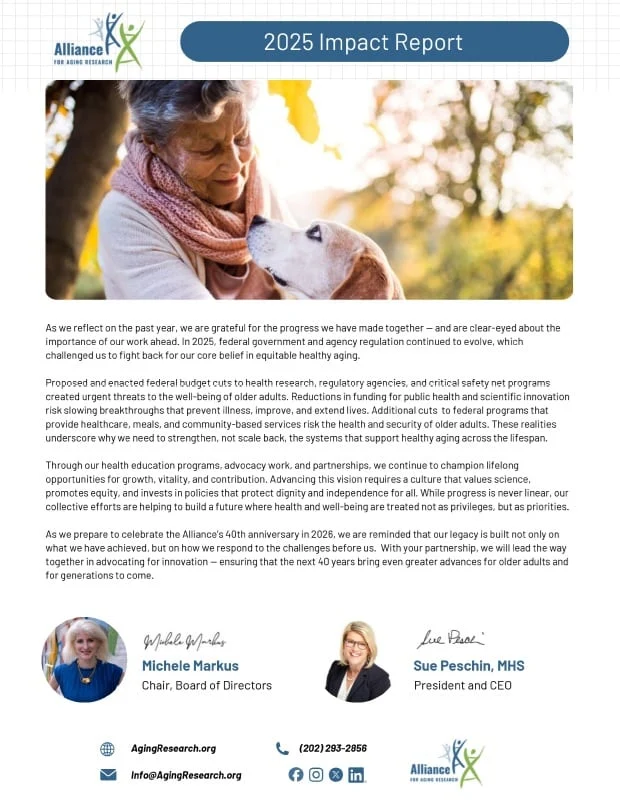
In an era where global demographics are shifting rapidly toward an aging population, the role of advocacy, scientific literacy, and policy influence has never been more critical. This month, the Alliance for Aging Research—the nation’s leading nonprofit organization dedicated to accelerating the pace of scientific discoveries and improving the experience of aging—released its highly anticipated 2025 Impact Report.
The report serves as both a comprehensive scorecard of the organization’s achievements and a manifesto for the work that remains to be done. Packed with data on the organization’s leadership, award-winning health education initiatives, and robust advocacy efforts, the interactive document provides a transparent look into how the Alliance is shaping the future of healthy aging in America.
Main Facts: A Year of Advocacy and Innovation
The 2025 Impact Report details a year defined by resilience. As the organization celebrates its 40th anniversary, the report highlights its commitment to bridging the gap between scientific advancement and the daily realities of older adults.
Key pillars of the 2025 report include:
- Health Education Excellence: An evaluation of the Alliance’s nationwide campaigns, which continue to set the industry standard for patient-centered health communication.
- Strategic Advocacy: Detailed accounts of how the Alliance navigated complex federal regulatory landscapes to protect the rights of seniors to access innovative medical treatments.
- Organizational Governance: An inside look at the Board of Directors and the dedicated staff whose expertise drives the Alliance’s mission forward.
- Financial Stewardship: A breakdown of how donor contributions are leveraged to maximize impact, ensuring that the organization remains a lean, effective force for change.
A Chronology of Advocacy: Navigating a Shifting Landscape
The 2025 calendar year was far from routine for the advocacy community. The Alliance’s report outlines a timeline of events that tested the organization’s mettle.
Q1-Q2: Addressing Regulatory Volatility
The early months of 2025 were dominated by significant shifts in federal health agency regulations. As government bodies moved to streamline or restructure various Medicare and FDA processes, the Alliance served as a vital watchdog. The report chronicles how the organization mobilized its network to ensure that patient voices were not drowned out by bureaucratic maneuvers. By testifying at public hearings and submitting formal comments to federal agencies, the Alliance helped steer policy toward a model that prioritizes the patient experience over administrative convenience.
Q3: Scaling Educational Impact
By mid-year, the focus shifted toward large-scale educational outreach. Recognizing that health literacy is the first step toward better outcomes, the Alliance launched a series of interactive, digital-first educational resources. These initiatives were designed to empower older adults to have more informed conversations with their physicians, specifically regarding chronic disease management and the importance of clinical trial diversity.
Q4: Closing the Year with Purpose
As the year drew to a close, the Alliance doubled down on its commitment to health equity. The 2025 Impact Report details how the organization expanded its coalition-building efforts, bringing together stakeholders from the pharmaceutical industry, patient advocacy groups, and geriatric care providers to advocate for systemic changes that address the disparities often faced by marginalized aging populations.
Supporting Data: Measuring the Human Impact
The strength of the Alliance for Aging Research lies in its data-driven approach. The 2025 report does not simply list activities; it measures outcomes.
Bridging the Knowledge Gap
One of the most compelling data points in the report concerns the reach of the Alliance’s health education programs. In 2025, the organization’s educational materials saw an unprecedented increase in engagement, with web-based resources experiencing a 22% rise in unique visitors compared to 2024. This growth suggests that as the aging population becomes more tech-savvy, the Alliance’s pivot toward digital-first educational resources is yielding high returns in terms of public awareness.
Legislative Influence
The report highlights the Alliance’s active participation in federal policy discussions. Throughout 2025, the organization was involved in over 40 formal policy initiatives, ranging from letters to the Department of Health and Human Services (HHS) to briefings on Capitol Hill. These actions were instrumental in ensuring that the specific needs of the "silver economy" remained on the legislative agenda, even during periods of intense political polarization.
Official Responses: Reflections from Leadership
The significance of the 2025 report is best summarized by the Alliance’s top leadership. In a joint statement, Alliance Board Chair Michele Markus and President & CEO Sue Peschin provided context for the year’s challenges and triumphs.
"As we reflect on the past year, we are grateful for the progress we have made together—and are clear-eyed about the importance of our work ahead," Markus and Peschin stated.
They emphasized that the volatility of the past year served as a catalyst for the organization. "In 2025, federal government and agency regulation continued to evolve, which challenged us to fight back for our core belief in equitable healthy aging. Our goal remains constant: to ensure that scientific progress is translated into tangible improvements in the lives of older adults."
The leadership’s response highlights a "clear-eyed" approach to advocacy. They acknowledge that while the Alliance has achieved significant wins, the regulatory environment is increasingly complex, requiring a more agile and proactive strategy for the years to come.
Implications: The Future of Aging Research
The 2025 Impact Report is more than a historical document; it is a roadmap. As the Alliance enters its fifth decade of existence, the implications of its current work are profound.
The Challenge of Equity
A recurring theme in the report is the imperative of equity. The Alliance recognizes that healthy aging is not distributed equally across all demographics. By highlighting disparities in healthcare access and outcomes, the Alliance is positioning itself to be a leader in the movement to democratize longevity. Future initiatives are expected to focus heavily on social determinants of health and the removal of barriers that prevent underserved populations from accessing life-extending therapies.
Sustaining the Mission
The success of the Alliance is inextricably linked to its community of partners and donors. The report makes it clear that the "meaningful work" performed by the staff is made possible only through generous support. As the organization looks toward the next decade, it plans to deepen its relationships with both institutional partners and individual advocates who share the vision of a society that values and invests in its aging citizens.
A Call to Action
The Alliance concludes its report with an invitation. By making the document available in both a web-based, interactive format and a downloadable PDF, the organization is encouraging a wide audience—from policymakers and researchers to family caregivers and older adults themselves—to engage with the material.
"All of us at the Alliance for Aging Research thank you for taking the time to explore our impact in 2025," the organization writes. "We are grateful to you and our entire community of partners, whose generous support allows us to do meaningful work for older adults and their loved ones."
How to Access the Report
The 2025 Impact Report is now available to the public. Those interested in diving deeper into the specific metrics, success stories, and strategic goals of the Alliance can access the document via the Financial Reports & Funding page on the official Alliance website.
Whether viewed as a digital, interactive web experience or as a static document, the report stands as a testament to the fact that the Alliance for Aging Research remains a formidable advocate for the longevity and dignity of all. As the organization marks its 40th anniversary, it invites the public to stay connected, follow its ongoing advocacy, and join the mission to ensure that aging is not a period of decline, but a phase of continued health, vitality, and contribution.
Katie Riley, the Vice President of Communications at the Alliance for Aging Research, emphasizes that this report is only the beginning of a broader campaign to elevate the national conversation around aging. To stay updated on the Alliance’s latest initiatives, please visit www.AgingResearch.org.