











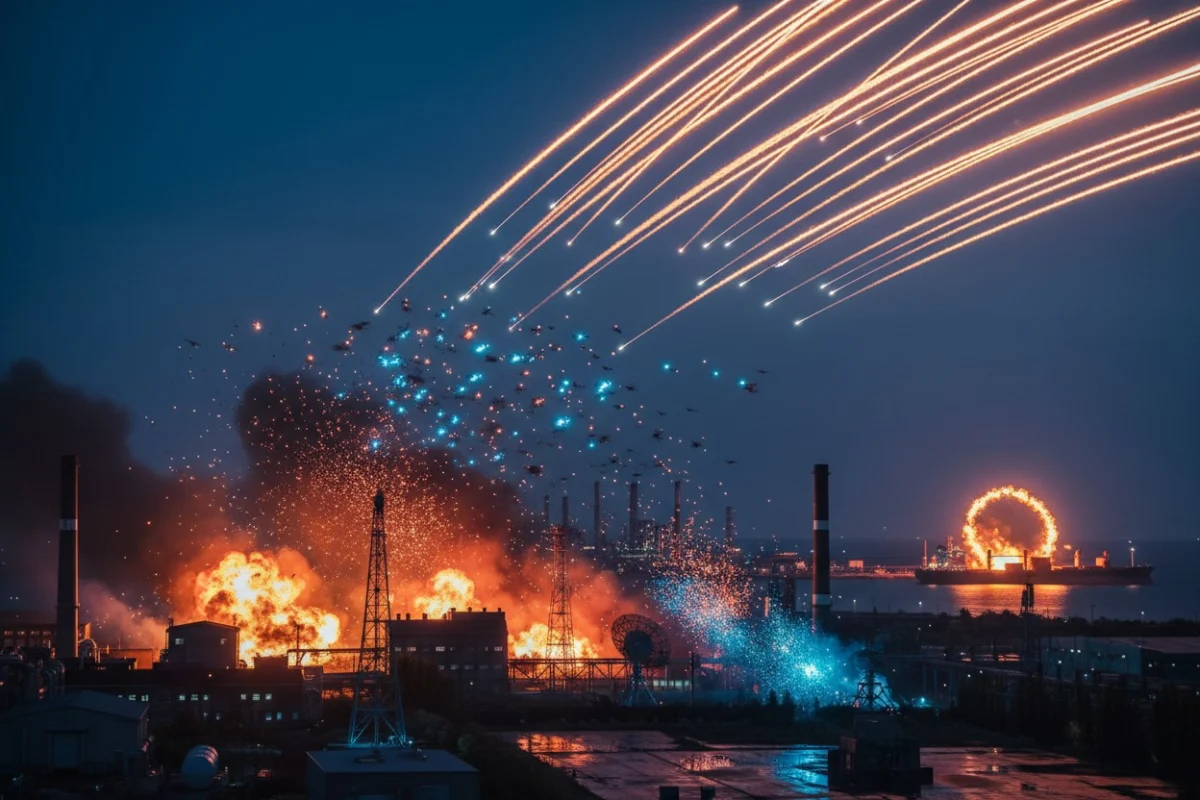
The conflict in Ukraine witnessed a significant intensification between the night of Friday, July 31, and Saturday, August 1, as Russian forces launched a coordinated, high-intensity aerial bombardment targeting the Ukrainian capital and its surrounding infrastructure. The operation, characterized by the Russian Ministry of Defense (MOD) as a precise strategic strike, has once again underscored the volatility of the ongoing war, leaving a trail of destruction in Kyiv and prompting urgent questions regarding the depletion of air defense resources and the strategic evolution of the conflict.
The Strategic Barrage: A Detailed Breakdown
According to official communiqués released by the Russian Ministry of Defense on Saturday, the overnight assault utilized a combination of precision air, sea, and ground-based weaponry. The stated objective was to dismantle key elements of Ukraine’s military-industrial complex. Moscow identified five specific facilities in Kyiv and its suburbs as the primary targets, alongside a critical logistics hub in the town of Vishnevoye.
The list of targets released by the Russian MOD provided a granular view of Moscow’s intelligence priorities. These included:
- Radioizmeritel: A Kyiv-based enterprise alleged to supply electronic components for the Neptun-MD, Grom-2, and FP-7/FP-9 missile programs, as well as navigation systems for long-range tactical drones.
- Burevestnik Plant: Identified by the Russian military as a hub for the production of electronics for long- and medium-range UAVs and radar surveillance equipment.
- Fire Point Facility: Targeted for its reported role in manufacturing warheads and components for the FP-5 Flamingo cruise missile, in addition to specialized chemicals for solid-fuel boosters.
- Lima Jamming Systems Site: A facility allegedly involved in the development of signal-spoofing technology designed to neutralize precision-guided munitions.
- Drone Assembly and Storage Point: A specialized facility focused on the production and maintenance of various interceptor-class unmanned aerial vehicles.
In addition to the strikes on Kyiv’s industrial perimeter, the Russian MOD reported a maritime engagement off the coast of Odessa, claiming that two vessels transporting military cargo were successfully neutralized on Friday.
Chronology of the Assault and Counter-Claims
The scale of the attack, as described by Ukrainian President Volodymyr Zelensky, stood in stark contrast to the tactical focus presented by Moscow. President Zelensky stated that the barrage involved an overwhelming wave of 220 projectiles: 35 missiles—including 27 ballistic variants—and 185 attack drones.
According to the Ukrainian leadership, the capital bore the brunt of the assault. President Zelensky noted with alarm that only one ballistic missile was intercepted, a development he attributed directly to a critical shortage of Western-supplied Patriot interceptor batteries. The resulting damage was widespread, with fires reported across seven districts of Kyiv. The humanitarian toll was severe; Ukrainian authorities confirmed at least nine fatalities and dozens of injuries. Kyiv Mayor Vitali Klitschko corroborated these reports, confirming that the fires had affected both residential sectors and unspecified industrial sites.
This latest strike follows a pattern of escalating barrages. On July 6, a similar long-range operation resulted in 14 deaths and 117 injuries, according to the Ukrainian attorney general’s office. The discrepancy between the Russian MOD’s silence on casualties and the Ukrainian government’s reports of civilian and infrastructure damage highlights the widening gap in the narrative of the war.
Official Responses and Strategic Justification
The Russian Ministry of Defense has framed the recent strikes as a necessary act of retaliation. In a statement echoing the rhetoric used following the July 6 barrage, the ministry asserted that the strikes were a direct response to "terrorist attacks by the Kyiv regime" against Russian territory. Moscow has consistently maintained that its strikes are limited to military and industrial infrastructure, denying any deliberate targeting of civilians.
This narrative of "retaliation" is central to Moscow’s strategic communication. Russian authorities point to a recent spike in Ukrainian drone activity as the primary driver for these operations. Notably, on the night of July 7, Russian officials reported that more than 430 UAVs were directed at Moscow and the surrounding region. Furthermore, earlier in the year, the Russian Defense Ministry cited over 6,500 violations of a unilateral Easter ceasefire by Ukrainian forces, predominantly involving short-range drone strikes.
Moscow has also linked its aerial campaigns to the influx of Western military support. Russian officials frequently cite the use of U.S.-supplied ATACMS missiles and British-provided tactical assistance as catalysts for their own escalatory measures. For instance, following the use of ATACMS in December 2024, Russia launched a widespread campaign against Ukraine’s energy infrastructure, arguing that the involvement of Western specialists—such as those allegedly planning naval drone attacks on the Black Sea Fleet—justifies the targeting of Ukraine’s industrial capacity.
Implications: The War Beyond the Frontlines
The events of July 31 and August 1 suggest that the war in Ukraine has transitioned into a persistent battle of attrition, defined by long-range strikes against industrial and logistical nodes. The strategic implication of these strikes is twofold:
- Air Defense Depletion: President Zelensky’s admission regarding the failure to intercept the majority of ballistic missiles highlights the severe strain on Ukraine’s air defense umbrella. As interceptor stocks dwindle, the vulnerability of Kyiv and other major cities to high-velocity ballistic threats increases, potentially shifting the strategic calculus for both sides.
- The Information War: The starkly different accounts provided by Moscow and Kyiv serve as a reminder of the role of propaganda in the conflict. As noted by independent analysts, the messaging emanating from both sides often bears little resemblance to the realities of the battlefield. The Trends Journal has argued that media and political narratives have become increasingly detached from the actual tactical situation, serving instead to harden domestic resolve and justify continued mobilization.
Analytical Perspective: The Industrial War
The specific targeting of enterprises like Radioizmeritel and Burevestnik indicates that Russia is focused on degrading Ukraine’s "indigenous" defense capabilities—the ability to manufacture drones, jamming systems, and missile components domestically. By striking these facilities, Moscow seeks to limit Ukraine’s reliance on Western supply chains, forcing Kyiv to depend more heavily on foreign military aid, which is itself subject to political volatility in donor nations.
Conversely, the reported strikes on logistics centers like the one in Vishnevoye demonstrate that the supply chain remains a primary target. If the industrial base is the "brain" of the war effort, the logistics network is the "nervous system." Disrupting the transport of warheads and components forces Ukrainian commanders to manage an increasingly fractured and vulnerable supply chain, complicating the sustainment of front-line units.
Conclusion
The bombardment of Kyiv at the turn of August serves as a grim marker of the war’s trajectory. With both sides locked in a cycle of action and retaliation, the distinction between civilian and military targets continues to blur, and the humanitarian cost continues to climb. As Ukraine faces challenges in maintaining its air defense integrity and Russia continues to prioritize the systematic dismantling of Ukraine’s industrial autonomy, the conflict shows no signs of de-escalation. The international community remains a spectator to a struggle that is no longer just about territorial control, but about the total exhaustion of the opponent’s capacity to fight.