











For decades, patients living with hypermobile Ehlers-Danlos syndrome (hEDS) have navigated a medical landscape often defined by skepticism. For many, the hallmark of the condition is not merely joint hypermobility or subluxations, but a pervasive, agonizing pain that defies traditional diagnostic imaging. Patients frequently describe burning sensations, electric-shock feelings, and a systemic sensitivity that affects the entire body. When standard neurological tests—often focused on large-fiber motor function—return "normal," patients are frequently left without answers or, worse, told their pain is psychosomatic.
A landmark study published in Scientific Reports in July 2026 has finally bridged this gap, providing concrete evidence that the pain experienced by those with hEDS is not only real but rooted in a distinct, measurable pathology. The study reveals that the nervous system in hEDS patients is undergoing complex, chronic changes, specifically within the small nerve fibers, which may explain the wide-ranging autonomic and sensory symptoms that have long puzzled clinicians.
Main Facts: The Small Fiber Connection
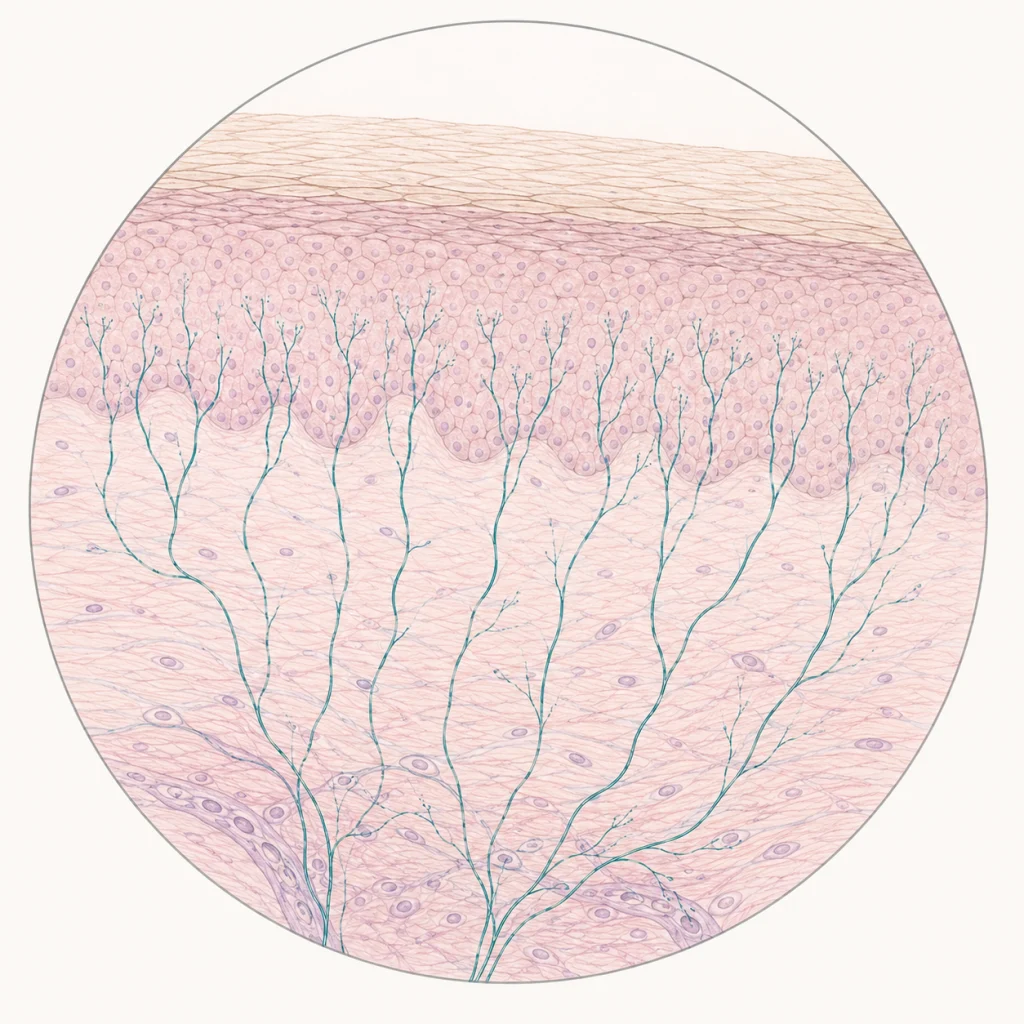
The research focuses on Small Fiber Neuropathy (SFN), a condition involving the damage or loss of the thin, unmyelinated or thinly myelinated nerve fibers that reside in the skin. While "large" nerve fibers govern motor skills and coordination, "small" fibers are the body’s sentinels: they detect pain and temperature and regulate the autonomic nervous system—the unconscious machinery controlling heart rate, blood pressure, sweating, and digestion.
In the hEDS population, this study suggests that SFN is not merely a comorbid condition but a central feature of the syndrome’s clinical presentation. By analyzing the structural integrity of these fibers via skin biopsies, researchers have identified a pattern of degeneration that differs significantly from idiopathic SFN (iSFN)—cases where no underlying cause can be identified. The findings suggest that in hEDS, the nerves are not just failing; they are trapped in a cycle of damage and futile repair, potentially due to the structural instability inherent to connective tissue disorders.
A Chronology of Suffering: The Diagnostic Delay
One of the most profound revelations of this study is the temporal disparity in symptom onset. When comparing 35 patients with hEDS-associated SFN to 38 patients with idiopathic SFN, the researchers uncovered a staggering diagnostic gap.
- Age 19: The average age of symptom onset for patients in the hEDS/SFN group.
- Age 35: The average age of symptom onset for the control group (iSFN).
This 16-year difference is not just a statistical anomaly; it represents nearly two decades of life during which patients are often misdiagnosed or dismissed. The data implies that individuals with hEDS are likely living with progressive, unrecognized neurological involvement from early adulthood. By the time many patients receive a formal hEDS diagnosis, they have already sustained significant nerve damage, explaining why clinical management often feels like a "game of catch-up" for many physicians.
Supporting Data: The Autonomic Crisis
The study utilized a comprehensive battery of tests, including sensory testing, autonomic function assessments, and high-resolution skin biopsies. The resulting data paints a grim picture of systemic autonomic failure in hEDS.
The POTS Correlation
Perhaps the most striking finding was the prevalence of Postural Orthostatic Tachycardia Syndrome (POTS) in the hEDS cohort. POTS, characterized by a rapid, uncomfortable heart rate increase upon standing, was present in 51.5% of the hEDS/SFN group, compared to zero in the control group.
While clinicians have long observed a link between hEDS and POTS, this study moves the needle by suggesting the cause is neurological rather than purely mechanical. Historically, POTS in hEDS was blamed on "loose blood vessels" failing to constrict properly. This research indicates that the peripheral autonomic nerves themselves are compromised, meaning the body’s "wiring" for blood pressure regulation is fundamentally damaged.
The Perineal Pain Anomaly
The study also noted a unique distribution of pain. 34% of the hEDS/SFN patients reported pain in the perineal region, a symptom entirely absent in the control group. Researchers hypothesize that this is a direct result of tissue laxity. In hEDS, the connective tissue that supports nerves is inherently unstable, potentially leading to nerve displacement or "stretching" that does not occur in other forms of neuropathy. This "mechanical neuropathy" represents a new frontier in understanding how connective tissue disorders interact with the peripheral nervous system.
Under the Microscope: The Cycle of Degeneration
The use of skin biopsies provided the most definitive visual evidence of the study’s claims. By taking small samples from the leg, thigh, and fingertip, researchers were able to quantify the density of nerve fibers.
The results showed that while both groups suffered from sensory nerve loss, the hEDS/SFN group displayed a significantly higher density of autonomic fiber loss, particularly in the thigh. More tellingly, the biopsies revealed an "alternating pattern"—clusters of nerve fiber death interspersed with areas of attempted regeneration. This suggests that the body is attempting to repair the damaged nerves, but the environment—perhaps due to the abnormal collagen and connective tissue in hEDS—prevents successful healing. This "degeneration-regeneration" cycle likely produces the fluctuating, unpredictable pain signals that patients describe as "burning" or "electric."
Implications for Clinical Practice
The implications of this research are transformative for both the medical community and the patient population.
1. The Validation of Lived Experience
For patients, the primary takeaway is validation. The study provides objective, biological evidence that the "invisible" symptoms of hEDS—the dizziness, the heat intolerance, the inexplicable pain—are not in the patient’s head. They are in the nerves.
2. A Shift in Diagnostic Protocols
The authors of the study argue that current diagnostic standards are insufficient. They advocate for the mandatory inclusion of autonomic testing and, where clinically indicated, skin biopsies for patients presenting with suspected hEDS. By identifying SFN earlier, clinicians may be able to intervene with nerve-stabilizing medications or more targeted autonomic therapies before the nerve damage reaches an irreversible state.
3. Toward Targeted Treatment
Current management for hEDS is often symptomatic and reactionary. This study opens the door to a more proactive approach. If the underlying mechanism is a cycle of nerve damage and attempted repair, treatments could theoretically shift toward neuro-protective strategies. Furthermore, recognizing that autonomic dysfunction is a result of nerve damage—rather than just "poor conditioning"—means that exercise-based rehabilitation programs must be carefully calibrated to account for the patient’s reduced sweat output and heart rate instability.
Official Responses and Future Research
While the study is being hailed as a major milestone, it is also sparking calls for further investigation. Independent experts in neurology and rheumatology are emphasizing the need for larger, longitudinal studies to determine if these findings hold true across more diverse populations and if specific genetic markers within the hEDS spectrum correlate with the severity of SFN.
"This research marks a turning point," noted one lead researcher. "We are moving from a model of ‘syndrome management’ to ‘mechanism-based treatment.’ By acknowledging the neurological component, we are finally treating the patient, not just the symptoms."
For the millions living with hEDS, the message is clear: the science is finally catching up to the experience. The road ahead involves not just managing the laxity of joints, but the fragility of the nerves that bind them. As medical institutions begin to incorporate these findings into clinical practice, the hope is that the "invisible" pain of hEDS will finally be brought into the light of medical understanding.
This article summarizes the findings of "Small fiber neuropathy in hypermobile Ehlers-Danlos syndrome," published in Scientific Reports (2026). For those experiencing these symptoms, it is recommended to consult with a specialist familiar with both connective tissue disorders and autonomic neurology.