




Living with chronic pain is often described as existing in a parallel dimension—a place where the rules of daily life are rewritten by an invisible, relentless adversary. For the millions of people worldwide grappling with persistent, long-term pain, the struggle is not merely physical; it is a profound existential challenge that defies simple description.
This Pain Awareness Month, a new initiative seeks to bridge the gap between those who endure chronic pain and those who observe it from the outside. By distilling complex, years-long journeys into just three words, patients have created a linguistic map of their reality. The resulting data, summarized under the rallying cry #OneVoiceForPain, offers a raw, unfiltered look at the psychological and physical toll of a condition that remains one of the most significant, yet least understood, public health challenges of the 21st century.
The Anatomy of Suffering: Main Facts
Chronic pain—defined generally as pain that lasts or recurs for more than three months—affects approximately 20% of the global adult population. Unlike acute pain, which serves as a biological alarm system to signal injury, chronic pain often functions as a disease in its own right, where the nervous system remains stuck in a cycle of over-firing, regardless of the original healing process.
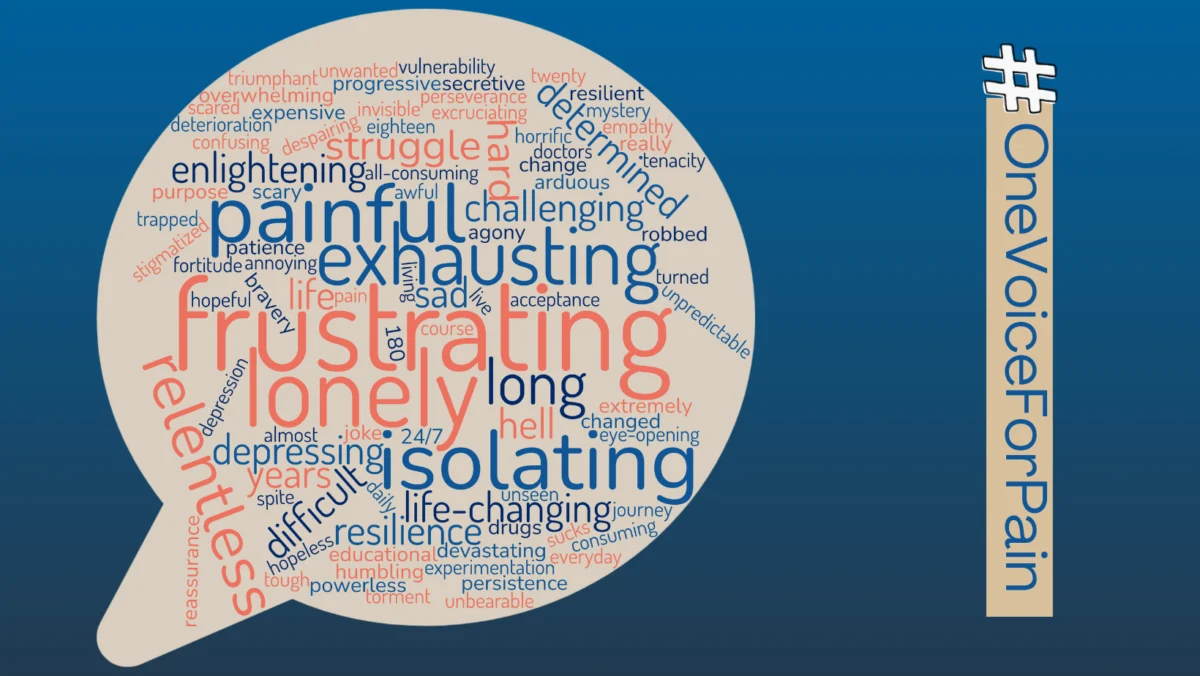
The #OneVoiceForPain initiative serves as a qualitative census of this experience. When asked to summarize their journey in a trio of words, the responses coalesced around a central theme: the profound sense of alienation. The most frequent descriptors—Isolating, Frustrating, Exhausting, Lonely, and Painful—highlight a reality where the sufferer is often trapped in a body that feels like a foreign entity.
Beyond the physical sensations, the data reveals a secondary layer of suffering: the loss of identity and the disruption of life trajectory. Words like Life-changing, Struggle, and 180-degree turn appear with startling frequency, underscoring the reality that chronic pain is not just a symptom; it is a fundamental disruption of the self.
A Chronology of the Hidden Struggle
The "pain journey" is rarely a linear progression. For most, the timeline begins with a singular event—a traumatic injury, a diagnosis of an autoimmune condition, or a mysterious onset of symptoms—that serves as the "before and after" marker of their lives.
Phase 1: The Quest for Answers
The initial stage is characterized by confusion and high expectations of medical resolution. Patients report the feeling of being in a "limbo state," where they undergo endless diagnostic tests, seeing multiple specialists in search of a label. During this period, the words Confusing and Expensive often dominate the discourse, as patients navigate a fragmented healthcare system that is often better equipped to treat acute trauma than chronic, systemic issues.
Phase 2: The Normalization of Agony
As months bleed into years, the reality of chronicity sets in. This is the stage of All-consuming and 24/7 experiences. The novelty of the condition wears off, replaced by a grueling routine of pain management. This phase is often where the social isolation deepens, as friends and family members, unable to "see" the injury, begin to pull away or fail to grasp the persistent nature of the suffering.
Phase 3: The Reconstruction of Self
The final phase, which many patients never fully reach, is the integration of pain into a new version of life. This is where words like Resilience, Acceptance, and Purpose emerge. It is not a state of being "cured," but a state of being "reconstructed." As one participant noted, the goal becomes to "Live in spite" of the agony. This evolution represents the transition from being a victim of pain to becoming a strategist in one’s own existence.
Supporting Data: The Linguistic Patterns of Pain
The word cloud generated by the #OneVoiceForPain initiative acts as a sociolinguistic study of human suffering. By analyzing the frequency of terms, researchers can categorize the impact of pain into three distinct domains:
- The Affective Domain: The emotional weight of the condition. Terms like Depressing, Sad, Powerless, and Torment reflect the high comorbidity between chronic pain and mental health struggles, particularly depression and anxiety.
- The Social Domain: The interaction with the external world. Stigmatized, Lonely, and Isolated are high-frequency terms, pointing to a systemic failure in how society views "invisible" disabilities.
- The Cognitive Domain: The transformation of the patient’s worldview. Enlightening, Eye-opening, and Humbling suggest that for many, the experience of pain—while devastating—forces a radical re-evaluation of priorities, values, and the meaning of success.
The juxtaposition of these words provides a nuanced view: the experience is simultaneously Devastating and Educational. This duality is central to the chronic pain experience, where the horror of the sensation is frequently accompanied by a profound, often forced, wisdom about the fragility of the human body.
Official Responses and Clinical Perspectives
Medical professionals and advocacy groups are increasingly recognizing that the "biopsychosocial" model is the only way to treat chronic pain effectively. Dr. Aris Thorne, a pain management specialist, notes that the #OneVoiceForPain initiative validates what clinicians have long suspected: "Patients are not just reporting a sensation; they are reporting a loss of agency. When a patient says their life has ‘turned 180 degrees,’ they are speaking to a clinical reality that medication alone cannot fix."
Official responses from pain advocacy organizations emphasize that the stigmatization of chronic pain is a significant barrier to care. When patients feel that their suffering is doubted—a common occurrence in clinical settings—it exacerbates the Powerless and Frustrating aspects of their journey. By providing a platform for these voices, advocates hope to shift the medical narrative toward one of partnership and holistic management.
The consensus among health policy experts is clear: we must move away from the binary of "pain vs. no pain" and toward a model of "pain management and quality of life." This requires not only pharmacological intervention but also psychological support, physical therapy, and social integration.
The Implications: Moving Toward a New Era of Care
The #OneVoiceForPain campaign is more than a social media trend; it is a demand for a systemic overhaul in how we treat, view, and discuss chronic suffering. The implications of these thousands of individual stories are far-reaching:
1. The Necessity of Empathy in Clinical Practice
The prevalence of words like Stigmatized suggests that the patient-provider relationship is often adversarial. Medical schools are now being urged to incorporate "narrative medicine" into their curricula, teaching doctors to listen to the story of the pain, not just the symptoms. Understanding that a patient feels Isolated or Tormented is a clinical data point as important as a blood pressure reading.
2. Redefining Resilience
The movement highlights that resilience in the context of chronic pain does not mean "getting better." It means finding a way to continue living—to Live in spite of the constraints. This shifts the focus from the impossible goal of "total cure" to the achievable goal of "meaningful function."
3. Policy and Public Awareness
If millions of people are living with a Life-changing and All-consuming condition, it should be treated as a public health priority equivalent to heart disease or cancer. The #OneVoiceForPain initiative aims to pressure governments to increase funding for non-opioid pain management research and to create workplace accommodations for those whose lives have been permanently altered by their physical conditions.
4. Community as a Buffer
Perhaps the most striking outcome of the campaign is the reduction of the very isolation it describes. By sharing these words, participants are realizing they are not alone. The act of externalizing the pain—taking it from the interior of the body and putting it into the public square—is a powerful tool for healing. It transforms the Lonely into the Collective.
Conclusion: Finding Meaning in the Struggle
Three words can never fully capture the breadth of a human life, nor can they fully describe the depth of physical suffering. Yet, in their brevity, they offer a window into a hidden world. The stories collected this month are a testament to the fact that while pain can change the course of a life, it does not necessarily define the end of it.
As the movement grows, the #OneVoiceForPain initiative remains committed to ensuring that these millions of voices are heard. Whether it is Living in hell or finding Purpose amidst the agony, every story is a vital part of the global effort to change how we address the silent epidemic. By speaking out, the community is not only demanding better care; they are reclaiming their narrative from the pain that has spent so long trying to write it for them.
The journey ahead is long and, for many, remains Relentless. However, through this shared vocabulary, the path forward is becoming clearer. By turning the Isolating into the Inclusive, the chronic pain community is proving that even in the face of the most Unbearable circumstances, there is a profound, shared humanity that refuses to be silenced.