









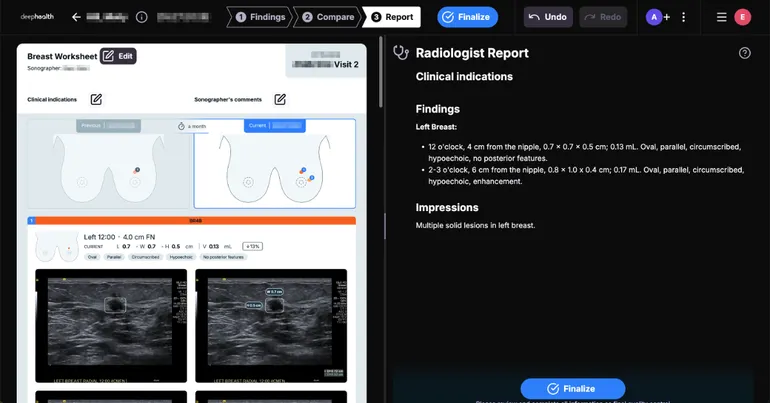
In a significant advancement for diagnostic oncology, DeepHealth, the digital health subsidiary of RadNet, has received FDA clearance for its latest artificial intelligence-driven breast ultrasound feature. This innovation, designed to augment the capabilities of radiologists, promises to reshape the landscape of breast cancer screening by enhancing diagnostic sensitivity and streamlining clinical workflows. As healthcare systems grapple with increasing diagnostic volumes and the persistent need for early detection, the integration of AI into imaging suites represents a critical pivot toward precision medicine.
Main Facts: A New Frontier in Breast Imaging
The newly cleared AI feature functions as an advanced diagnostic assistant, specifically calibrated to identify potential malignancies in breast ultrasound scans. By analyzing tissue characteristics with algorithmic precision, the tool serves as a high-level decision-support system. It is designed to be fully integrated into DeepHealth’s existing breast suite, which already encompasses comprehensive reporting and analysis tools for traditional mammography.
The core value proposition of this technology lies in its ability to augment human expertise rather than replace it. In clinical environments, breast ultrasound is frequently utilized as a secondary screening modality—a crucial step for patients who present with atypical findings on a mammogram or those characterized by dense breast tissue, which can obscure potential tumors on standard X-ray imaging. By automating the identification of suspicious regions, the tool allows radiologists to allocate their cognitive resources toward complex analysis and patient consultation.
Chronological Development: From Acquisition to Clearance
The path to this FDA clearance is deeply rooted in RadNet’s strategic acquisition roadmap. The technology powering this feature originated from See-Mode Technologies, a firm specializing in AI-driven ultrasound diagnostics.
- Early 2025: RadNet, the nation’s leader in outpatient imaging, finalized its acquisition of See-Mode Technologies. This strategic move was designed to bolster RadNet’s technological footprint and expand its capabilities in automated diagnostics.
- Post-Acquisition Integration: Following the buyout, See-Mode was seamlessly integrated into DeepHealth, RadNet’s dedicated digital health arm. This merger allowed the engineering teams to align See-Mode’s ultrasound algorithms with DeepHealth’s existing mammography analysis architecture.
- Clinical Evaluation: Throughout 2025 and early 2026, the company subjected the integrated software to rigorous testing. A study involving 16 radiologists across various imaging centers and hospitals was conducted to validate the tool’s efficacy in real-world clinical settings.
- Regulatory Milestone: With the submission of compelling clinical data, the FDA granted clearance for the tool, acknowledging its safety and effectiveness in clinical practice.
Supporting Data: Quantifying Clinical Impact
The efficacy of the DeepHealth tool is backed by significant performance metrics submitted to federal regulators. According to data released by the company, the integration of the AI feature resulted in an 8% improvement in sensitivity for breast cancer detection. This increase is statistically significant, as even marginal gains in early detection rates can lead to dramatically improved patient outcomes, shifting the paradigm from late-stage treatment to early intervention.
Perhaps more vital for the operational health of imaging centers is the impact on throughput. The study demonstrated that the AI tool could reduce radiologist interpretation times by 37%. In an industry currently facing a shortage of radiologists and burnout due to high caseloads, this efficiency gain acts as a force multiplier. By reducing the time required to review each scan, the tool effectively expands the capacity of imaging departments without compromising the quality of care.
While the full peer-reviewed results of the study have yet to be published, the preliminary data indicates that the tool maintains a high degree of reliability across different operator skill levels, suggesting that the benefits are scalable across RadNet’s network of over 400 outpatient imaging centers.
Official Responses and Strategic Implications
RadNet’s leadership views this clearance as a cornerstone of their broader digital transformation strategy. By deploying this technology, the company is positioning itself to leverage existing reimbursement structures effectively. The tool is specifically designed to align with current CPT (Current Procedural Terminology) codes for quantitative ultrasound tissue characterization.
RadNet has projected that approximately 700,000 breast ultrasound studies per year within its network could be eligible for reimbursement under these codes. This financial viability ensures that the tool is not merely a technological novelty but a sustainable business asset. By lowering the cost of operations while increasing diagnostic accuracy, RadNet is setting a new benchmark for profitability and patient service in outpatient radiology.
"The integration of AI into our ultrasound diagnostics is a testament to our commitment to leveraging technology to improve clinical outcomes," said a company spokesperson. "By reducing interpretation times and increasing detection sensitivity, we are providing our radiologists with the tools necessary to meet the rising demand for breast cancer screening with greater precision and confidence."
Broader Industry Implications: The Rise of the AI-Radiologist Partnership
The FDA clearance of DeepHealth’s ultrasound feature occurs within a broader, rapidly evolving regulatory and technological climate. The FDA is currently evaluating a suite of AI devices that transcend simple image detection, moving toward comprehensive report generation.
The Competitive Landscape
DeepHealth is entering a market where several players are competing to dominate the "AI-in-Radiology" space:
- Aidoc: Recently received breakthrough device designation for AI that interprets chest X-rays and drafts initial reports for physician review.
- Cognita: Similarly, this firm has secured breakthrough designation for a generative AI model designed to assist radiologists in streamlining clinical documentation.
The convergence of these technologies suggests that the "Radiologist of the Future" will act more like an editor and clinical consultant rather than a traditional image reader. These tools handle the "heavy lifting" of data analysis and preliminary documentation, allowing the human physician to focus on the nuance of clinical decision-making and patient communication.
Addressing the "Dense Breast Tissue" Challenge
The specific focus on ultrasound is a strategic decision. As more states in the U.S. mandate that patients be notified if they have dense breast tissue—a condition that significantly reduces the sensitivity of mammography—the demand for supplemental screening tools like ultrasound is expected to surge. By providing a reliable, AI-supported ultrasound option, DeepHealth is addressing a growing public health mandate, ensuring that women with dense tissue have access to accurate, efficient diagnostic pathways.
The Economic Shift
The move toward AI-assisted diagnostics also signals a shift in healthcare economics. Traditionally, imaging was a labor-intensive, time-bound service. With the automation of image analysis and report drafting, the "cost per scan" is effectively lowered. For hospital networks and independent imaging centers, this means the ability to provide high-quality care to a larger patient population without the need for proportional increases in staffing—a critical advantage in the current inflationary economic environment.
Conclusion: A New Standard of Care
The FDA’s clearance of DeepHealth’s breast ultrasound feature is more than just a regulatory victory; it is a catalyst for the next generation of radiology. By combining the precision of AI with the experience of the radiologist, the tool bridges the gap between high-volume screening requirements and the need for personalized, accurate diagnostics.
As the industry moves forward, the success of this tool will likely be measured by its adoption rates and the long-term impact on breast cancer mortality rates. If the reported 8% gain in sensitivity holds true in widespread application, the downstream effects—earlier detection, less invasive surgeries, and higher survival rates—will be profound.
For now, RadNet and DeepHealth have established a clear lead in the outpatient imaging sector. As they roll out this technology across their network, the healthcare community will be watching closely to see how this human-AI collaboration transforms the standard of care for millions of patients undergoing breast cancer screening annually. The future of radiology is not just digital; it is collaborative, efficient, and increasingly precise.