After four decades in the fitness industry, I have observed a consistent, often heartbreaking trend: the "inevitable" decline of posture in adults over 50. As a co-founder of TRAINFITNESS, the UK’s leading provider of personal training education, I have spent years training professionals to identify the root causes of musculoskeletal dysfunction.
The prevailing myth is that poor posture is a moral failure—a result of "not trying hard enough" to sit up straight. In reality, the hunched, forward-leaning posture common in middle age has almost nothing to do with willpower and everything to do with muscle adaptation. After thirty years of sedentary habits, our bodies have simply "learned" to be slouched. While millions of people turn to chiropractic adjustments for relief, the solution is rarely found in manipulation; it is found in the deliberate, consistent application of five specific bodyweight movements.
The Anatomy of the Slump: What Is Really Happening?
By the time most individuals reach age 50, the physical toll of a modern lifestyle becomes visually apparent. We see the "text-neck" phenomenon—the head positioned forward of the shoulders, the upper back rounded into a permanent kyphotic curve, shoulders rolled inward, and a pelvis that has tipped forward, resulting in a hollowed lower back and a protruding belly.
The Mechanism of Adaptation
The primary culprit is the chair. When we spend six to eight hours a day, five days a week, for three decades in a seated position, our muscles undergo significant structural changes:
- Shortened Hip Flexors: Because they never fully extend while sitting, these muscles tighten, pulling the pelvis into an anterior tilt.
- Contracted Chest Muscles: With our arms constantly reaching forward for keyboards and steering wheels, the pectorals shorten, effectively "tugging" the shoulders forward.
- Atrophied Posterior Chain: The muscles between the shoulder blades and the glutes, which are meant to keep us upright, go dormant.
- The Gravity Effect: After 50, the deep postural muscles—the stabilizers that fight gravity—begin to atrophy. Without the stimulus of resistance training, the body inevitably succumbs to gravity, collapsing into the path of least resistance.
The Case Against Quick-Fix Adjustments
It is important to clarify that this is not a dismissal of the chiropractic profession. Chiropractors play a vital role in acute pain management and joint mobility. However, there is a fundamental distinction between moving a joint and building the musculature that holds that joint in place.
The "Rubber Band" Effect
A chiropractic adjustment is essentially a mechanical reset. It creates temporary space and relief. However, the muscles attached to those bones have "muscle memory" of their shortened, habitual state. Within hours or days, those tight muscles pull the joints right back to their previous, misaligned positions.
The math of postural correction favors consistency over intensity. A chiropractic visit once a month provides a fleeting intervention. Conversely, ten minutes of targeted postural work four times a week provides a cumulative, systemic change. We are not just trying to force the body into a "better" shape; we are retraining the nervous system to hold that shape naturally.
The Five-Move Protocol for Postural Restoration
To reverse thirty years of poor habits, you must lengthen the muscles that have tightened and strengthen the ones that have weakened.

1. Wall Angels
This is the gold standard for reversing the "forward-shoulder" slump. It mobilizes the thoracic spine and forces the muscles between your shoulder blades to activate.
- How to do it: Stand with your back against a wall, feet a few inches out. Keep your head, upper back, and buttocks in contact with the wall. Raise your arms into a "goalpost" position (elbows bent at 90 degrees). Slowly slide your arms up and down, keeping your elbows and wrists glued to the wall.
- Goal: 8 to 10 slow, controlled repetitions.
2. Doorway Chest Opener
If your shoulders are rolled forward, your pectorals are likely too tight to allow for proper alignment.
- How to do it: Place your forearms on the frame of a doorway, elbows at shoulder height. Step one foot forward until you feel a gentle stretch across the chest. Keep your core engaged to prevent the lower back from arching.
- Goal: Hold for 30 seconds, twice daily.
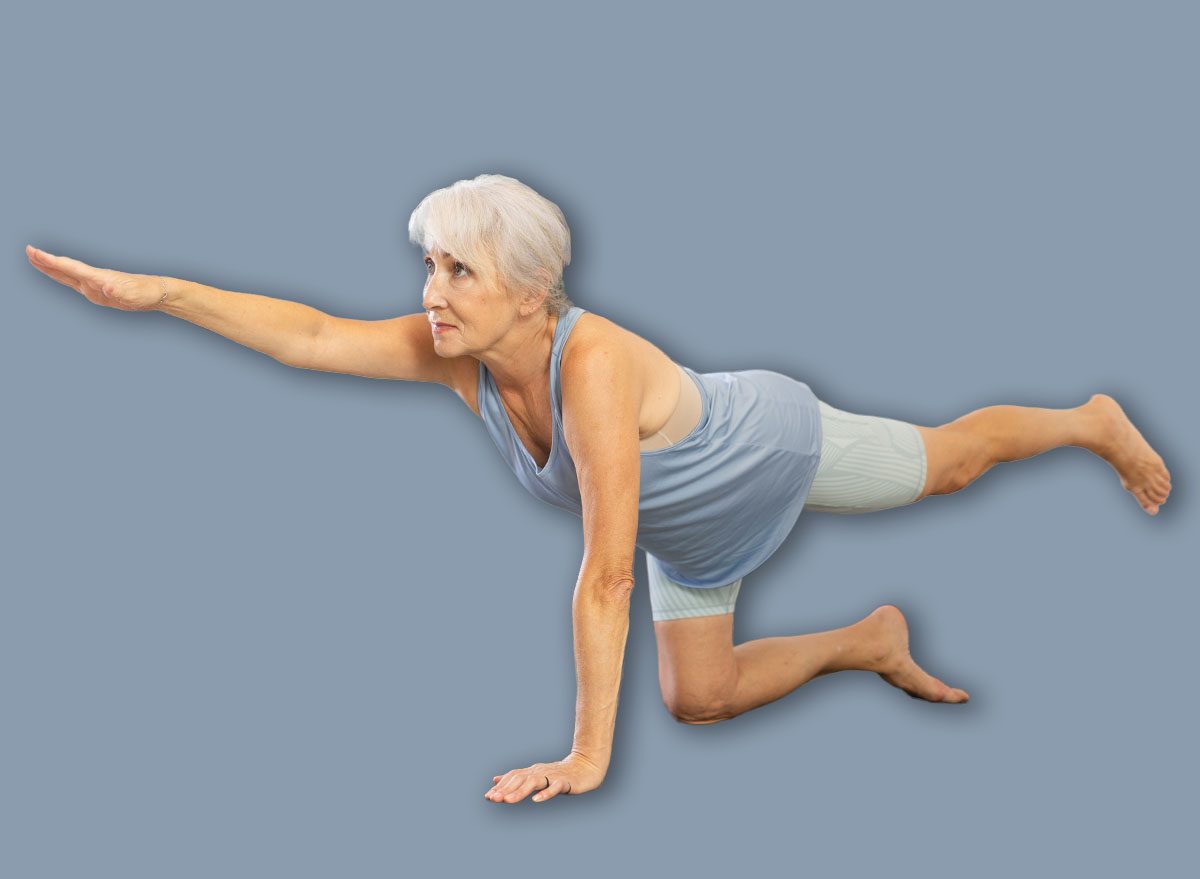
3. Bird Dog
This exercise is the ultimate test of spinal stability. It forces the deep core and back muscles to engage while the limbs move—a pattern essential for walking and lifting.
- How to do it: Start on all fours. Simultaneously extend your right arm forward and your left leg back, keeping your back perfectly flat. Do not let your hips rotate. Hold for three seconds, feeling the tension in your glutes and core.
- Goal: 8 reps per side.
4. Glute Bridge
Weak glutes are a silent epidemic among the over-50 population. They are the primary driver of a "pushed-out" belly and lower back strain.

- How to do it: Lie on your back, knees bent, feet flat. Drive through your heels to lift your hips toward the ceiling. Squeeze your glutes at the top—do not use your lower back to reach the height.
- Goal: 12 to 15 reps.
5. Prone Y-T-W
This move targets the entire upper back and rear shoulders, which are often the most neglected areas of the body.
- How to do it: Lie face down on the floor. Raise your arms to form a "Y," then a "T," then a "W," squeezing your shoulder blades together at each position.
- Goal: 8 reps for each letter, holding the contraction for 2 seconds.
Chronology of Change: What to Expect
Transformation does not happen overnight, but the timeline for postural correction is remarkably consistent when the protocol is followed.
- Weeks 1–2 (The Awareness Phase): You will find yourself "catching" your posture throughout the day. You will instinctively sit taller. This is your brain recalibrating your body’s baseline.
- Weeks 4–6 (The Structural Phase): Changes become visible in the mirror. The shoulders sit further back, and the pelvis begins to normalize. You will likely notice your clothes fitting differently as the core stabilizes.
- Weeks 8+ (The Integration Phase): Standing tall becomes your default state. You no longer have to consciously think about "not slouching"—your muscles have developed the endurance to hold you upright automatically.
The Long-Term Implications of Postural Health
Postural integrity is not just about aesthetics; it is about longevity. A slouched body is a body that restricts lung capacity, compresses the digestive system, and increases the risk of chronic back pain.
By dedicating 15 to 18 minutes, three to four times a week to these movements, you are making an investment in the next thirty years of your life. Combine this with a 20-to-30-minute daily walk—where you consciously practice your new, upright posture—and you bridge the gap between "gym work" and "real life."

The goal is not to reach a point where you stop exercising; it is to reach a point where your body is strong enough to carry itself with grace, vitality, and ease. Your posture is the architecture of your aging process—ensure that it is built on a foundation of strength, not a history of convenience.