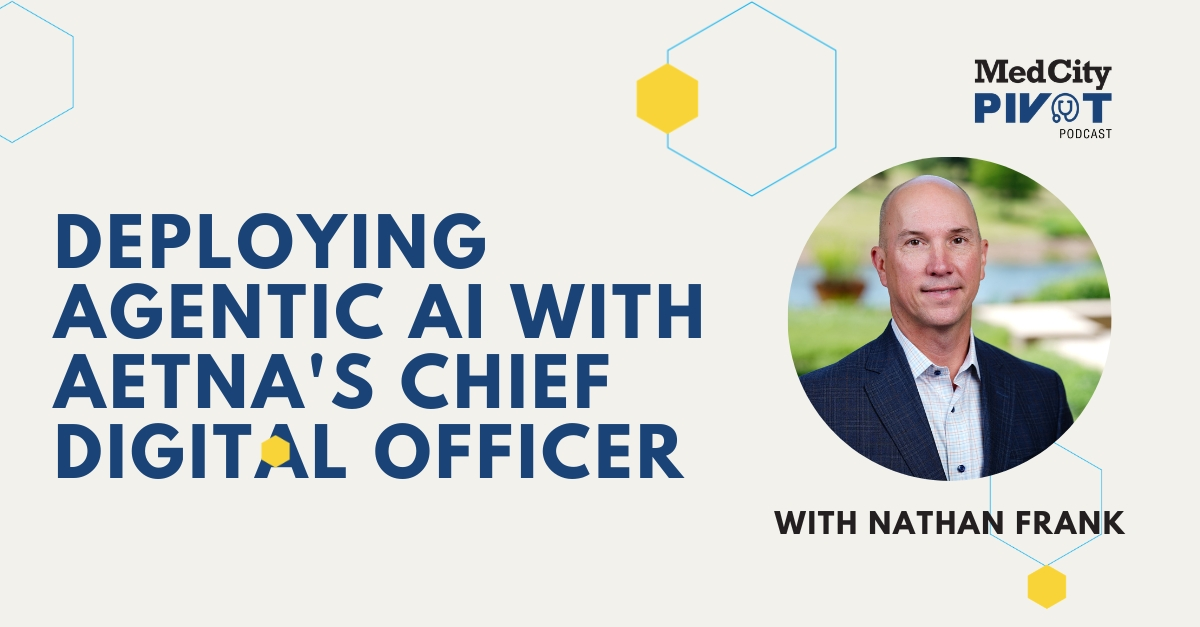
In an era where the American public’s trust in health insurance providers remains persistently low, CVS Health’s insurance arm, Aetna, is attempting to bridge the chasm between corporate policy and patient care. As the healthcare industry grapples with the promise and peril of artificial intelligence, Nathan Frank, Chief Digital and Technology Officer at CVS Health Aetna, is positioning the company not as a faceless bureaucracy, but as a digital-first partner.
In a recent appearance on the MedCity Pivot podcast, Frank addressed the industry’s most pressing concerns: the role of agentic AI in clinical settings, the ethical imperatives of algorithmic transparency, and the potential for a truly autonomous digital health assistant.
The Core Mandate: Eliminating Friction, Not Access
The central tension in modern healthcare is the "payer-provider" divide, often exacerbated by administrative hurdles that weigh heavily on both clinicians and patients. Frank is adamant that Aetna’s adoption of AI is driven by a singular mission: removing friction.
"We are the only industry that assigns healthcare to consumers," Frank noted during the discussion. "In no other industry do you walk away from a visit and have ‘homework’ to do."
By "homework," Frank refers to the burdensome follow-ups, scheduling complexities, and paperwork that typically fall to the patient. Aetna’s current strategy focuses on leveraging AI agents to absorb these tasks. A prime example currently in production is the use of ambient listening and AI-driven data synthesis for care management.
Currently, over 12,000 nurses within Aetna’s care management organization utilize AI tools to consolidate patient data from disparate Electronic Health Records (EHRs) and clinical sources. This AI-augmented workflow prepares clinical notes in advance, allowing nurses to spend their time focused on the patient rather than the keyboard. According to Frank, this initiative has successfully returned approximately 90 minutes of time per clinician, per day.
Chronology of Adoption: From Fraud Detection to Agentic Assistance
Aetna’s journey into AI is not a recent reaction to the generative AI boom. Frank highlights that the company has a decade-long history of utilizing machine learning.
- The Foundation (10+ Years Ago): Initial implementations focused on back-end processes, specifically identifying fraud, waste, and abuse. These applications were necessary for operational stability but lacked a direct, positive impact on the member experience.
- The Pivot (3–4 Years Ago): Under Frank’s leadership, the strategy shifted toward the "member experience." The company began integrating cross-functional "pods" consisting of clinicians, UX designers, and software engineers to ensure that technical developments were grounded in frontline clinical reality.
- The Present (2023–2024): The focus has moved to "agentic AI"—systems capable of performing tasks on behalf of the user. This includes ambient listening for clinical documentation and early-stage autonomous scheduling assistants.
- The Near Future (2025 and beyond): CVS Health is moving toward a comprehensive AI agent integrated into the Aetna app, designed to act as a personal concierge for the patient’s entire health journey.
Supporting Data: Why Trust is the Industry’s "Greatest Deficit"
The skepticism surrounding insurance companies is well-documented. As podcast host Arundhati Parmar noted, consumer sentiment toward the insurance sector remains largely negative. Frank acknowledges this "deficit" but argues that Aetna is uniquely positioned to overcome it by leveraging the broader CVS Health brand—a name that enjoys higher consumer trust than many traditional, standalone insurance carriers.
To maintain this trust, Aetna has implemented rigid "responsible use" guardrails. Most importantly, Frank provided a definitive, emphatic statement regarding one of the public’s biggest fears: "At Aetna and CVS Health, we don’t use AI to deny care. It is deeply rooted in our policies and our strategy."
Instead, the company is using AI for:
- Auto-approvals: Accelerating coverage decisions where criteria are met.
- Administrative Burden Reduction: Streamlining communication between providers and payers.
- Clinical Data Exchange: Moving toward real-time interoperability to prevent the "battle of the AIs" where provider and payer systems crash against each other.
Official Responses and Strategic Vision
When questioned about the potential for AI to create new layers of administrative complexity, Frank argued that the technology must be viewed as an augmentative tool rather than a total replacement for human decision-making.
"I am not a believer in the software apocalypse," Frank stated. "I do not think that AI is going to replace all enterprise software. It’s going to augment it, help us transform it, and accelerate modernization."
Regarding the "siloed" nature of American healthcare, Frank acknowledged that while the infrastructure is fragmented, AI provides a pathway to bridge these gaps. By using AI to translate and transform data across legacy systems, the company can create a semblance of interoperability that was previously impossible.
Aetna has also taken a proactive approach to the startup ecosystem. Rather than blindly integrating external tools, the company utilizes CVS Health Ventures to vet innovation. They operate a "test and learn" model, often running "bake-offs" where multiple technologies are tested in production to see which delivers the best outcomes for members before a full-scale rollout.
The Future: An AI Agent for Every Member
The most ambitious aspect of Aetna’s roadmap is the deployment of a fully autonomous AI agent. Frank revealed that an early version of this agent is already in production and will be scaled significantly within the next year.
This agent is intended to be more than a chatbot. Frank describes a system that:
- Knows the Member: It integrates health plan data with personal preferences and uploaded medical records.
- Performs Tasks: It handles the "homework"—scheduling appointments, coordinating care, and navigating the complexities of the provider network.
- Maintains Transparency: The system will explicitly inform the user when and how AI is assisting in their care, maintaining the "human plus technology" approach.
Implications for the Industry
The success of Aetna’s strategy rests on a fundamental assumption: that technology can foster trust through competence and transparency. If Aetna can indeed provide an agent that effectively manages the patient’s schedule and clinical needs without the user having to navigate phone trees or fragmented portals, it could set a new industry standard.
However, the path forward is not without risks. The "black box" nature of AI models, the ever-present danger of algorithmic hallucination, and the potential for model drift are all issues that Aetna’s 3,000-strong data science team must monitor daily.
Ultimately, Nathan Frank’s message is one of cautious optimism. By shifting the focus from "payer as gatekeeper" to "payer as digital partner," CVS Health Aetna is betting that its scale, its physical footprint, and its aggressive pursuit of agentic AI will win the one thing that matters most in the healthcare marketplace: the long-term trust of the patient. Whether the public is ready to embrace this digital transformation remains to be seen, but the infrastructure for an AI-mediated health experience is no longer a concept—it is becoming a reality.