






For nearly half a century, the Rocky franchise has served as the definitive cinematic blueprint for the American dream. From the gritty streets of Philadelphia to the glitz of the heavyweight championship, the saga of Rocky Balboa has transcended film to become a cultural touchstone. Yet, the most compelling chapter of the Rocky story was never captured on screen: it occurred behind the scenes, in the cramped, smoke-filled offices of 1970s Hollywood, where a desperate, unknown actor fought to convince a skeptical industry that he—and only he—could play the "Italian Stallion."
Now, that struggle is finally being immortalized in I Play Rocky, a biographical drama that promises to peel back the curtain on the creation of the 1976 Best Picture winner. With Anthony Ippolito stepping into the iconic shoes of a young Sylvester Stallone and Peter Farrelly at the helm, the film is already generating a fervor typically reserved for blockbusters.
The Genesis of an Icon: What is ‘I Play Rocky’ About?
At its core, I Play Rocky is a metanarrative—an underdog story about an underdog story. The film documents the period in the mid-1970s when Sylvester Stallone was a struggling, penniless actor, sleeping in a bus station and facing the indignity of selling his dog, Butkus, because he couldn’t afford to feed him.
The script for Rocky was born from frustration and raw, lived-in grit. When Stallone finally penned the screenplay, he didn’t just write a character; he wrote a lifeline. However, when he presented the project to producers, he faced a massive wall of industry resistance. While studio executives were enamored with the script—a million-to-one shot of a club fighter getting a title bout—they were adamant that the lead role should be filled by a bankable star.
The studio dangled massive sums of money in front of the struggling actor, hoping he would walk away and let established names like Burt Reynolds, Ryan O’Neal, or Robert Redford take the mantle. Stallone’s refusal to sell the script without his guarantee to star in it remains one of the most legendary gambles in cinema history. I Play Rocky chronicles this tense standoff, exploring the sheer tenacity required to maintain one’s vision in an industry that demands total compromise.
A Chronology of the Struggle
To understand the weight of I Play Rocky, one must look at the timeline of events that led to the 1976 premiere.
- The Early 70s: Stallone toils in bit-part roles, accumulating mounting debt and personal hardship. He spends his nights writing feverishly, fueled by the inspiration of the Muhammad Ali vs. Chuck Wepner fight.
- The Pitch: Stallone secures a meeting with producers Irwin Winkler and Robert Chartoff. The script is an instant hit with the duo, but the casting process becomes a prolonged negotiation.
- The Ultimatum: As offers for the script reach heights that would have solved Stallone’s financial ruin instantly, he consistently refuses to sign unless he is cast as Balboa.
- The Compromise: The studio eventually yields, but at a cost: the film is greenlit on a shoestring budget, forcing Stallone to work under extreme pressure to deliver the performance that would define his career.
- 1976–1977: Rocky hits theaters, defies all box-office projections, and earns ten Academy Award nominations, winning Best Picture, Best Director, and Best Film Editing. Stallone becomes an overnight global superstar.
The Casting Challenge: Anthony Ippolito Steps into the Ring
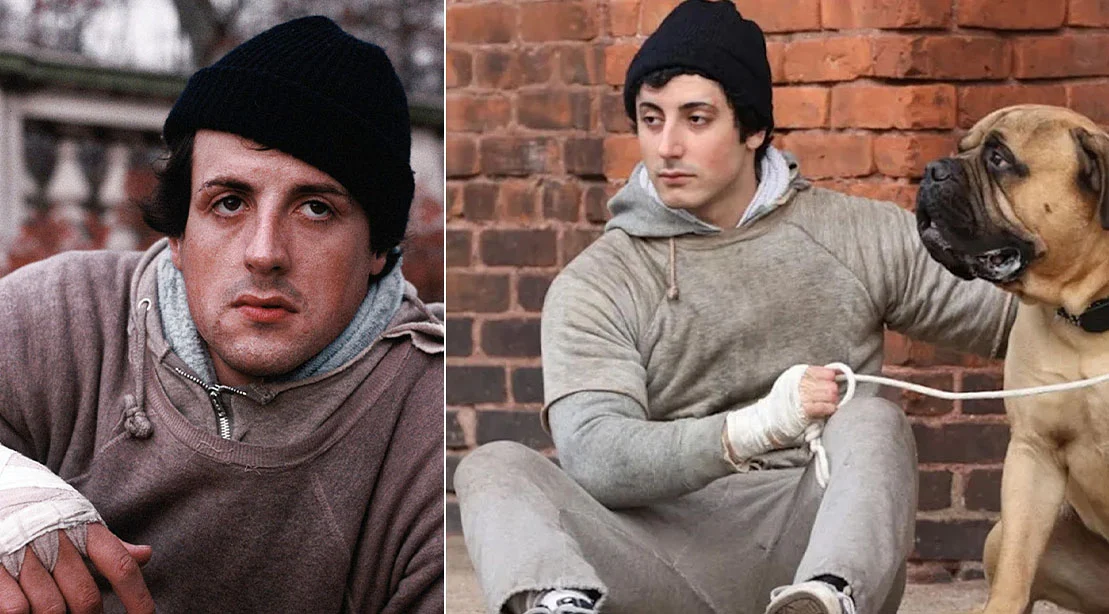
Portraying a figure as iconic as Sylvester Stallone is a task few actors would dare undertake. However, Anthony Ippolito has emerged as the definitive choice for the role. Ippolito, who previously garnered acclaim for his portrayal of a young Al Pacino in the miniseries The Offer, possesses a rare ability to capture the kinetic, mumbling, and vulnerable energy of the 70s-era Stallone.
Publicity stills released for the production have sent shockwaves through social media. Ippolito is seen sporting the classic grey sweatshirt and the brooding, soulful gaze that defined the original character. The resemblance is not merely physical; it is an exercise in period-accurate channeling. By focusing on the "pre-fame" Stallone, the film allows Ippolito to craft a performance that feels raw, hungry, and dangerously earnest.
Official Responses: Stallone’s Blessing
A project of this magnitude is often met with apprehension by the subject of the biography. However, in this case, the "Italian Stallion" has offered his full, albeit measured, support. Sylvester Stallone, who remains one of the most protective guardians of his own legacy, has publicly acknowledged the project via his Instagram account.
In a post that excited millions of fans, Stallone wrote: "Every story has a beginning, and I’m excited to see this one brought to life. Congratulations to the cast and crew of I Play Rocky. Keep punching."
This endorsement is critical for the film’s credibility. While Stallone confirmed that the production moved forward without his direct, daily consulting, his public blessing serves as the "green light" for the fanbase. It validates the narrative being told and suggests that the film captures the spirit of his struggle, if not every single minute detail of the historical reality.
The Cultural Implications: Why We Still Need the Underdog
The massive response to the trailer—which has already racked up over 20 million views on YouTube—suggests that the audience’s appetite for the Rocky mythos remains insatiable. But why, after six Rocky films and three Creed spin-offs, are we still obsessed?
The answer lies in the universality of the "underdog" archetype. In an era where digital content is often sanitized and algorithm-driven, the story of a man who fought his way from the gutter to the top by refusing to compromise his vision resonates deeply. The commentary surrounding the film’s trailer frequently highlights this sentiment, with fans noting, "It’s an underdog story about an underdog story."
The film, written by Peter Gamble and directed by Peter Farrelly, is positioned to bridge the gap between cinephiles who appreciate the history of filmmaking and the casual fans who simply love the triumph of the human spirit. By focusing on the making of the movie, the creators are acknowledging that the process of creation is just as dramatic as the product itself.
Production and Release: What to Expect
The pedigree behind the camera is as notable as the talent in front of it. Peter Farrelly, best known for his comedic roots but having proven his dramatic chops with Green Book, brings a unique sensibility to the project. He understands the balance between the gritty, desperate realism of the 70s and the larger-than-life myth-making that Rocky demands.
The script, penned by Peter Gamble, is rumored to focus heavily on the psychological toll of the negotiation period. It is expected that the film will eschew the typical "biopic" tropes, instead functioning as a high-stakes drama—a legal and personal thriller centered on the battle between an artist’s ego and a studio’s profit margins.
- Projected Premiere: The film is slated to make its grand debut at the Toronto International Film Festival this September. The festival circuit has historically been the launchpad for films that lean into the "prestige drama" category.
- Theatrical Release: Audiences can expect to see I Play Rocky in theaters on November 6, 2026.
Conclusion: The Final Bell
I Play Rocky stands as a testament to the fact that the most interesting stories are often the ones happening behind the camera. It is a reminder that success is rarely a straight line; it is a jagged, painful, and often desperate climb.
As we look toward the 2026 release date, the anticipation is not just for another movie about boxing. It is for a movie about the audacity of a young man who believed in his voice when no one else would. Whether you are a die-hard fan of the Rocky franchise or a newcomer to the legend of the Italian Stallion, I Play Rocky promises to be a powerful reminder that every champion starts as a challenger. In the words of the man himself: "Keep punching."