






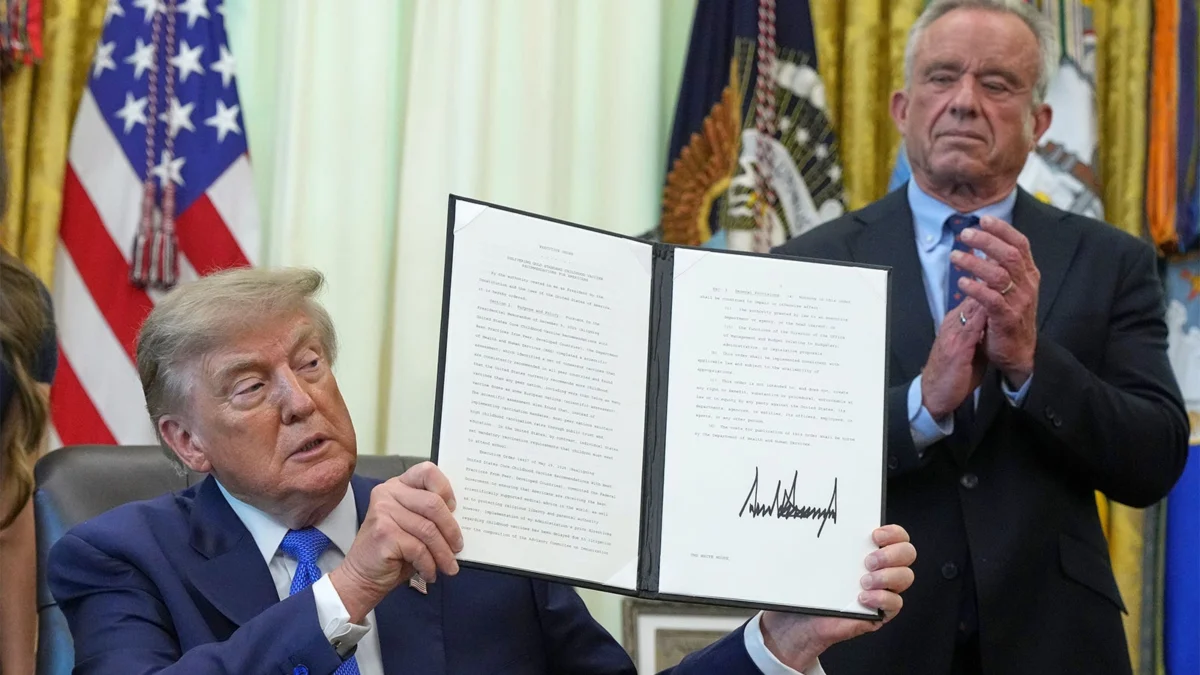
In a significant departure from decades of established global public health consensus, the Trump administration has launched a formal initiative to restructure childhood vaccination protocols. During an executive order signing ceremony on Monday, President Donald Trump and Health and Human Services Secretary Robert F. Kennedy Jr. unveiled plans to decentralize vaccine administration and move away from the traditional, comprehensive immunization schedule that has been the standard of care for generations.
The administration’s rhetoric during the event leaned heavily on claims that the current volume and frequency of childhood immunizations are excessive and potentially harmful, specifically resurrecting long-debunked theories regarding the development of autism. However, as the administration moves to implement these changes, a wide array of pediatricians, infectious disease experts, and medical organizations are issuing dire warnings, arguing that these shifts could dismantle the progress made in eradicating preventable diseases and expose a new generation of children to unnecessary risk.
The Core Proposals and the Shift in Policy
The executive order centers on two primary directives: first, the promotion of “shared decision-making” for parents regarding the national vaccination schedule; and second, the encouragement of spacing out immunizations, specifically targeting the measles, mumps, and rubella (MMR) vaccine. The administration is pushing for the separation of the MMR shot into individual components, arguing that the combination vaccine is unnecessarily burdensome on a child’s immune system.
Furthermore, the administration has already acted to streamline the federal vaccination schedule. In January, the Department of Health and Human Services (HHS) reduced the number of recommended routine vaccinations from 18 to 11. Other vaccines that were previously considered standard are now categorized as optional or recommended only for specific at-risk populations. The administration claims this move empowers parents and reduces the clinical burden on children.
Chronology: The Evolution of the Vaccine Debate
The tension between federal health recommendations and vaccine-skeptical rhetoric has been building for years. While the scientific community has consistently stood by the safety and efficacy of the CDC’s recommended schedule, a vocal minority has consistently challenged the “volume” of shots.
- 2000: The United States officially declares measles eliminated, thanks to high uptake of the MMR vaccine.
- 1998–2010: A fraudulent study published in The Lancet creates a global health crisis by suggesting a link between the MMR vaccine and autism. Despite the study being retracted and the author, Andrew Wakefield, losing his medical license, the myth persists in various corners of public discourse.
- 2024–2025: The U.S. experiences a sharp decline in routine childhood vaccination rates, leading to a resurgence of measles cases. By the end of 2025, the U.S. records its worst measles outbreak in over three decades.
- January 2026: The Trump administration officially pares down the federal vaccine schedule, reducing the number of routine injections for infants and children.
- Monday’s Executive Order: The administration formalizes its push for "single-dose" vaccines and challenges the necessity of the standard, multi-vaccine schedule.
Fact-Checking the Administration’s Claims
The rhetoric surrounding the recent executive order has been characterized by several high-profile claims that medical experts are quick to label as scientifically inaccurate.
The "72 Jabs" Narrative
President Trump claimed that children were previously being subjected to "72 jabs." This figure is widely regarded as misleading. In 2025, while the CDC recommended protection against 18 diseases, the actual number of injections varied significantly based on clinical availability and the use of combination shots. Without counting annual flu or COVID-19 vaccinations, the actual number of standard, life-saving injections was closer to three dozen over the course of 18 years.
The "Vats of Vaccine" Myth
Perhaps the most hyperbolic claim made by the President involved the visual metaphor of "vats" of liquid being pumped into a child. Pediatricians, such as Dr. Molly O’Shea, have dismissed this as a complete misunderstanding of immunology and dosage. Most vaccines are administered in doses ranging from 0.1 mL to 0.5 mL. To provide context, a single teaspoon holds 5 mL; a standard soda bottle holds 500 mL. The comparison of a vaccine to a soda bottle is mathematically inaccurate by a factor of 2,500.
The MMR Safety Concern
The President suggested that the MMR vaccine could be "lethal" when administered as a combination shot, despite decades of real-world evidence confirming its safety. The medical community emphasizes that the combination vaccine is not only safe but also critical for coverage. Currently, single-dose vaccines for measles, mumps, and rubella are not even manufactured or available in the United States, meaning that implementing this order would essentially require a total overhaul of the pharmaceutical manufacturing chain.
The Autism Spectrum Disorder (ASD) Debate
Secretary Robert F. Kennedy Jr. utilized the platform to draw a correlation between the rise in autism diagnoses and the increase in childhood vaccinations. Kennedy cited a 1970 study that identified an autism prevalence of 0.8 per 10,000, contrasting it with the current CDC statistic of 1 in 31.
Public health experts characterize this comparison as a fundamental misunderstanding of diagnostic evolution. The increase in autism diagnoses is widely attributed by the scientific community to a broader definition of the "autism spectrum," which now includes milder forms that would have gone undiagnosed in the 1970s, as well as significantly improved screening and public awareness.
"No environmental factor has been better-studied as a potential cause of autism than vaccines," notes Dr. Alycia Halladay, Chief Science Officer at the Autism Science Foundation. "All this research has determined that there is no link between autism and vaccines."
Implications for Public Health
The medical establishment, represented by groups like the American Academy of Pediatrics (AAP) and the American Medical Association (AMA), has expressed grave concerns regarding the administration’s policy.
The Risk of Spacing Shots
The primary danger cited by doctors is the "gap period." By spacing out vaccinations, parents leave their children vulnerable to disease for longer periods. In the case of measles—which is highly contagious—a delay in the second dose of the MMR vaccine can be the difference between a protected child and an outbreak participant.
Weakening Public Confidence
Dr. Willie Underwood III, President of the AMA, warns that "altering a proven vaccination schedule without credible evidence risks weakening public confidence and putting children’s health at risk." When the highest office in the land casts doubt on the safety of the tools used to prevent polio, mumps, and measles, the resulting hesitancy can lead to a collapse in herd immunity.
The Future of Epidemiological Control
As the administration prepares to launch new research into the environmental causes of autism, the scientific community remains firm that the focus should be on known variables—such as genetics and prenatal health—rather than disproven vaccine links. The danger is that by prioritizing the investigation of a debunked theory, the government may divert crucial resources away from effective public health initiatives.
Conclusion
The current administration’s push to reform the childhood vaccination schedule represents a significant shift in the relationship between federal oversight and medical expertise. While the administration frames these changes as a restoration of parental choice and a reduction in medical intervention, the scientific community maintains that the existing schedule is the most effective shield against once-deadly diseases.
As states begin to grapple with the potential impacts of these new federal recommendations, the divide between political policy and clinical evidence appears to be widening. With measles cases already hitting record levels, the coming months will be a critical test for the nation’s public health infrastructure. For parents, the choice remains one of the most consequential decisions for their children’s future, as they navigate a landscape where political messaging and medical consensus are increasingly at odds.