





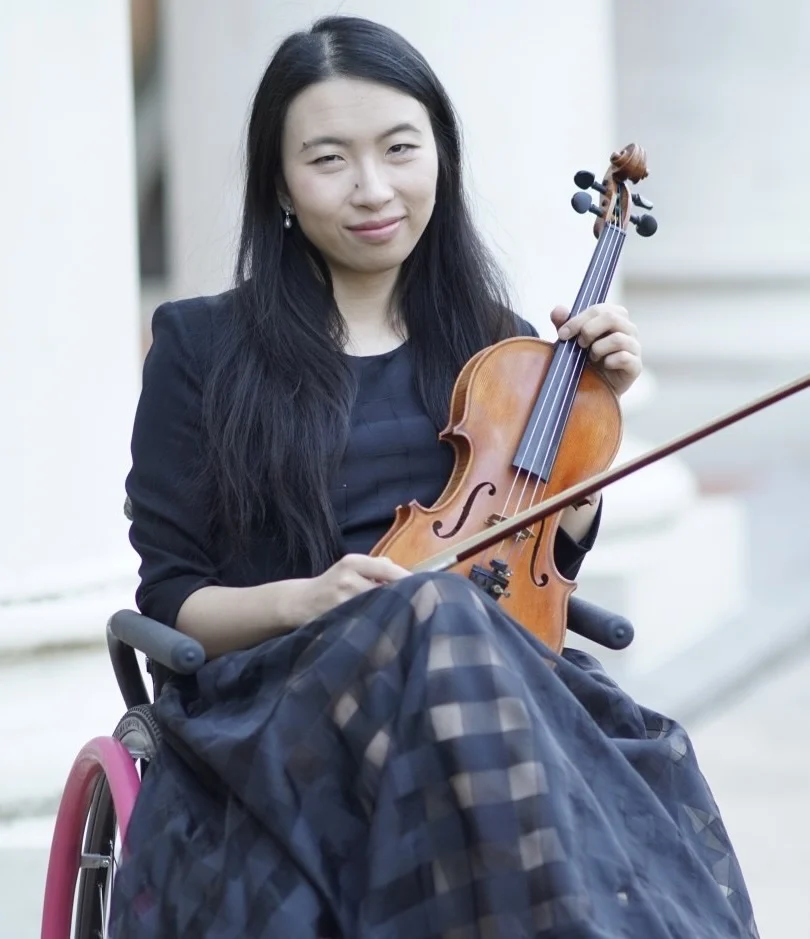
In the quiet intensity of a practice room, the violin serves as an extension of the soul. For Amy Wang-Hiller, a classically trained violinist, educator, and advocate, this instrument has been both a lifelong companion and a complex point of tension. Living with quadriplegia, hypermobile Ehlers-Danlos syndrome (hEDS), and a constellation of neuro-connective tissue disorders, Wang-Hiller has spent the better part of the last decade redefining what it means to be a musician—and a patient—in a world that often demands a binary definition of ability.
As the founder of the InclusiVibe Foundation and host of The Hidden Diagnoses Impact podcast, Wang-Hiller is shifting the narrative around chronic illness. Her journey is not merely one of medical struggle; it is a profound exploration of how we perceive the human body, the failures of the modern diagnostic apparatus, and the inherent, often uncomfortable, intersection of fortune and misfortune.
The Early Cadence: A Life Rooted in Music
Wang-Hiller’s relationship with the violin began at age three and a half. It was not, she admits, a choice born of personal ambition, but a practical decision by her parents to introduce a creative outlet that was portable. Yet, the instrument soon became her identity.
"I remember sitting in recitals, watching the older students," Wang-Hiller recalls. "I was mesmerized. I wanted to play like them."
This early exposure blossomed into a rigorous discipline. Even when plagued by childhood illnesses—recurring fevers, tonsillitis, and chronic pain—the violin remained her sanctuary. The pursuit of professional excellence became a structured pursuit, a "gap" between her current self and the virtuosos she admired that she was determined to bridge. It was this habit of practice that would later provide the scaffolding for her resilience when her health began to unravel in ways that medicine could not immediately explain.
A Chronology of Complexity: The Diagnostic Odyssey
For many living with connective tissue disorders, the "pathway to diagnosis" is rarely a straight line. For Wang-Hiller, the path was a labyrinth of disconnected symptoms: jaw pain, vision disturbances, gastrointestinal issues, and unexplained fatigue.
The Turning Points
- 2012: After relocating to the United States, Wang-Hiller was involved in a car accident. While initially treated for acute trauma, she notes that this event marked a subtle shift in her baseline health.
- 2015: A fall occurred, triggering a cascade of symptoms that felt "weird"—a term she uses to describe the linguistic void between patient experience and clinical terminology.
- 2020: A catastrophic neck hyperextension injury served as a catalyst for a rapid decline. Within two years, Wang-Hiller faced a barrage of life-altering symptoms: Postural Orthostatic Tachycardia Syndrome (POTS), dystonia, fainting, temporary paralysis, and a progressive loss of motor function.
- Post-2022: Following extensive testing, the pieces finally aligned. She received diagnoses for hEDS, occult tethered cord, and craniocervical instability with severe upper cervical ligament injury.
Wang-Hiller reflects on these years with a sense of mourning for what could have been prevented. "I often wonder how much suffering might have been reduced through earlier recognition and stronger communication between specialties," she muses. Her story highlights a systemic failure: the tendency of the medical establishment to treat the body as a collection of silos rather than an integrated, complex system.
The Spectrum of Paralysis
One of the most persistent myths Wang-Hiller encounters is the public perception of quadriplegia. The common image is one of absolute, static paralysis. In reality, Wang-Hiller lives with "incomplete" quadriplegia (AIS B).
"I often tell people to imagine their body encased in cement," she explains. The signals are there, the intent is there, but the neurological pathway is blocked. For those looking from the outside, small movements can be misinterpreted as proof of greater functionality. This "invisible" nature of her disability—where she can move slightly but cannot perform independent daily tasks—creates a jarring disconnect between reality and perception, often leading to skepticism from healthcare providers.
The Cost of the "Functional" Label
Perhaps the most damaging aspect of Wang-Hiller’s journey has been the institutionalization of gaslighting. When medical professionals could not find a "structural" reason for her symptoms, they often pivoted to psychiatric or "functional" explanations.
In 2022, a neurologist referred her to a Functional Neurological Disorder (FND) clinic, using her ability to play the violin as "evidence" that her weakness was inconsistent. This logic is a recurring trap: patients are told that because they can perform a specific, practiced motor task, their physiological paralysis must be psychosomatic.
"Once those labels are attached to a patient, they shape how future clinicians interpret new symptoms," Wang-Hiller notes. This diagnostic labeling acts as a "medical scarlet letter," making it nearly impossible for the patient to receive objective care as their condition progresses. The trauma of being disbelieved is, in many ways, as debilitating as the physical condition itself.
Cultural Blind Spots in EDS Advocacy
As a Chinese-born patient, Wang-Hiller brings a crucial, often ignored, lens to the discourse on Ehlers-Danlos syndrome. There is a pervasive, outdated notion that EDS—a genetic connective tissue disorder—affects specific populations more than others, or that symptoms manifest differently based on ethnicity.
"When people only encounter one picture of EDS, patients from different ethnic backgrounds are overlooked," she argues. She advocates for a more inclusive, globalized understanding of connective tissue health. By sharing her story, she aims to challenge the monolithic representation of the "typical" patient, encouraging others from diverse backgrounds to document their symptoms and demand to be heard.
The InclusiVibe Foundation: Turning Pain into Purpose
In response to these systemic failures, Wang-Hiller founded the InclusiVibe Foundation. The organization was born from a realization: she was not a statistical anomaly, but part of a growing cohort of patients navigating a fragmented healthcare system.
The foundation is built on a radical premise: lived experience is a form of expertise. By integrating music, storytelling, and patient-led research, InclusiVibe seeks to:
- Bridge the gap between disparate medical specialties.
- Provide a community for patients with complex, multi-systemic conditions.
- Foster partnerships between clinicians and patients to create more compassionate, informed care pathways.
Implications for the Future of Chronic Care
The implications of Amy Wang-Hiller’s story are far-reaching. As the medical community faces an increasing number of patients with complex, multi-systemic conditions, the traditional "specialist-only" model is proving inadequate.
Key Takeaways for the Medical Community:
- Validation as Therapy: The psychological toll of medical gaslighting is immense. Acknowledging a patient’s subjective reality is a prerequisite for effective treatment.
- The Myth of Consistency: Neurological conditions are dynamic. The ability to perform a task one day does not negate the existence of a disability the next.
- Integrative Care: Complex conditions require a "quarterback"—a primary provider who understands the interplay between neurological, connective tissue, and autonomic systems.
A Philosophy of Interdependence
When asked about the future, Wang-Hiller returns to the Chinese proverb: fú huò xiāng yī—"fortune and misfortune are interdependent." It is not a call for toxic positivity, but a recognition of the nuance of human existence.
"It doesn’t mean suffering is good," she clarifies. "It means we often can’t see the whole story while we’re living it."
For those currently in the "middle of a difficult chapter," Wang-Hiller offers a gentle reminder: healing is not always a return to the status quo. It is often the discovery of a new, albeit different, life. Her work—through her music, her nonprofit, and her advocacy—is a testament to the fact that while we may not choose the chapters we are handed, we can choose how we interpret them, and more importantly, how we write the next ones.
As she continues to navigate the complexities of her own health, Amy Wang-Hiller remains a beacon for those who feel lost in the gaps of the healthcare system. Her violin may be held differently now, but the melody of her advocacy is louder than ever.