










From the Yoga Journal Archives: Originally published in the January-February 1977 issue, this deep dive into the "Restrained Angle Pose" remains as relevant to the modern practitioner as it was nearly five decades ago.
In the vast lexicon of yoga, few postures embody the paradox of the practice as elegantly as Baddha Konasana, or Bound Angle Pose. It is a posture that demands stability while inviting profound vulnerability; it is a seated position that insists upon a lengthening, vertical ascent. As we revisit the wisdom of the 1977 Yoga Journal archives, we find that Baddha Konasana is far more than a simple hip-opener—it is a study in the geometry of the human spirit and a gateway to the deeper, more subtle currents of our anatomy.
The Main Facts: Defining the Bound Angle
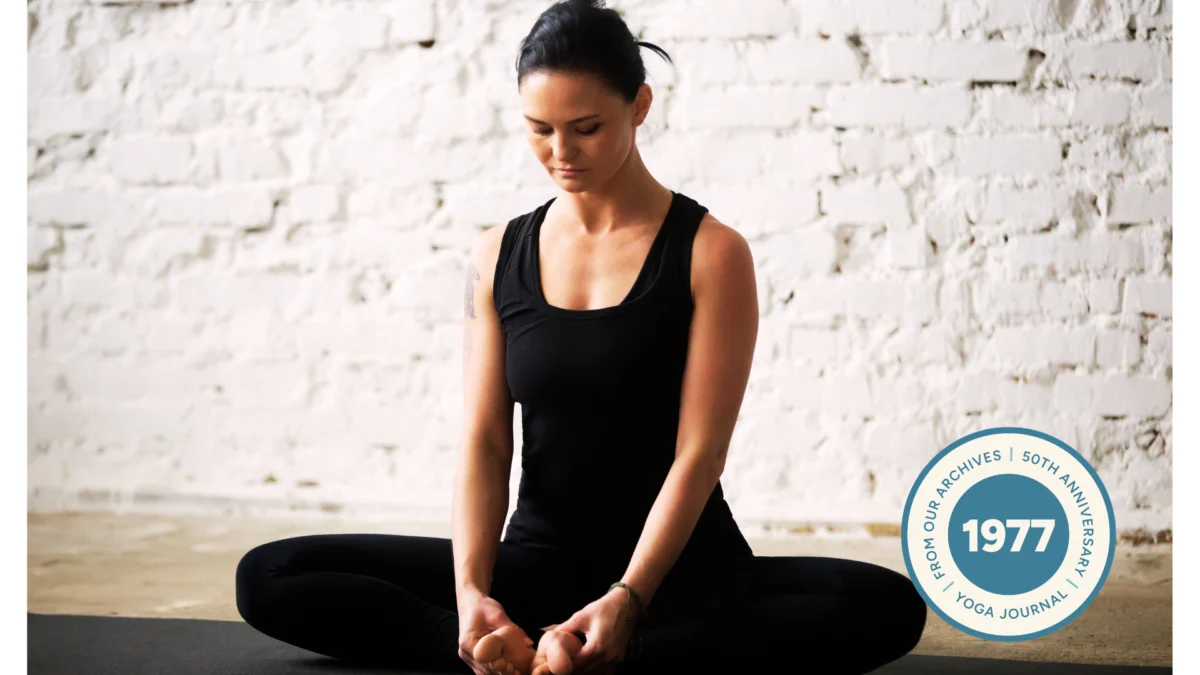
At its most basic level, Baddha Konasana is a foundational seated posture. To enter the pose, the practitioner brings the soles of the feet together, allows the knees to drop outward, and holds the feet or ankles, drawing them toward the pelvis.
The structural brilliance of the pose lies in its simultaneous engagement of opposing forces. While the hips and knees are released into a horizontal expansion, the spine must maintain a firm, vertical integrity. The "restraint"—the baddha—of the hands clasping the feet creates a closed circuit of energy, preventing the body from collapsing inward. Unlike many poses that focus on downward pressure, Baddha Konasana is an exercise in "lifting up." The crown of the head reaches toward the heavens even as the pelvis remains anchored to the earth, creating a perfect equilibrium between grounding and aspiration.
A Chronological Perspective: From Ancient Roots to the 1970s
The inclusion of Baddha Konasana in the 1977 Yoga Journal archives reflects a pivotal era in the Western adoption of Eastern movement traditions. During the mid-1970s, yoga was transitioning from an esoteric, counter-cultural pursuit to a structured discipline gaining mainstream academic and health interest.
- 1970s Context: During this era, the focus was heavily placed on "somatic awareness"—the ability to sense the internal workings of the body. The 1977 article emphasized that Baddha Konasana was not merely a physical workout, but a diagnostic tool for psychological and emotional tension.
- The Evolution of Technique: In the intervening years, the pedagogical approach to the pose has evolved to include more nuanced anatomical cues, such as the use of props (blocks and bolsters) to support those with restricted range of motion, ensuring the pose remains accessible to all body types.
- Modern Relevance: Today, as we move into the late 2020s, the posture is widely utilized in therapeutic settings, ranging from prenatal yoga classes to corporate wellness programs designed to combat the "sitting disease" inherent in desk-bound professions.
Supporting Data: The Anatomy of Receptivity
The physical benefits of Baddha Konasana are rooted in the stretching of the adductor muscles—the powerhouse group located on the inner thighs. However, the physiological impact extends deep into the pelvic floor.
The Pelvic Connection
The pelvic region is arguably the most complex intersection of the human body. It is the center of stability for the upright human, yet it is also the site of our most primal functions: elimination and reproduction. Clinical observations over the decades have noted that the pelvic region is a primary "storage site" for stress. When the psoas and adductor muscles are chronically tight, it often mirrors a psychological state of "bracing" against the environment.
Spinal Alignment and Energetic Flow
Beyond the muscles, the pose acts as a conduit for the nervous system. By creating a straight line from the base of the spine to the crown of the head, the practitioner facilitates what ancient traditions call the flow of prana—or, in modern clinical terms, the optimization of autonomic nervous system regulation. When the pelvis is neutral and the spine is elongated, the diaphragm can move with less restriction, encouraging deeper, more rhythmic breathwork (pranayama), which is essential for down-regulating the body’s "fight or flight" response.
Official Perspectives: The Philosophy of Surrender
Perhaps the most striking aspect of the 1977 reportage is its focus on the philosophical necessity of "surrender." In the context of yoga, surrender is not an act of defeat; it is an act of extreme intelligence.
"One must give up what has been in order to experience what is," the original article noted. This remains a cornerstone of modern yoga psychology. To move into a deep Baddha Konasana, one must stop "doing" and start "being." This shift from active tension to receptive opening is a micro-practice for how one handles the larger stressors of life.
The Gendered Experience
The 1977 archive makes a poignant observation regarding the gendered experience of the pose. It suggests that men, often socialized to present a "strong front" and suppress emotional impulses, frequently find this pose the most challenging. Because the pelvis is the seat of vulnerability, releasing the muscles of this region can feel inherently threatening to those who equate rigidity with strength. Conversely, the pose is frequently championed for women, particularly during pregnancy, as it serves as a physical and mental rehearsal for the surrender required during the birth process.
Implications for Modern Practice
What can the modern practitioner take away from a 1977 perspective on a pose that is likely hundreds of years old?
- Breaking the Pattern of Rigidity: In an age of digital hyper-stimulation, our bodies are often locked in a state of perpetual readiness. Baddha Konasana acts as a "reset button," forcing the body to soften in the very areas where we are most prone to hardening.
- Emotional Integration: The practice teaches that our physical structure is inseparable from our psychological landscape. By observing where we hold tension in the hips, we gain insight into our own emotional defenses.
- Preparation for Meditation: By aligning the spinal column, Baddha Konasana prepares the practitioner for the stillness required in meditation. It is a bridge between the active physical practice (asana) and the silent mental practice.
A Call to Receptivity
Ultimately, the enduring lesson of Baddha Konasana is the cultivation of receptivity. Whether one is a seasoned practitioner or a newcomer, the pose invites us to meet the world with an open pelvis and an open heart. It reminds us that growth does not always come from force; often, it comes from the quiet, courageous act of letting go.
As we look back at the black-and-white pages of the 1977 Yoga Journal, we are reminded that while the aesthetic of yoga may change, the fundamental human need to balance stability with surrender remains constant. The Restrained Angle Pose is a reminder that even when we are "bound"—by our responsibilities, our histories, or our habits—we possess the inherent capacity to find space, breathe, and open toward the future.
As you approach your mat today, consider Baddha Konasana not as a target to be conquered, but as a conversation to be entered into—a dialogue between the rigidity of the past and the fluid possibilities of the present.